Home > Press > New nontoxic process promises larger ultrathin sheets of 2-D nanomaterials
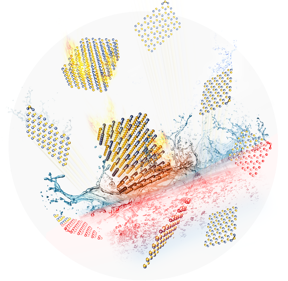 |
| A new ORNL study published in Angewandte Chemie International Edition describes a new gas exfoliation process that yields a 20 percent increase in surface area per nanosheet of boron nitride. Image credit: Angewandte Chemie International Edition. |
Abstract:
A team of scientists led by the Department of Energy's Oak Ridge National Laboratory has developed a novel way to produce two-dimensional nanosheets by separating bulk materials with nontoxic liquid nitrogen. The environmentally friendly process generates a 20-fold increase in surface area per sheet, which could expand the nanomaterials' commercial applications.
New nontoxic process promises larger ultrathin sheets of 2-D nanomaterials
Oak Ridge, TN | Posted on July 27th, 2016"It's actually a very simple procedure," said ORNL chemist Huiyuan Zhu, who co-authored a study published in Angewandte Chemie International Edition. "We heated commercially available boron nitride in a furnace to 800 degrees Celsius to expand the material's 2D layers. Then, we immediately dipped the material into liquid nitrogen, which penetrates through the interlayers, gasifies into nitrogen, and exfoliates, or separates, the material into ultrathin layers."
Nanosheets of boron nitride could be used in separation and catalysis, such as transforming carbon monoxide to carbon dioxide in gasoline-powered engines. They also may act as an absorbent to mop up hazardous waste. Zhu said the team's controlled gas exfoliation process could be used to synthesize other 2D nanomaterials such as graphene, which has potential applications in semiconductors, photovoltaics, electrodes and water purification.
Because of the versatility and commercial potential of one-atom-thick 2D nanomaterials, scientists are seeking more efficient ways to produce larger sheets. Current exfoliation procedures use harsh chemicals that produce hazardous byproducts and reduce the amount of surface area per nanosheet, Zhu said.
"In this particular case, the surface area of the boron nitride nanosheets is 278 square meters per gram, and the commercially available boron nitride material has a surface area of only 10 square meters per gram," Zhu said. "With 20 times more surface area, boron nitride can be used as a great support for catalysis."
Further research is planned to expand the surface area of boron nitride nanosheets and also test their feasibility in cleaning up engine exhaust and improving the efficiency of hydrogen fuel cells.
###
Along with Zhu, several co-authors participated in the paper, "Controlled Gas Exfoliation of Boron Nitride into Few-Layered Nanosheets," including ORNL's Sheng Dai, Xiang Gao, Qian Li, Shannon M. Mahurin and Wenshuai Zhu; Yanhong Chao, Hongping Li and Huaming Li with Jiangsu University and Meijun Li from the University of Tennessee. The Angewandte Chemie study can be found here.
The study was supported by the DOE Office of Science. Additional funding was provided by the Liane Russell Distinguished Early Career Fellowship through the Laboratory Directed Research and Development program. Zhu joined ORNL in 2014 as one of the lab's first Russell Fellows, and her primary area of research is on synthetic control of hybrid nanomaterials for catalytic applications.
####
About Oak Ridge National Laboratory
ORNL is managed by UT-Battelle for the Department of Energy's Office of Science, the single largest supporter of basic research in the physical sciences in the United States. DOE's Office of Science is working to address some of the most pressing challenges of our time. For more information, please visit science.energy.gov.
For more information, please click here
Contacts:
Sara Shoemaker
865-576-9219
Copyright © Oak Ridge National Laboratory
If you have a comment, please Contact us.Issuers of news releases, not 7th Wave, Inc. or Nanotechnology Now, are solely responsible for the accuracy of the content.
Bookmark:


| Related News Press |
News and information
 Quantum computer improves AI predictions April 17th, 2026
Flexible sensor gains sensitivity under pressure April 17th, 2026
A reusable chip for particulate matter sensing April 17th, 2026
Detecting vibrational quantum beating in the predissociation dynamics of SF6 using time-resolved photoelectron spectroscopy April 17th, 2026
2 Dimensional Materials
Flexible sensor gains sensitivity under pressure April 17th, 2026
MXene nanomaterials enter a new dimension Multilayer nanomaterial: MXene flakes created at Drexel University show new promise as 1D scrolls January 30th, 2026
ICFO researchers overcome long-standing bottleneck in single photon detection with twisted 2D materials August 8th, 2025
First real-time observation of two-dimensional melting process: Researchers at Mainz University unveil new insights into magnetic vortex structures August 8th, 2025
Chemistry
Projecting light to dispense liquids: A new route to ultra-precise microdroplets January 30th, 2026
From sensors to smart systems: the rise of AI-driven photonic noses January 30th, 2026
"Nanoreactor" cage uses visible light for catalytic and ultra-selective cross-cycloadditions October 3rd, 2025
Single-atom catalysts change spin state when boosted by a magnetic field June 4th, 2025
Laboratories
Researchers develop molecular qubits that communicate at telecom frequencies October 3rd, 2025
Graphene/ Graphite
Electrifying results shed light on graphene foam as a potential material for lab grown cartilage June 6th, 2025
Govt.-Legislation/Regulation/Funding/Policy
Quantum computer improves AI predictions April 17th, 2026
Metasurfaces smooth light to boost magnetic sensing precision January 30th, 2026
New imaging approach transforms study of bacterial biofilms August 8th, 2025
Possible Futures
A fundamentally new therapeutic approach to cystic fibrosis: Nanobody repairs cellular defect April 17th, 2026
UC Irvine physicists discover method to reverse ‘quantum scrambling’ : The work addresses the problem of information loss in quantum computing system April 17th, 2026
Chip Technology
A reusable chip for particulate matter sensing April 17th, 2026
Metasurfaces smooth light to boost magnetic sensing precision January 30th, 2026
Nanoelectronics
Lab to industry: InSe wafer-scale breakthrough for future electronics August 8th, 2025
Interdisciplinary: Rice team tackles the future of semiconductors Multiferroics could be the key to ultralow-energy computing October 6th, 2023
Key element for a scalable quantum computer: Physicists from Forschungszentrum Jülich and RWTH Aachen University demonstrate electron transport on a quantum chip September 23rd, 2022
Reduced power consumption in semiconductor devices September 23rd, 2022
Discoveries
Quantum computer improves AI predictions April 17th, 2026
Flexible sensor gains sensitivity under pressure April 17th, 2026
A reusable chip for particulate matter sensing April 17th, 2026
Detecting vibrational quantum beating in the predissociation dynamics of SF6 using time-resolved photoelectron spectroscopy April 17th, 2026
Announcements
A fundamentally new therapeutic approach to cystic fibrosis: Nanobody repairs cellular defect April 17th, 2026
UC Irvine physicists discover method to reverse ‘quantum scrambling’ : The work addresses the problem of information loss in quantum computing system April 17th, 2026
Interviews/Book Reviews/Essays/Reports/Podcasts/Journals/White papers/Posters
A fundamentally new therapeutic approach to cystic fibrosis: Nanobody repairs cellular defect April 17th, 2026
UC Irvine physicists discover method to reverse ‘quantum scrambling’ : The work addresses the problem of information loss in quantum computing system April 17th, 2026
Energy
Sensors innovations for smart lithium-based batteries: advancements, opportunities, and potential challenges August 8th, 2025
Simple algorithm paired with standard imaging tool could predict failure in lithium metal batteries August 8th, 2025
Water
Taking salt out of the water equation October 7th, 2022
Automotive/Transportation
Decoding hydrogen‑bond network of electrolyte for cryogenic durable aqueous zinc‑ion batteries January 30th, 2026
Sensors innovations for smart lithium-based batteries: advancements, opportunities, and potential challenges August 8th, 2025
Simple algorithm paired with standard imaging tool could predict failure in lithium metal batteries August 8th, 2025
Battery Technology/Capacitors/Generators/Piezoelectrics/Thermoelectrics/Energy storage
Decoding hydrogen‑bond network of electrolyte for cryogenic durable aqueous zinc‑ion batteries January 30th, 2026
COF scaffold membrane with gate‑lane nanostructure for efficient Li+/Mg2+ separation January 30th, 2026
MXene nanomaterials enter a new dimension Multilayer nanomaterial: MXene flakes created at Drexel University show new promise as 1D scrolls January 30th, 2026
Fuel Cells
Deciphering local microstrain-induced optimization of asymmetric Fe single atomic sites for efficient oxygen reduction August 8th, 2025
Current and Future Developments in Nanomaterials and Carbon Nanotubes: Applications of Nanomaterials in Energy Storage and Electronics October 28th, 2022
Solar/Photovoltaic
Spinel-type sulfide semiconductors to operate the next-generation LEDs and solar cells For solar-cell absorbers and green-LED source October 3rd, 2025
KAIST researchers introduce new and improved, next-generation perovskite solar cell November 8th, 2024
Groundbreaking precision in single-molecule optoelectronics August 16th, 2024
Development of zinc oxide nanopagoda array photoelectrode: photoelectrochemical water-splitting hydrogen production January 12th, 2024
 |
||
 |
||
| The latest news from around the world, FREE | ||
 |
||
|
|
||
| Premium Products | ||
 |
||
|
Only the news you want to read!
Learn More |
||
 |
||
|
Full-service, expert consulting
Learn More |
||
|
|
||