Home > Press > Detecting vibrational quantum beating in the predissociation dynamics of SF6 using time-resolved photoelectron spectroscopy
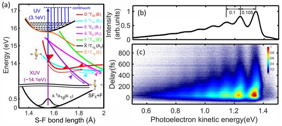 |
| Figure 1: Schematic of SF6 predissociation dynamics and time-resolved photoelectron spectroscopy. Credit Ultrafast Science |
Abstract:
Quantum coherence is a fundamental mechanism driving ultrafast molecular reaction dynamics, playing a decisive role in processes such as light-induced ultrafast vision molecular isomerization and dissociation. However, due to the complexity of highly excited states in polyatomic molecules and interference from decoherence processes, directly observing vibrational quantum coherence signals from excited states has long been a major experimental challenge. This study, using time-resolved photoelectron spectroscopy, clearly resolves quantum beat signals resulting from interference between different vibrational states during the ultrafast predissociation dynamics of excited SF6 molecules. By combining high-precision calculations of the excited state potential energy surface and quantum dynamics simulations, the vibrational levels involved in the quantum coherence process are identified, and the lifetimes of the predissociating vibrational states are quantitatively analyzed. This work opens new avenues for understanding the role of quantum coherence in complex photo-induced ultrafast chemical reactions and ultimately for achieving active control over them.
Detecting vibrational quantum beating in the predissociation dynamics of SF6 using time-resolved photoelectron spectroscopy
Washington, DC | Posted on April 17th, 2026As shown in Figure 1, the experiment employs an extreme ultraviolet (XUV) pump-ultraviolet (UV) probe scheme: an XUV pulse (14.1 eV) resonantly excitesSF6 molecules from the neutral ground state to a predissociative state. Subsequently, a time-delayed UV pulse (3.1 eV) ionizes the excited molecules to the ground state of the cation, and the kinetic energy of the emitted photoelectrons is recorded. The potential energy curves in Figure 1a show non-adiabatic coupling between the excited state and dissociative states, leading to predissociation of the nuclear wave packet, which causes a decay in photoelectron spectroscopy intensity as a function of pump-probe delay. In Figures 1b and 1c, a series of vibrational peaks spaced by approximately 0.1 eV appear in the high kinetic energy region, corresponding to ionization to different vibrational levels of the cationic ground state.
Figure 2 focuses on the structure of the main photoelectron spectroscopy peak, revealing the vibrational quantum beating. Figure 2a shows the experimentally measured photoelectron spectroscopy intensity as a function of delay time, exhibiting clear oscillatory behavior within approximately 300 fs (Figure 2b). By analyzing this oscillatory feature, the research team determined a period of 318 fs, corresponding to a vibrational energy level difference of 0.013 eV. This quantum beat signal demonstrates that multiple vibrational levels are coherently excited and their interference persists during the predissociation process. The figure also shows a slight blue shift of the peak position with increasing delay time, indicating differences in the lifetimes of the vibrational levels, providing a crucial clue for subsequent analysis. To identify the specific vibrational levels involved, based on ab initio calculations, the research term identified that the pump pulse resonantly excites three closely spaced vibrational eigenstates, where the energy difference between the two higher levels matches the experimentally observed beat period. The lifetimes of the three vibrational states obtained from wave packet dynamics simulations align with the decay trends extracted from the experiment.
This study, using time-resolved photoelectron spectroscopy, reports the first observation of vibrational quantum beating in the highly excited state predissociation of a polyatomic molecule, SF6, and identifies the participating vibrational levels and their lifetimes. This finding not only reveals the influence of the highly excited state potential energy surface structure on quantum coherence but also provides a new perspective for studying photochemical processes in complex molecular systems. In the future, combining this approach with broader bandwidth attosecond pump pulses holds promise for actively controlling electronic coherence motion, advancing the field of attochemistry.
####
For more information, please click here
Contacts:
Pan Zhao
Ultrafast Science
Copyright © Ultrafast Science
If you have a comment, please Contact us.Issuers of news releases, not 7th Wave, Inc. or Nanotechnology Now, are solely responsible for the accuracy of the content.
Bookmark:


| Related Links |
| Related News Press |
News and information
 Quantum computer improves AI predictions April 17th, 2026
Flexible sensor gains sensitivity under pressure April 17th, 2026
A reusable chip for particulate matter sensing April 17th, 2026
Quantum Physics
Beyond silicon: Electronics at the scale of a single molecule January 30th, 2026
MXene nanomaterials enter a new dimension Multilayer nanomaterial: MXene flakes created at Drexel University show new promise as 1D scrolls January 30th, 2026
Possible Futures
A fundamentally new therapeutic approach to cystic fibrosis: Nanobody repairs cellular defect April 17th, 2026
UC Irvine physicists discover method to reverse ‘quantum scrambling’ : The work addresses the problem of information loss in quantum computing system April 17th, 2026
Discoveries
Quantum computer improves AI predictions April 17th, 2026
Flexible sensor gains sensitivity under pressure April 17th, 2026
A reusable chip for particulate matter sensing April 17th, 2026
Announcements
A fundamentally new therapeutic approach to cystic fibrosis: Nanobody repairs cellular defect April 17th, 2026
UC Irvine physicists discover method to reverse ‘quantum scrambling’ : The work addresses the problem of information loss in quantum computing system April 17th, 2026
Grants/Sponsored Research/Awards/Scholarships/Gifts/Contests/Honors/Records
Quantum computer improves AI predictions April 17th, 2026
Metasurfaces smooth light to boost magnetic sensing precision January 30th, 2026
Researchers tackle the memory bottleneck stalling quantum computing October 3rd, 2025
 |
||
 |
||
| The latest news from around the world, FREE | ||
 |
||
|
|
||
| Premium Products | ||
 |
||
|
Only the news you want to read!
Learn More |
||
 |
||
|
Full-service, expert consulting
Learn More |
||
|
|
||