Home > Press > A reusable chip for particulate matter sensing
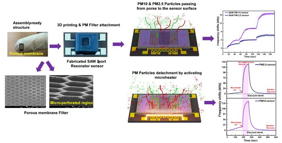 |
| Reusable SAW sensor for selective PM10 and PM2.5 detection. Schematic overview of the reusable surface acoustic wave (SAW) particulate matter sensor system. The figure shows the porous membrane filter, sensor assembly, and sensing mechanism for particle-size-selective detection. A microperforated membrane is mounted above the SAW resonator to separate airborne particles by size, allowing simultaneous monitoring of particulate matter (PM) in the PM10 and PM2.5 ranges. The lower panel illustrates microheater-assisted particle detachment, which restores the sensor surface after dust exposure and enables repeated use. The frequency-shift curves on the right show the sensor response during particle capture and its recovery after heating. Credit Microsystems & Nanoengineering |
Abstract:
Air pollution is often monitored using instruments that are accurate but can be bulky, costly, or difficult to reuse continuously after particle accumulation. A new sensor system offers a compact alternative by combining surface acoustic wave (SAW) sensing with a porous membrane for particle-size separation and an integrated microheater for sensor recovery. In laboratory tests, the device simultaneously and selectively detected particulate matter in the PM10 and PM2.5 size ranges and then recovered toward its baseline after heating under vacuum. The study demonstrates a reusable sensing platform that may support future compact air-quality monitoring systems.
A reusable chip for particulate matter sensing
London, UK | Posted on April 17th, 2026Fine airborne particles are especially challenging to monitor because particle size affects both how long they remain suspended in air and how deeply they can penetrate into the respiratory system. PM2.5 is of particular concern because of its association with adverse health effects. Existing techniques, including beta-ray absorption, gravimetric methods, and light-scattering approaches, can provide useful measurements, but they may also involve tradeoffs such as system size, cost, humidity sensitivity, or reduced reliability under some conditions. Earlier SAW-based particulate sensors showed high sensitivity, but many relied on one-time particle attachment and did not provide a practical reusable format with clear size selectivity. Against this background, reusable and size-selective PM sensing remains an important research need.
Researchers from the Department of Electrical and Computer Engineering and the Department of Intelligence Semiconductor Engineering at Ajou University in Suwon, Republic of Korea, reported the study in Microsystems & Nanoengineering, published (DOI: 10.1038/s41378-025-01137-5) on 24 March 2026. Their system integrates two acoustic sensing channels, porous microstructured membranes, and an on-chip microheater to measure airborne particles and restore the sensor after particle buildup. The study presents the first SAW-based particulate matter sensor integrating a porous microstructure membrane for particle separation with an on-board microheater for particle detachment, enabling sensor reusability.
The design uses two porous filter membranes: one with pore diameters of approximately 11 μm for the PM10 channel and one with pore diameters of approximately 3 μm for the PM2.5 channel. These membranes were placed above two-port SAW resonator sensors operating at a center frequency of 222 MHz on 128° YX LiNbO₃ substrates. Simulations and experiments indicated that the 11 μm membrane allowed both larger and smaller particles to pass, while the 3 μm membrane preferentially passed smaller particles. In chamber tests, the PM2.5 sensor showed a sensitivity of 0.11 kHz/(μg/m³) to PM2.5 particles, while the PM10 channel showed 0.246 kHz/(μg/m³) to PM2.5 and, after subtraction-based calibration, 0.218 kHz/(μg/m³) to particles in the 2.5–10 μm range. When particles accumulated on the sensing surface, the integrated microheater was driven at 12 V, raising the device temperature to approximately 100 °C and enabling recovery under vacuum conditions. Over five days, the PM10 channel retained more than 90% of its relative response, while the PM2.5 channel remained above 80%.
The broader significance lies in integrating size-selective filtration and recovery into the chip itself. By combining particle separation and thermal recovery within a single SAW-based platform, the system may reduce reliance on conventional external separation components used in some particulate matter sensing setups. This approach could support the development of smaller, more reusable sensors for portable and continuous particulate matter monitoring. With further validation in real operating environments, such devices may be useful in a range of air-quality monitoring applications.
####
About Microsystems & Nanoengineering
Microsystems & Nanoengineering is an online-only, open access international journal devoted to publishing original research results and reviews on all aspects of Micro and Nano Electro Mechanical Systems from fundamental to applied research. The journal is published by Springer Nature in partnership with the Aerospace Information Research Institute, Chinese Academy of Sciences, supported by the State Key Laboratory of Transducer Technology.
For more information, please click here
Contacts:
Na Li
Microsystems & Nanoengineering
Copyright © Microsystems & Nanoengineering
If you have a comment, please Contact us.Issuers of news releases, not 7th Wave, Inc. or Nanotechnology Now, are solely responsible for the accuracy of the content.
Bookmark:


| Related Links |
| Related News Press |
News and information
 Quantum computer improves AI predictions April 17th, 2026
Flexible sensor gains sensitivity under pressure April 17th, 2026
Detecting vibrational quantum beating in the predissociation dynamics of SF6 using time-resolved photoelectron spectroscopy April 17th, 2026
Possible Futures
A fundamentally new therapeutic approach to cystic fibrosis: Nanobody repairs cellular defect April 17th, 2026
UC Irvine physicists discover method to reverse ‘quantum scrambling’ : The work addresses the problem of information loss in quantum computing system April 17th, 2026
Chip Technology
Metasurfaces smooth light to boost magnetic sensing precision January 30th, 2026
Beyond silicon: Electronics at the scale of a single molecule January 30th, 2026
Discoveries
Quantum computer improves AI predictions April 17th, 2026
Flexible sensor gains sensitivity under pressure April 17th, 2026
Detecting vibrational quantum beating in the predissociation dynamics of SF6 using time-resolved photoelectron spectroscopy April 17th, 2026
Announcements
A fundamentally new therapeutic approach to cystic fibrosis: Nanobody repairs cellular defect April 17th, 2026
UC Irvine physicists discover method to reverse ‘quantum scrambling’ : The work addresses the problem of information loss in quantum computing system April 17th, 2026
Interviews/Book Reviews/Essays/Reports/Podcasts/Journals/White papers/Posters
A fundamentally new therapeutic approach to cystic fibrosis: Nanobody repairs cellular defect April 17th, 2026
UC Irvine physicists discover method to reverse ‘quantum scrambling’ : The work addresses the problem of information loss in quantum computing system April 17th, 2026
Environment
Researchers unveil a groundbreaking clay-based solution to capture carbon dioxide and combat climate change June 6th, 2025
Onion-like nanoparticles found in aircraft exhaust May 14th, 2025
 |
||
 |
||
| The latest news from around the world, FREE | ||
 |
||
|
|
||
| Premium Products | ||
 |
||
|
Only the news you want to read!
Learn More |
||
 |
||
|
Full-service, expert consulting
Learn More |
||
|
|
||