Home > Press > Metasurfaces smooth light to boost magnetic sensing precision
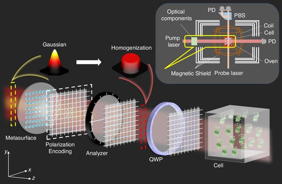 |
| Schematic diagram of the beam homogenization method based on polarization-encoded metasurface. QWP quarter-wave plate, PD photoelectric detection. The inset in the upper right corner illustrates the NMR co-magnetometer configuration implemented using this approach. Credit Microsystems & Nanoengineering |
Abstract:
High-precision magnetic sensors rely on uniform light to polarize atomic spins, yet most laser beams naturally deliver energy unevenly, limiting measurement accuracy. This study introduces a compact optical strategy that transforms a standard Gaussian laser beam into a spatially uniform pumping field by encoding intensity information into light polarization. By reshaping how light interacts with atomic ensembles, the approach reduces spin decoherence and enhances signal stability without increasing system complexity. The work demonstrates that controlling polarization, rather than reshaping intensity through bulky optics, can significantly improve magnetic measurement performance. The findings highlight a new pathway for improving the sensitivity, compactness, and robustness of next-generation quantum sensors.
Metasurfaces smooth light to boost magnetic sensing precision
Beijing, China | Posted on January 30th, 2026Nuclear magnetic resonance–based co-magnetometers are essential tools for applications ranging from inertial navigation to geophysical exploration and biomedical sensing. Their performance critically depends on efficient optical pumping, which polarizes atomic spins through laser illumination. However, commonly used Gaussian laser beams concentrate intensity at the center while weakening toward the edges, leading to non-uniform spin polarization and accelerated decoherence. Existing beam-homogenization solutions, such as microlens arrays or spatial light modulators, often require fixed propagation distances, consume additional power, or are difficult to integrate into compact devices. Based on these challenges, it is necessary to develop an integrated, propagation-insensitive approach to achieve uniform optical pumping.
Researchers from Beihang University and Westlake University report a polarization-encoded metasurface that significantly improves optical pumping uniformity in nuclear magnetic resonance co-magnetometers. The study, published (DOI: 10.1038/s41378-025-00989-1) in Microsystems & Nanoengineering in November 2025, presents a chip-scale optical component that converts an uneven Gaussian beam into a homogenized pumping field independent of propagation distance. By combining geometric phase control with polarization filtering, the method enhances atomic spin coherence and improves magnetic sensing sensitivity, demonstrating a practical route toward more compact and precise quantum sensors.
The core innovation lies in encoding spatial intensity information into the polarization profile of light rather than reshaping the beam through conventional amplitude or phase modulation. The metasurface consists of subwavelength silicon nanoantennas whose orientations locally rotate the polarization of incoming light. When combined with an analyzer, this polarization mapping selectively transmits light to produce a flat, uniform intensity distribution across the beam profile. Importantly, the homogenized output remains stable during propagation, overcoming a key limitation of traditional beam-shaping techniques.
Experimental measurements confirmed that the metasurface significantly improved light uniformity, reducing intensity contrast across the beam cross-section. When applied to optical pumping in a nuclear magnetic resonance co-magnetometer, the homogenized beam increased both electronic and nuclear spin polarization while lowering transverse relaxation rates. These improvements translated directly into enhanced sensor performance. Under identical pumping power, the magnetic measurement sensitivity improved by approximately 23% compared with conventional Gaussian beam pumping.
The metasurface approach also offers practical advantages. Its planar, passive structure eliminates the need for bulky optics, active modulation, or additional power consumption. The device operates effectively over a relevant frequency range and is compatible with chip-level integration, making it well suited for miniaturized quantum sensing systems.
According to the researchers, optical pumping uniformity has long been an overlooked bottleneck in compact atomic sensors. By shifting the problem from intensity shaping to polarization control, the metasurface provides a fundamentally different solution that aligns with the needs of integrated quantum technologies. The team emphasizes that improving spin coherence is not only about stronger light, but about distributing light more intelligently. This work demonstrates how nanophotonic design can directly translate into measurable gains in sensor precision and stability.
The proposed metasurface-based homogenization strategy has broad implications for quantum sensing and precision measurement technologies. Beyond nuclear magnetic resonance co-magnetometers, the approach could be applied to atomic gyroscopes, chip-scale magnetometers, and other systems that rely on optical pumping. Its compact form factor and passive operation make it attractive for portable and space-constrained platforms, including navigation systems and biomedical instrumentation. More broadly, the study illustrates how metasurfaces can bridge nanophotonics and quantum engineering, offering scalable solutions that improve performance without increasing complexity. Such integration-friendly designs may play a key role in advancing practical quantum devices.
Funding Information
The authors appreciate the financial support from the Innovation Program for Quantum Science and Technology, 2021ZD0300403; National Natural Science Foundation of China, General Program, 62373028; Zhejiang Provincial Natural Science Foundation, LZ24F050007; National Science Fund for Distinguished Young Scholars, 62225102; Beijing Natural Science Foundation, General Program, 4232071; and National Natural Science Foundation of China, 42388101.
####
About Aerospace Information Research Institute, Chinese Academy of Sciences
About Microsystems & Nanoengineering
Microsystems & Nanoengineering is an online-only, open access international journal devoted to publishing original research results and reviews on all aspects of Micro and Nano Electro Mechanical Systems from fundamental to applied research. The journal is published by Springer Nature in partnership with the Aerospace Information Research Institute, Chinese Academy of Sciences, supported by the State Key Laboratory of Transducer Technology.
For more information, please click here
Contacts:
Na Li
Microsystems & Nanoengineering
Copyright © Aerospace Information Research Institute, Chinese Academy of Sciences
If you have a comment, please Contact us.Issuers of news releases, not 7th Wave, Inc. or Nanotechnology Now, are solely responsible for the accuracy of the content.
Bookmark:


| Related Links |
| Related News Press |
News and information
 Quantum computer improves AI predictions April 17th, 2026
Flexible sensor gains sensitivity under pressure April 17th, 2026
A reusable chip for particulate matter sensing April 17th, 2026
Detecting vibrational quantum beating in the predissociation dynamics of SF6 using time-resolved photoelectron spectroscopy April 17th, 2026
Magnetism/Magnons
Researchers develop molecular qubits that communicate at telecom frequencies October 3rd, 2025
First real-time observation of two-dimensional melting process: Researchers at Mainz University unveil new insights into magnetic vortex structures August 8th, 2025
Magnetism in new exotic material opens the way for robust quantum computers June 4th, 2025
Govt.-Legislation/Regulation/Funding/Policy
Quantum computer improves AI predictions April 17th, 2026
New imaging approach transforms study of bacterial biofilms August 8th, 2025
Electrifying results shed light on graphene foam as a potential material for lab grown cartilage June 6th, 2025
Possible Futures
A fundamentally new therapeutic approach to cystic fibrosis: Nanobody repairs cellular defect April 17th, 2026
UC Irvine physicists discover method to reverse ‘quantum scrambling’ : The work addresses the problem of information loss in quantum computing system April 17th, 2026
Chip Technology
A reusable chip for particulate matter sensing April 17th, 2026
Beyond silicon: Electronics at the scale of a single molecule January 30th, 2026
Discoveries
Quantum computer improves AI predictions April 17th, 2026
Flexible sensor gains sensitivity under pressure April 17th, 2026
A reusable chip for particulate matter sensing April 17th, 2026
Detecting vibrational quantum beating in the predissociation dynamics of SF6 using time-resolved photoelectron spectroscopy April 17th, 2026
Announcements
A fundamentally new therapeutic approach to cystic fibrosis: Nanobody repairs cellular defect April 17th, 2026
UC Irvine physicists discover method to reverse ‘quantum scrambling’ : The work addresses the problem of information loss in quantum computing system April 17th, 2026
Interviews/Book Reviews/Essays/Reports/Podcasts/Journals/White papers/Posters
A fundamentally new therapeutic approach to cystic fibrosis: Nanobody repairs cellular defect April 17th, 2026
UC Irvine physicists discover method to reverse ‘quantum scrambling’ : The work addresses the problem of information loss in quantum computing system April 17th, 2026
Tools
From sensors to smart systems: the rise of AI-driven photonic noses January 30th, 2026
Japan launches fully domestically produced quantum computer: Expo visitors to experience quantum computing firsthand August 8th, 2025
Grants/Sponsored Research/Awards/Scholarships/Gifts/Contests/Honors/Records
Quantum computer improves AI predictions April 17th, 2026
Detecting vibrational quantum beating in the predissociation dynamics of SF6 using time-resolved photoelectron spectroscopy April 17th, 2026
Researchers tackle the memory bottleneck stalling quantum computing October 3rd, 2025
Photonics/Optics/Lasers
From sensors to smart systems: the rise of AI-driven photonic noses January 30th, 2026
 |
||
 |
||
| The latest news from around the world, FREE | ||
 |
||
|
|
||
| Premium Products | ||
 |
||
|
Only the news you want to read!
Learn More |
||
 |
||
|
Full-service, expert consulting
Learn More |
||
|
|
||