Home > Press > COF scaffold membrane with gate‑lane nanostructure for efficient Li+/Mg2+ separation
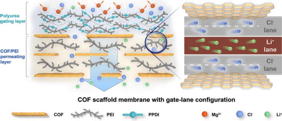 |
| •Covalent organic framework (COF) scaffold membranes with gate-lane nanostructure were prepared. •The gating layer affords high rejection to Mg2+ and thus high Li+/Mg2+ selectivity. The permeating layer bearing Li+ lanes and Cl− lanes facilitates Li+ transport and thus high Li+ permeability. •The COF scaffold membrane exhibits the true selectivity of 231.9 with Li+ enrichment of 120.2% at the Mg2+/Li+ mass ratio of 50, exceeding the ideal selectivity of 80.5. Credit Zixuan Zhang, Yan Kong, Runlai Li, Xiaolin Yue, Hao Deng, Yu Zheng, Sui Zhang*, Runnan Zhang*, Zhongyi Jiang*. |
Abstract:
As the global shift to clean energy accelerates, securing a stable lithium supply becomes critical, yet conventional extraction methods struggle with the “permeability–selectivity” trade-off when separating Li⁺ from chemically similar Mg2+ in salt-lake brines. Now researchers from Tianjin University, National University of Singapore and Sichuan University—led by Prof. Zhongyi Jiang, Prof. Runnan Zhang and Prof. Sui Zhang—report a covalent-organic-framework (COF) scaffold membrane whose gate-lane architecture delivers record-high true Li⁺/Mg²⁺ selectivity together with high Li⁺ flux. The work offers a blueprint for next-generation ion-separation membranes that can harvest battery-grade lithium with unprecedented efficiency.
COF scaffold membrane with gate‑lane nanostructure for efficient Li+/Mg2+ separation
Shanghai, China | Posted on January 30th, 2026Why Gate-Lane COF Membranes Matter
Favorable Ion-Mixing Effect: True selectivity (231.9) far exceeds ideal selectivity (80.5) at Mg2+/Li+ mass ratio 50, turning multi-ion interference into a separation booster instead of a penalty.
High Li+ Permeability: 11.5 L m-2 h-1 bar-1 water permeance with only 135 nm thickness ensures low energy consumption and compact module design.
Superior Stability: >99 % Mg2+ rejection is maintained for 7 days under 5 bar, 5000 ppm MgCl2, pH 3–11, demonstrating robustness for real brine processing.
Innovative Design and Features
Gate-Lane Nanostructure: A 20 nm polyurea “gating” layer (small pores, high positive charge) rejects Mg²⁺, while an underlying COF/PEI “permeating” layer forms separate Li+ and Cl⁻ nano-lanes that accelerate Li+ transport.
Charge-Asymmetric Scaffold: Positively charged COF nanosheets attract Cl⁻ to create “Cl⁻ lanes”; lower-charged PEI chains provide “Li+ lanes”, achieving spatial segregation verified by in-situ MD simulations and DFT calculations.
Tunable Architecture: Varying COF/PEI mass ratio from 0.001 to 0.1 switches the membrane from hybrid to scaffold, allowing precise control of pore size (MWCO 335 Da), surface zeta potential (+55.7 mV) and thus selectivity.
Applications and Future Outlook
Lithium Extraction from Brines: At Mg2+/Li⁺ = 50 the permeate ratio drops to <0.22, cutting more than 200-fold of original Mg content and surpassing all reported positively charged nanofiltration membranes.
Seawater & Battery Electrolyte Pretreatment: >98 % rejection of Ca2+ and Mg2+ protects downstream reverse-osmosis modules and enables high-purity electrolyte salts for Li-ion batteries.
Modular Upscaling: Vacuum-filtration fabrication is roll-to-roll compatible; 1.54 cm2 lab cross-flow results scale linearly with pressure, indicating easy path to commercial spiral-wound elements.
Challenges & Opportunities: Long-term fouling under natural brine, anti-scaling surface modification and cost-effective COF synthesis at tonne scale are next targets. Future work will also extend the gate-lane concept to other mono/divalent separations such as K⁺/Ca2+ and Na⁺/Mg2+.
This comprehensive study demonstrates that hierarchical, charge-asymmetric COF membranes can turn the “ion-mixing penalty” into a separation bonus, breaking the traditional permeability–selectivity ceiling. It underscores the power of integrating precise chemistry, advanced spectroscopy and molecular simulations to design membranes for sustainable metal recovery. Stay tuned for more disruptive advances from Prof. Zhongyi Jiang, Prof. Runnan Zhang and Prof. Sui Zhang and their teams!
####
For more information, please click here
Contacts:
Bowen Li
Shanghai Jiao Tong University Journal Center
Office: 021-62800059
Copyright © Shanghai Jiao Tong University Journal Center
If you have a comment, please Contact us.Issuers of news releases, not 7th Wave, Inc. or Nanotechnology Now, are solely responsible for the accuracy of the content.
Bookmark:


| Related Links |
| Related News Press |
News and information
 Quantum computer improves AI predictions April 17th, 2026
Flexible sensor gains sensitivity under pressure April 17th, 2026
A reusable chip for particulate matter sensing April 17th, 2026
Detecting vibrational quantum beating in the predissociation dynamics of SF6 using time-resolved photoelectron spectroscopy April 17th, 2026
Mining/Extraction/Drilling
Rice membrane extracts lithium from brines with greater speed, less waste October 3rd, 2025
Chile coating and composite industry makes leap forward leveraging graphene nanotube solutions April 9th, 2021
Membrane technology could cut emissions and energy use in oil refining July 17th, 2020
Possible Futures
A fundamentally new therapeutic approach to cystic fibrosis: Nanobody repairs cellular defect April 17th, 2026
UC Irvine physicists discover method to reverse ‘quantum scrambling’ : The work addresses the problem of information loss in quantum computing system April 17th, 2026
Discoveries
Quantum computer improves AI predictions April 17th, 2026
Flexible sensor gains sensitivity under pressure April 17th, 2026
A reusable chip for particulate matter sensing April 17th, 2026
Detecting vibrational quantum beating in the predissociation dynamics of SF6 using time-resolved photoelectron spectroscopy April 17th, 2026
Announcements
A fundamentally new therapeutic approach to cystic fibrosis: Nanobody repairs cellular defect April 17th, 2026
UC Irvine physicists discover method to reverse ‘quantum scrambling’ : The work addresses the problem of information loss in quantum computing system April 17th, 2026
Interviews/Book Reviews/Essays/Reports/Podcasts/Journals/White papers/Posters
A fundamentally new therapeutic approach to cystic fibrosis: Nanobody repairs cellular defect April 17th, 2026
UC Irvine physicists discover method to reverse ‘quantum scrambling’ : The work addresses the problem of information loss in quantum computing system April 17th, 2026
Battery Technology/Capacitors/Generators/Piezoelectrics/Thermoelectrics/Energy storage
Decoding hydrogen‑bond network of electrolyte for cryogenic durable aqueous zinc‑ion batteries January 30th, 2026
MXene nanomaterials enter a new dimension Multilayer nanomaterial: MXene flakes created at Drexel University show new promise as 1D scrolls January 30th, 2026
Rice membrane extracts lithium from brines with greater speed, less waste October 3rd, 2025
 |
||
 |
||
| The latest news from around the world, FREE | ||
 |
||
|
|
||
| Premium Products | ||
 |
||
|
Only the news you want to read!
Learn More |
||
 |
||
|
Full-service, expert consulting
Learn More |
||
|
|
||