Home > Press > Single-atom catalysts change spin state when boosted by a magnetic field
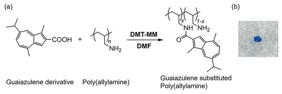 |
| (a) Synthesis of guaiazulene substituted poly(allylamine) (b) Photo of guaiazulene substituted poly(allylamine). Credit Kouki Oka et al. |
Abstract:
Guaiazulene belongs to the class of azulene compounds, known for their vibrant blue color. Guaiazulene produces a blue color more saturated than that of naturally derived blue pigments and contains antioxidant properties.
Single-atom catalysts change spin state when boosted by a magnetic field
Sendai, Japan | Posted on June 4th, 2025Although it is often found in topical creams for skincare, it has also been touted as a potential food coloring agent. Yet this potential has been stymied because of its poor water solubility and color degradation under acidic conditions.
A group of researchers, however, has overcome this common stumbling block by introducing guaiazulene into a hydrophilic poly(allylamine).
"We prepared a carboxylic acid, a common type of acid found in many citrus fruits and vinegars, with a guaiazulene skeleton, which can be easily condensed with amines," explains Kouki Oka, an associate professor at Tohoku University who led the research group. "We then synthesized a blue polymer, incorporating the guaiazulene skeleton into the side chain. The synthesis was carried out by reacting the carboxylic acid with a highly hydrophilic poly(allylamine) condensation agent."
The guaiazulene introduction degree was easily adjustable by changing the equivalent amount of carboxylic acid with the guaiazulene skeleton. The polymer with a 3.2% introduction degree was more than 10,000 times more water soluble than guaiazulene alone.
Oka and his colleagues also measured the absorption spectra of guaiazulene and guaiazulene-substituted poly(allylamine) in acidic solution. While the absorption spectrum of guaiazulene (Figure 2a) changed significantly in shape and maximum wavelength after one month, the absorption spectrum of guaiazulene-substituted poly(allylamine) (Figure 2b) showed no significant change. This indicated that the introduction of guaiazulene into poly(allylamine) improves its stability under acidic conditions.
Oka believes that the results will lead to more than just the development of blue colorants under acidic conditions. "This could lead to the development of new functions for hydrophobic and acid-sensitive materials, something that has been difficult to achieve in the past."
Details of the teams' breakthrough were published in the New Journal of Chemistry on May 20, 2025.
####
For more information, please click here
Contacts:
Public Relations
Tohoku University
Copyright © Tohoku University
If you have a comment, please Contact us.Issuers of news releases, not 7th Wave, Inc. or Nanotechnology Now, are solely responsible for the accuracy of the content.
Bookmark:


| Related Links |
| Related News Press |
News and information
 Quantum computer improves AI predictions April 17th, 2026
Flexible sensor gains sensitivity under pressure April 17th, 2026
A reusable chip for particulate matter sensing April 17th, 2026
Detecting vibrational quantum beating in the predissociation dynamics of SF6 using time-resolved photoelectron spectroscopy April 17th, 2026
Chemistry
Projecting light to dispense liquids: A new route to ultra-precise microdroplets January 30th, 2026
From sensors to smart systems: the rise of AI-driven photonic noses January 30th, 2026
"Nanoreactor" cage uses visible light for catalytic and ultra-selective cross-cycloadditions October 3rd, 2025
Cambridge chemists discover simple way to build bigger molecules – one carbon at a time June 6th, 2025
Possible Futures
A fundamentally new therapeutic approach to cystic fibrosis: Nanobody repairs cellular defect April 17th, 2026
UC Irvine physicists discover method to reverse ‘quantum scrambling’ : The work addresses the problem of information loss in quantum computing system April 17th, 2026
Discoveries
Quantum computer improves AI predictions April 17th, 2026
Flexible sensor gains sensitivity under pressure April 17th, 2026
A reusable chip for particulate matter sensing April 17th, 2026
Detecting vibrational quantum beating in the predissociation dynamics of SF6 using time-resolved photoelectron spectroscopy April 17th, 2026
Announcements
A fundamentally new therapeutic approach to cystic fibrosis: Nanobody repairs cellular defect April 17th, 2026
UC Irvine physicists discover method to reverse ‘quantum scrambling’ : The work addresses the problem of information loss in quantum computing system April 17th, 2026
Interviews/Book Reviews/Essays/Reports/Podcasts/Journals/White papers/Posters
A fundamentally new therapeutic approach to cystic fibrosis: Nanobody repairs cellular defect April 17th, 2026
UC Irvine physicists discover method to reverse ‘quantum scrambling’ : The work addresses the problem of information loss in quantum computing system April 17th, 2026
 |
||
 |
||
| The latest news from around the world, FREE | ||
 |
||
|
|
||
| Premium Products | ||
 |
||
|
Only the news you want to read!
Learn More |
||
 |
||
|
Full-service, expert consulting
Learn More |
||
|
|
||