Home > Press > Projecting light to dispense liquids: A new route to ultra-precise microdroplets
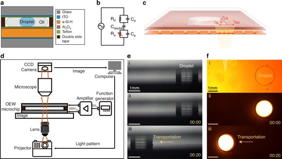 |
| Overview of the OEW-based droplet dispensing system. a Schematic diagram of the microchip. b Equivalent circuit diagram of OEW. c Principle diagram of OEW. d Schematic diagram of the system. e Side view (f) Top view of droplet manipulation ((i) Initial. (ii) Contact angle of droplet changed with input signal and light pattern. (iii) Droplet driven by light pattern. Credit Microsystems & Nanoengineering |
Abstract:
Precise control of tiny liquid volumes is essential for modern biochemical analysis, yet reliably dispensing nanoliter-scale droplets remains technically challenging. This study presents a light-controlled droplet dispensing strategy that enables highly accurate generation of tunable nanoliter droplets on a microfluidic chip. By combining optoelectrowetting with dynamically designed light patterns, the system guides droplets to deform, shrink, and detach in a controlled manner. The approach achieves exceptional volume consistency across a wide range of droplet sizes and supports stable formation of uniform droplet arrays. Beyond technical precision, the work demonstrates that light-driven droplet control can reliably support small-scale biochemical reactions, offering a powerful alternative to conventional liquid-handling methods.
Projecting light to dispense liquids: A new route to ultra-precise microdroplets
Beijing, China | Posted on January 30th, 2026Droplet-based microfluidic systems are widely used for biochemical assays, diagnostics, and drug discovery because they reduce reagent consumption and improve reaction control. However, dispensing individual droplets with high accuracy is difficult, especially at volumes below hundreds of nanoliters. Traditional electrowetting systems rely on fixed electrodes, which limit flexibility and require complex fabrication. Optical control methods offer greater freedom but often suffer from inconsistent droplet size and poor reproducibility. In particular, uncontrolled droplet necking and random pinch-off during dispensing lead to large volume errors. Based on these challenges, there is a strong need to develop a controllable, high-precision droplet dispensing strategy capable of stable nanoliter-scale operation.
Researchers from the Southern University of Science and Technology, reporting on November 28, 2025, in Microsystems & Nanoengineering, describe a new optoelectrowetting-based droplet dispensing system that uses programmable light patterns to precisely control droplet formation. The study (DOI: 10.1038/s41378-025-01071-6) introduces a dynamic light-guided strategy that enables reliable dispensing of nanoliter droplets with tunable volumes. By projecting tailored optical patterns onto a microfluidic chip, the system achieves accurate droplet shaping, separation, and transport, demonstrating both high precision and strong reproducibility in small-volume liquid handling.
The core innovation of the study lies in a dynamic light-pattern design that actively controls droplet deformation and pinch-off during dispensing. Instead of relying on fixed electrodes, the system creates "virtual electrodes" through localized illumination, allowing droplets to be guided solely by projected light. A specially designed necking light pattern plays a critical role by stabilizing the liquid bridge that forms between the parent droplet and the emerging daughter droplet.
During dispensing, the droplet first extends under illumination, then undergoes a controlled back-pumping step that reshapes the liquid to match the light pattern. This process slows down the pinch-off event, eliminating random splitting and significantly improving volume accuracy. Through systematic optimization of light pattern geometry, voltage, and necking position, the researchers achieved a minimum relative error of 0.45% and a coefficient of variation of 2.49% for droplets around 36 nanoliters.
The system also demonstrated strong flexibility, accurately dispensing droplets across a broad size range while maintaining precision below commonly accepted error thresholds. Importantly, the researchers validated the platform using polymerase chain reaction (PCR) amplification, showing that on-chip droplets performed comparably to manually pipetted samples, even at volumes below 200 nanoliters.
"This work shows that light can be used not just to move droplets, but to precisely define their final volume," said the study's corresponding author. “By controlling the entire dispensing process with programmable optical patterns, we eliminate many sources of randomness that limit conventional microfluidic systems. The ability to generate uniform nanoliter droplets with such low error opens new possibilities for automated biochemical workflows, especially where consistency and miniaturization are critical."
The light-guided droplet dispensing strategy offers a versatile solution for lab-on-a-chip platforms used in molecular diagnostics, drug screening, and organ-on-chip research. Its ability to reliably handle sub-200-nanoliter volumes addresses a long-standing gap between conventional pipetting and microfluidic automation. Because the system avoids complex electrode fabrication, it also simplifies device design and improves scalability. More broadly, the work highlights how optical control can transform digital microfluidics into a flexible, reconfigurable tool for precision chemistry and biology, with potential impact across clinical testing, pharmaceutical development, and high-throughput biochemical analysis.
Funding information
This work was financially supported in part by Guangdong-Hong Kong-Macau Joint Laboratory on Micro-Nano Manufacturing Technology (Grant No. 2021LSYS004), National Natural Science Foundation of China (Grant No. 62403231), National Natural Science Foundation of China (Grant No. 31927802) and Shenzhen Science and Technology Innovation Commission (Grant No. RCJC20200714114436046).
####
About Aerospace Information Research Institute, Chinese Academy of Sciences
About Microsystems & Nanoengineering
Microsystems & Nanoengineering is an online-only, open access international journal devoted to publishing original research results and reviews on all aspects of Micro and Nano Electro Mechanical Systems from fundamental to applied research. The journal is published by Springer Nature in partnership with the Aerospace Information Research Institute, Chinese Academy of Sciences, supported by the State Key Laboratory of Transducer Technology.
For more information, please click here
Contacts:
Na Li
Microsystems & Nanoengineering
Copyright © Aerospace Information Research Institute, Chinese Academy of Sciences
If you have a comment, please Contact us.Issuers of news releases, not 7th Wave, Inc. or Nanotechnology Now, are solely responsible for the accuracy of the content.
Bookmark:


| Related Links |
| Related News Press |
News and information
 Quantum computer improves AI predictions April 17th, 2026
Flexible sensor gains sensitivity under pressure April 17th, 2026
A reusable chip for particulate matter sensing April 17th, 2026
Detecting vibrational quantum beating in the predissociation dynamics of SF6 using time-resolved photoelectron spectroscopy April 17th, 2026
Chemistry
From sensors to smart systems: the rise of AI-driven photonic noses January 30th, 2026
"Nanoreactor" cage uses visible light for catalytic and ultra-selective cross-cycloadditions October 3rd, 2025
Cambridge chemists discover simple way to build bigger molecules – one carbon at a time June 6th, 2025
Single-atom catalysts change spin state when boosted by a magnetic field June 4th, 2025
Microfluidics/Nanofluidics
Implantable device shrinks pancreatic tumors: Taming pancreatic cancer with intratumoral immunotherapy April 14th, 2023
Researchers design new inks for 3D-printable wearable bioelectronics: Potential uses include printing electronic tattoos for medical tracking applications August 19th, 2022
Oregon State University research pushes closer to new therapy for pancreatic cancer May 6th, 2022
Possible Futures
A fundamentally new therapeutic approach to cystic fibrosis: Nanobody repairs cellular defect April 17th, 2026
UC Irvine physicists discover method to reverse ‘quantum scrambling’ : The work addresses the problem of information loss in quantum computing system April 17th, 2026
Discoveries
Quantum computer improves AI predictions April 17th, 2026
Flexible sensor gains sensitivity under pressure April 17th, 2026
A reusable chip for particulate matter sensing April 17th, 2026
Detecting vibrational quantum beating in the predissociation dynamics of SF6 using time-resolved photoelectron spectroscopy April 17th, 2026
Announcements
A fundamentally new therapeutic approach to cystic fibrosis: Nanobody repairs cellular defect April 17th, 2026
UC Irvine physicists discover method to reverse ‘quantum scrambling’ : The work addresses the problem of information loss in quantum computing system April 17th, 2026
Interviews/Book Reviews/Essays/Reports/Podcasts/Journals/White papers/Posters
A fundamentally new therapeutic approach to cystic fibrosis: Nanobody repairs cellular defect April 17th, 2026
UC Irvine physicists discover method to reverse ‘quantum scrambling’ : The work addresses the problem of information loss in quantum computing system April 17th, 2026
 |
||
 |
||
| The latest news from around the world, FREE | ||
 |
||
|
|
||
| Premium Products | ||
 |
||
|
Only the news you want to read!
Learn More |
||
 |
||
|
Full-service, expert consulting
Learn More |
||
|
|
||