Home > Press > Two-dimensional bimetallic selenium-containing metal-organic frameworks and their calcinated derivatives as electrocatalysts for overall water splitting
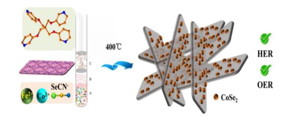 |
| By utilizing the 2D-MOF as self-sacrificial template selenium-containing materials had been produced via simple method, which exhibits the efficient activity for overall water splitting CREDIT HIGHER EDUCATION PRESS |
Abstract:
Transition metal selenides have been considered to be a good choice for electrocatalytic water splitting. In addition, Metal-organic frameworks (MOFs) have been used to make catalysts with good electrocatalytic capabilities. Traditionally, the MOF-derived selenides are produced via the self-sacrificing MOF template methods. However, this strategy is high-energy consuming, and it is difficult to precisely control the structure and component homogeneity of the product during pyrolysis.
Two-dimensional bimetallic selenium-containing metal-organic frameworks and their calcinated derivatives as electrocatalysts for overall water splitting
Beijing, China | Posted on March 8th, 2024A research group of Wang-ting Lu, Fan Yu, and Yun Zheng from Jianghan University and Fuzhou University used two-dimensional (2D) layered metal-organic frameworks (MOFs) as self-sacrificial templates to create high-efficiency Selenium (Se)-containing electrocatalysts for overall water splitting. They adopted two strategies to introduce Se element into the Co–Fe MOF, one being the etching of as-prepared MOF by SeO2 solution and the other, the replacing of SCN− with SeCN− as the construction unit. The electrochemical activity of Se-containing electrocatalysts for catalyzing the hydrogen evolution reaction (HER) and oxygen evolution reaction (OER) is evaluated and further discussed.
It is found that both two Se introducing approaches can obviously improve the HER performance during overall water splitting. The high electrochemical performance may be resulted from the unique 2D hierarchical porous structure and strong synergistic effect between different components in the material.
This work reveals that the rational design of layered MOFs with S- or Se-containing linkers as water splitting catalysts is a feasible option for the development of economical and low-energy-consuming electrocatalysts. Meanwhile, it provides an innovative approach for the synthesis of MOF-based metallic selenides.
####
For more information, please click here
Contacts:
Rong Xie
Higher Education Press
Office: 105-855-6485
Copyright © Higher Education Press
If you have a comment, please Contact us.Issuers of news releases, not 7th Wave, Inc. or Nanotechnology Now, are solely responsible for the accuracy of the content.
Bookmark:


| Related Links |
| Related News Press |
News and information
 Quantum computer improves AI predictions April 17th, 2026
Flexible sensor gains sensitivity under pressure April 17th, 2026
A reusable chip for particulate matter sensing April 17th, 2026
Detecting vibrational quantum beating in the predissociation dynamics of SF6 using time-resolved photoelectron spectroscopy April 17th, 2026
Chemistry
Projecting light to dispense liquids: A new route to ultra-precise microdroplets January 30th, 2026
From sensors to smart systems: the rise of AI-driven photonic noses January 30th, 2026
"Nanoreactor" cage uses visible light for catalytic and ultra-selective cross-cycloadditions October 3rd, 2025
Cambridge chemists discover simple way to build bigger molecules – one carbon at a time June 6th, 2025
Possible Futures
A fundamentally new therapeutic approach to cystic fibrosis: Nanobody repairs cellular defect April 17th, 2026
UC Irvine physicists discover method to reverse ‘quantum scrambling’ : The work addresses the problem of information loss in quantum computing system April 17th, 2026
Discoveries
Quantum computer improves AI predictions April 17th, 2026
Flexible sensor gains sensitivity under pressure April 17th, 2026
A reusable chip for particulate matter sensing April 17th, 2026
Detecting vibrational quantum beating in the predissociation dynamics of SF6 using time-resolved photoelectron spectroscopy April 17th, 2026
Announcements
A fundamentally new therapeutic approach to cystic fibrosis: Nanobody repairs cellular defect April 17th, 2026
UC Irvine physicists discover method to reverse ‘quantum scrambling’ : The work addresses the problem of information loss in quantum computing system April 17th, 2026
Water
Taking salt out of the water equation October 7th, 2022
UBCO researchers change the game when it comes to activity tracking: Flexible, highly sensitive motion device created by extrusion printing June 17th, 2022
Battery Technology/Capacitors/Generators/Piezoelectrics/Thermoelectrics/Energy storage
Decoding hydrogen‑bond network of electrolyte for cryogenic durable aqueous zinc‑ion batteries January 30th, 2026
COF scaffold membrane with gate‑lane nanostructure for efficient Li+/Mg2+ separation January 30th, 2026
MXene nanomaterials enter a new dimension Multilayer nanomaterial: MXene flakes created at Drexel University show new promise as 1D scrolls January 30th, 2026
 |
||
 |
||
| The latest news from around the world, FREE | ||
 |
||
|
|
||
| Premium Products | ||
 |
||
|
Only the news you want to read!
Learn More |
||
 |
||
|
Full-service, expert consulting
Learn More |
||
|
|
||