Home > Press > Nanowrinkles, nanofolds yield strange hidden channels
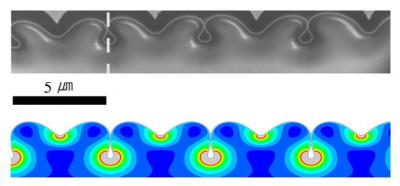 |
| Researchers at Brown University and in Korea used focused ion beams to extract a cross-section of compressed gold nanofilm. When tips of regular, neighboring folds touched, nanopipes were created beneath the surface.
Credit: Kyung-Suk Kim lab, Brown University |
Abstract:
Wrinkles and folds are ubiquitous. They occur in furrowed brows, planetary topology, the surface of the human brain, even the bottom of a gecko's foot. In many cases, they are nature's ingenious way of packing more surface area into a limited space. Scientists, mimicking nature, have long sought to manipulate surfaces to create wrinkles and folds to make smaller, more flexible electronic devices, fluid-carrying nanochannels or even printable cell phones and computers.
Nanowrinkles, nanofolds yield strange hidden channels
Providence, RI | Posted on November 23rd, 2011But to attain those technology-bending feats, scientists must fully understand the profile and performance of wrinkles and folds at the nanoscale, dimensions 1/50,000th the thickness of a human hair. In a series of observations and experiments, engineers at Brown University and in Korea have discovered unusual properties in wrinkles and folds at the nanoscale. The researchers report that wrinkles created on super-thin films have hidden long waves that lengthen even when the film is compressed. The team also discovered that when folds are formed in such films, closed nanochannels appear below the surface, like thousands of super-tiny pipes.
"Wrinkles are everywhere in science," said Kyung-Suk Kim, professor of engineering at Brown and corresponding author of the paper published in the journal Proceedings of the Royal Society A. "But they hold certain secrets. With this study, we have found mathematically how the wrinkle spacings of a thin sheet are determined on a largely deformed soft substrate and how the wrinkles evolve into regular folds."
Wrinkles are made when a thin stiff sheet is buckled on a soft foundation or in a soft surrounding. They are precursors of regular folds: When the sheet is compressed enough, the wrinkles are so closely spaced that they form folds. The folds are interesting to manufacturers, because they can fit a large surface area of a sheet in a finite space.
Kim and his team laid gold nanogranular film sheets ranging from 20 to 80 nanometers thick on a rubbery substrate commonly used in the microelectronics industry. The researchers compressed the film, creating wrinkles and examined their properties. As in previous studies, they saw primary wrinkles with short periodicities, the distance between individual wrinkles' peaks or valleys. But Kim and his colleagues discovered a second type of wrinkle, with a much longer periodicity than the primary wrinkles — like a hidden long wave. As the researchers compressed the gold nanogranular film, the primary wrinkles' periodicity decreased, as expected. But the periodicity between the hidden long waves, which the group labeled secondary wrinkles, lengthened.
"We thought that was strange," Kim said.
It got even stranger when the group formed folds in the gold nanogranular sheets. On the surface, everything appeared normal. The folds were created as the peaks of neighboring wrinkles got so close that they touched. But the research team calculated that those folds, if elongated, did not match the length of the film before it had been compressed. A piece of the original film surface was not accounted for, "as if it had been buried," Kim said.
Indeed, it had been, as nano-size closed channels. Previous researchers, using atomic force microscopy that scans the film's surface, had been unable to see the buried channels. Kim's group turned to focused ion beams to extract a cross-section of the film. There, below the surface, were rows of closed channels, about 50 to a few 100 nanometers in diameter. "They were hidden," Kim said. "We were the first ones to cut (the film) and see that there are channels underneath."
The enclosed nano channels are important because they could be used to funnel liquids, from drugs on patches to treat diseases or infections, to clean water and energy harvesting, like a microscopic hydraulic pump.
Contributing authors include Jeong-Yun Sun and Kyu Hwan Oh from Seoul National University; Myoung-Woon Moon from the Korea Institute of Science and Technology; and Shuman Xia, a researcher at Brown and now at the Georgia Institute of Technology. The National Science Foundation, the Korea Institute of Science and Technology, the Ministry of Knowledge Economy of Korea, and the Ministry of Education, Science, and Technology of Korea supported the research.
####
For more information, please click here
Contacts:
Richard Lewis
401-863-3766
Copyright © Brown University
If you have a comment, please Contact us.Issuers of news releases, not 7th Wave, Inc. or Nanotechnology Now, are solely responsible for the accuracy of the content.
Bookmark:


| Related News Press |
News and information
 Quantum computer improves AI predictions April 17th, 2026
Flexible sensor gains sensitivity under pressure April 17th, 2026
A reusable chip for particulate matter sensing April 17th, 2026
Detecting vibrational quantum beating in the predissociation dynamics of SF6 using time-resolved photoelectron spectroscopy April 17th, 2026
Flexible Electronics
Flexible sensor gains sensitivity under pressure April 17th, 2026
MXene nanomaterials enter a new dimension Multilayer nanomaterial: MXene flakes created at Drexel University show new promise as 1D scrolls January 30th, 2026
Flexible electronics integrated with paper-thin structure for use in space January 17th, 2025
Microfluidics/Nanofluidics
Projecting light to dispense liquids: A new route to ultra-precise microdroplets January 30th, 2026
Chip Technology
A reusable chip for particulate matter sensing April 17th, 2026
Metasurfaces smooth light to boost magnetic sensing precision January 30th, 2026
Discoveries
Quantum computer improves AI predictions April 17th, 2026
Flexible sensor gains sensitivity under pressure April 17th, 2026
A reusable chip for particulate matter sensing April 17th, 2026
Detecting vibrational quantum beating in the predissociation dynamics of SF6 using time-resolved photoelectron spectroscopy April 17th, 2026
Announcements
A fundamentally new therapeutic approach to cystic fibrosis: Nanobody repairs cellular defect April 17th, 2026
UC Irvine physicists discover method to reverse ‘quantum scrambling’ : The work addresses the problem of information loss in quantum computing system April 17th, 2026
Energy
Sensors innovations for smart lithium-based batteries: advancements, opportunities, and potential challenges August 8th, 2025
Simple algorithm paired with standard imaging tool could predict failure in lithium metal batteries August 8th, 2025
Water
Taking salt out of the water equation October 7th, 2022
Research partnerships
Lab to industry: InSe wafer-scale breakthrough for future electronics August 8th, 2025
HKU physicists uncover hidden order in the quantum world through deconfined quantum critical points April 25th, 2025
Printing/Lithography/Inkjet/Inks/Bio-printing/Dyes
Presenting: Ultrasound-based printing of 3D materials—potentially inside the body December 8th, 2023
Simple ballpoint pen can write custom LEDs August 11th, 2023
Disposable electronics on a simple sheet of paper October 7th, 2022
 |
||
 |
||
| The latest news from around the world, FREE | ||
 |
||
|
|
||
| Premium Products | ||
 |
||
|
Only the news you want to read!
Learn More |
||
 |
||
|
Full-service, expert consulting
Learn More |
||
|
|
||