Home > Press > Flexible electronics integrated with paper-thin structure for use in space
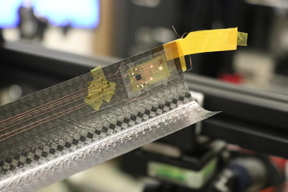 |
| The extended boom showing a lightweight, flexible electronics patch with a motion sensor, and a temperature sensor mounted on the boom tip Credit The Grainger College of Engineering at the University of Illinois Urbana-Champaign |
Abstract:
Being lightweight is essential for space structures, particularly for tools used on already small, lightweight satellites. The ability to perform multiple functions is a bonus. To address these characteristics in a new way, researchers at the University of Illinois Urbana-Champaign successfully integrated flexible electronics with a three-ply, self-deployable boom that weighs only about 20 grams.
Flexible electronics integrated with paper-thin structure for use in space
Urbana, IL | Posted on January 17th, 2025“It's difficult to get commercial electronics integrated into these super thin structures,” said Xin Ning, an aerospace professor in The Grainger College of Engineering at U. of I. “There were a lot of engineering constraints adding to the challenge of making the electronics able to withstand the harsh environment of space.”
Ning said the concept for the work began at a conference about two years ago. He presented his unique expertise in making multifunctional space structures that integrate lightweight, flexible electronics.
“It got the attention of Juan Fernandez from NASA Langley Research Center. He was making a boom structure for a Virginia Tech CubeSat project and saw the opportunity to collaborate and add multi-functional devices to the structures instead of just a pure structure,” Ning said.
Ultimately, the boom to contain the electronics was made at NASA Langley Research Center, Ning said. It is a three-ply carbon fiber and epoxy composite material designed to be extremely thin—about as thick as a sheet of paper. It is rolled up like a tape measure with stored energy in its coils until it unfurls on its own in space.
“Virginia Tech had specific requirements for us to follow, some that created challenges,” Ning said. “One was the length. They wanted to have power and data lines over a meter in length embedded in a paper-thin composite material. We tried different materials and different technologies.
“Eventually, we went with thin commercial wires coated with insulation and it worked. I think we were overthinking it at the beginning. We tried more difficult, fancier approaches, but they failed. This was a simple and reliable solution using off-the-shelf, readily available wires.”
Another key component is a lightweight, flexible electronics patch with a motion sensor, a temperature sensor, and a blue LED, all mounted on the boom tip. Ning explained that the electronics needed to endure the harsh thermal-vacuum conditions of space while remaining flexible enough to withstand the sudden unfurling of the coiled boom. The motion sensor monitors the deployment and vibration of the boom, and the blue LED assists CubeSat cameras in seeing the structure in space once deployed.
Ning’s team conducted comprehensive on-ground experiments and simulations to explore the mechanics of the bistable boom with flexible electronics, as well as its deployment and vibration behavior. Ning said that these fundamental studies could offer valuable insights for future designs of multifunctional space structures.
The Virginia Tech three-unit CubeSat with the multifunctional boom is aiming for launch in 2025.
“We are also working on making the flexible electronics more durable in space—ways to protect the electronics so they will be operational longer in the space environment.”
The study, “Multifunctional bistable ultrathin composite booms with flexible electronics,” by Yao Yao and Xin Ning from Illinois, Juan Fernandez from NASA Langley Research Center and Sven Bilén at Penn State is published in Extreme Mechanics Letters. DOI: 10.1016/j.eml.2024.102247
Yao Yao earned a double major in 2018 from Illinois in materials science and engineering and physics. He began working with Xin Ning when he was an undergraduate and Ning was a postdoctoral research associate in materials science at Illinois. Later, Yao joined Ning’s research group when Ning was a professor at Penn State, and now is completing his Ph.D. with Ning back at Illinois again.
####
For more information, please click here
Contacts:
Aaron Seidlitz
University of Illinois Grainger College of Engineering
Copyright © University of Illinois Grainger College of Engineering
If you have a comment, please Contact us.Issuers of news releases, not 7th Wave, Inc. or Nanotechnology Now, are solely responsible for the accuracy of the content.
Bookmark:


| Related Links |
| Related News Press |
News and information
 Quantum computer improves AI predictions April 17th, 2026
Flexible sensor gains sensitivity under pressure April 17th, 2026
A reusable chip for particulate matter sensing April 17th, 2026
Detecting vibrational quantum beating in the predissociation dynamics of SF6 using time-resolved photoelectron spectroscopy April 17th, 2026
Flexible Electronics
Flexible sensor gains sensitivity under pressure April 17th, 2026
Possible Futures
A fundamentally new therapeutic approach to cystic fibrosis: Nanobody repairs cellular defect April 17th, 2026
UC Irvine physicists discover method to reverse ‘quantum scrambling’ : The work addresses the problem of information loss in quantum computing system April 17th, 2026
Discoveries
Quantum computer improves AI predictions April 17th, 2026
Flexible sensor gains sensitivity under pressure April 17th, 2026
A reusable chip for particulate matter sensing April 17th, 2026
Detecting vibrational quantum beating in the predissociation dynamics of SF6 using time-resolved photoelectron spectroscopy April 17th, 2026
Announcements
A fundamentally new therapeutic approach to cystic fibrosis: Nanobody repairs cellular defect April 17th, 2026
UC Irvine physicists discover method to reverse ‘quantum scrambling’ : The work addresses the problem of information loss in quantum computing system April 17th, 2026
Interviews/Book Reviews/Essays/Reports/Podcasts/Journals/White papers/Posters
A fundamentally new therapeutic approach to cystic fibrosis: Nanobody repairs cellular defect April 17th, 2026
UC Irvine physicists discover method to reverse ‘quantum scrambling’ : The work addresses the problem of information loss in quantum computing system April 17th, 2026
Aerospace/Space
Decoding hydrogen‑bond network of electrolyte for cryogenic durable aqueous zinc‑ion batteries January 30th, 2026
ICFO researchers overcome long-standing bottleneck in single photon detection with twisted 2D materials August 8th, 2025
Onion-like nanoparticles found in aircraft exhaust May 14th, 2025
 |
||
 |
||
| The latest news from around the world, FREE | ||
 |
||
|
|
||
| Premium Products | ||
 |
||
|
Only the news you want to read!
Learn More |
||
 |
||
|
Full-service, expert consulting
Learn More |
||
|
|
||