Home > Press > Notre Dame researchers find transition point in semiconductor nanomaterials
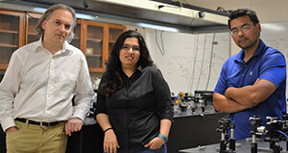 |
| Boldizsar Janko, left, Rusha Chatterjee and Masaru Kuno stand in the Kuno lab at Notre Dame |
Abstract:
Collaborative research at Notre Dame has demonstrated that electronic interactions play a significant role in the dimensional crossover of semiconductor nanomaterials. The laboratory of Masaru Kuno, professor of chemistry and biochemistry, and the condensed matter theory group of Boldizsár Jankó, professor of physics, have now shown that a critical length scale marks the transition between a zero-dimensional, quantum dot and a one-dimensional nanowire.
Notre Dame researchers find transition point in semiconductor nanomaterials
Notre Dame, IN | Posted on September 6th, 2016The findings, "Dimensional crossover in semiconductor nanostructures," were published in Nature Communications. Matthew P. McDonald and Rusha Chatterjee of Kuno's laboratory and Jixin Si of Jankó's group are also authors of the publication.
A quantum dot structure possesses the same physical dimensions in every direction while a quantum wire exhibits one dimension longer than the others. This means that quantum dots and nanowires made of the same material exhibit different optical and electrical responses at the nanoscale since these properties are exquisitely size- and shape-dependent. Understanding the size- and shape-dependent evolution of nanomaterial properties has therefore been a central focus of nanoscience over the last two decades. However, it has never been definitively established how a quantum dot evolves into a nanowire as its aspect ratio is made progressively larger. Do quantum properties evolve gradually or do they suddenly transition?
Kuno's laboratory discovered that a critical length exists where a quantum dot becomes nanowire-like. The researchers achieved this breakthrough by conducting the first direct, single particle absorption measurements on individual semiconductor nanorods, an intermediate species between quantum dots and nanowires. Single particle rather than ensemble measurements were used to avoid the effects of sample inhomogeneities. Furthermore, an absorption approach rather than an often-used emission approach was employed to circumvent existing limitations of modern emission-based single particle microscopy-namely, its restriction to the observation of highly fluorescent specimens.
The discovery marks a significant advance in our understanding of the size- and shape-dependent quantum mechanical response of semiconductor nanostructures. "All of the introductory-level solid state or semiconductor textbooks need to revise what they say about dimensional crossover," Jankó said. "This is another example where interactions makes things completely different." Beyond this, Kuno suggests that the single particle absorption approach advanced in the study "has practical, real-world applications, maybe 40 years down the road." Examples include the generic and label-free ultrasensitive detection of chemical and biomolecular species of paramount interest within the spheres of homeland security as well public health.
Kuno's group performed the experiments that led to the discovery while Jankó's group provided theoretical support.
####
For more information, please click here
Contacts:
Masaru Kuno
574-631-0494
Copyright © Notre Dame
If you have a comment, please Contact us.Issuers of news releases, not 7th Wave, Inc. or Nanotechnology Now, are solely responsible for the accuracy of the content.
Bookmark:


| Related Links |
| Related News Press |
News and information
 Quantum computer improves AI predictions April 17th, 2026
Flexible sensor gains sensitivity under pressure April 17th, 2026
A reusable chip for particulate matter sensing April 17th, 2026
Detecting vibrational quantum beating in the predissociation dynamics of SF6 using time-resolved photoelectron spectroscopy April 17th, 2026
Possible Futures
A fundamentally new therapeutic approach to cystic fibrosis: Nanobody repairs cellular defect April 17th, 2026
UC Irvine physicists discover method to reverse ‘quantum scrambling’ : The work addresses the problem of information loss in quantum computing system April 17th, 2026
Chip Technology
A reusable chip for particulate matter sensing April 17th, 2026
Metasurfaces smooth light to boost magnetic sensing precision January 30th, 2026
Sensors
Flexible sensor gains sensitivity under pressure April 17th, 2026
Tiny nanosheets, big leap: A new sensor detects ethanol at ultra-low levels January 30th, 2026
From sensors to smart systems: the rise of AI-driven photonic noses January 30th, 2026
Sensors innovations for smart lithium-based batteries: advancements, opportunities, and potential challenges August 8th, 2025
Nanoelectronics
Lab to industry: InSe wafer-scale breakthrough for future electronics August 8th, 2025
Interdisciplinary: Rice team tackles the future of semiconductors Multiferroics could be the key to ultralow-energy computing October 6th, 2023
Key element for a scalable quantum computer: Physicists from Forschungszentrum Jülich and RWTH Aachen University demonstrate electron transport on a quantum chip September 23rd, 2022
Reduced power consumption in semiconductor devices September 23rd, 2022
Discoveries
Quantum computer improves AI predictions April 17th, 2026
Flexible sensor gains sensitivity under pressure April 17th, 2026
A reusable chip for particulate matter sensing April 17th, 2026
Detecting vibrational quantum beating in the predissociation dynamics of SF6 using time-resolved photoelectron spectroscopy April 17th, 2026
Announcements
A fundamentally new therapeutic approach to cystic fibrosis: Nanobody repairs cellular defect April 17th, 2026
UC Irvine physicists discover method to reverse ‘quantum scrambling’ : The work addresses the problem of information loss in quantum computing system April 17th, 2026
Interviews/Book Reviews/Essays/Reports/Podcasts/Journals/White papers/Posters
A fundamentally new therapeutic approach to cystic fibrosis: Nanobody repairs cellular defect April 17th, 2026
UC Irvine physicists discover method to reverse ‘quantum scrambling’ : The work addresses the problem of information loss in quantum computing system April 17th, 2026
Homeland Security
The picture of health: Virginia Tech researchers enhance bioimaging and sensing with quantum photonics June 30th, 2023
Sensors developed at URI can identify threats at the molecular level: More sensitive than a dog's nose and the sensors don't get tired May 21st, 2021
Highly sensitive dopamine detector uses 2D materials August 7th, 2020
Quantum Dots/Rods
A new kind of magnetism November 17th, 2023
IOP Publishing celebrates World Quantum Day with the announcement of a special quantum collection and the winners of two prestigious quantum awards April 14th, 2023
Qubits on strong stimulants: Researchers find ways to improve the storage time of quantum information in a spin rich material January 27th, 2023
NIST’s grid of quantum islands could reveal secrets for powerful technologies November 18th, 2022
Quantum nanoscience
Beyond silicon: Electronics at the scale of a single molecule January 30th, 2026
MXene nanomaterials enter a new dimension Multilayer nanomaterial: MXene flakes created at Drexel University show new promise as 1D scrolls January 30th, 2026
ICFO researchers overcome long-standing bottleneck in single photon detection with twisted 2D materials August 8th, 2025
 |
||
 |
||
| The latest news from around the world, FREE | ||
 |
||
|
|
||
| Premium Products | ||
 |
||
|
Only the news you want to read!
Learn More |
||
 |
||
|
Full-service, expert consulting
Learn More |
||
|
|
||