Home > Press > Model aids efforts to reduce cost of carbon nanostructures for industry, research
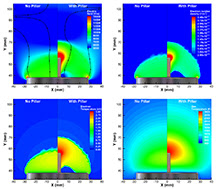 |
| In research at Purdue, a simulation technique may help to reduce the cost of carbon nanostructures for research and commercial technologies, including advanced sensors and batteries. These graphs show how including a “dielectric pillar” might affect the manufacturing process. Purdue University image/Gayathri Shivkumar and Siva Tholeti |
Abstract:
Analysis of Hydrogen Plasma in a Microwave Plasma Chemical Vapor Deposition Reactor
G. Shivkumar,1 S. S. Tholeti,1 M. A. Alrefae,2 T. S. Fisher,2 and A. A. Alexeenko1,a
1School of Aeronautics and Astronautics and Birck Nanotechnology Center, Purdue University, West Lafayette, Indiana 47907, USA 2School of Mechanical Engineering and Birck Nanotechnology Center, Purdue University
(Received 15 October 2015; accepted 16 February 2016; published online 15 March 2016)
a) Electronic mail:
The aim of this work is to build a numerical model of hydrogen plasma inside a microwave plasma chemical vapor deposition system. This model will help in understanding and optimizing the conditions for the growth of carbon nanostructures. A 2-D axisymmetric model of the system is implemented using the finite element high frequency Maxwell solver and the heat transfer solver in COMSOL Multiphysics. The system is modeled to study variation in parameters with reactor geometry, microwave power, and gas pressure. The results are compared with experimental measurements from the Q-branch of the H2 Fulcher band of hydrogen using an optical emission spectroscopy technique. The parameter c in F€uner’s model is calibrated to match experimental observations at a power of 500W and 30Torr. Good agreement is found between the modeling and experimental results for a wide range of powers and pressures. The gas temperature exhibits a weak dependence on power and a strong dependence on gas pressure. The inclusion of a vertical dielectric pillar that concentrates the plasma increases the maximum electron temperature by 70%, the maximum gas temperature by 50%, and the maximum electron number density by 70% when compared to conditions without the pillar at 500W and 30Torr. Experimental observations also indicate intensified plasma with the inclusion of a pillar.
Model aids efforts to reduce cost of carbon nanostructures for industry, research
West Lafayette, IN | Posted on April 5th, 2016A Purdue University research team has developed a simulation technique as part of a project to help reduce the cost of carbon nanostructures for research and potential commercial technologies, including advanced sensors and batteries.
Carbon nanostructures such as nanotubes, “nanopetals” and ultrathin sheets of graphite called graphene may find a wide variety of applications in engineering and biosciences. Due to the rapid increase in their use over the past decade, researchers are working to develop a mass-production system to reduce their cost. The nanostructures are manufactured with a method called plasma-enhanced chemical vapor deposition (CVD).
In new findings, researchers have developed a model to simulate what happens inside the CVD reactor chamber to optimize conditions for fast and environmentally friendly conversion of raw materials, such as methane and hydrogen, into carbon nanopetals and other structures.
“There is a very complex mix of phenomena, plasma absorption of microwave power, heat transfer between plasma and gas and, ultimately, the chemistry of the reacting gas mixture that creates the nanostructures,” said Alina Alexeenko, an associate professor in the School of Aeronautics and Astronautics who is leading the modeling work. “The modeling could enable us to do less trial and error in searching for conditions that are just right to create nanostructures.”
Findings are detailed in a paper published online in the Journal of Applied Physics. It was the featured article of the journal’s March 21 print edition.
The nanopetals show promise as a sensor for detecting glucose in the saliva or tears and for "supercapacitors" that could make possible fast-charging, high-performance batteries. However, for the material to be commercialized researchers must find a way to mass-produce it at low cost.
The researchers used a technique called optical emission spectroscopy to measure the temperature of hydrogen in the plasma and compare it to the modeling result. Findings showed the model matches experimental data.
"Dr. Alexeenko and her students were able to capture the essence of physical processes that we, as experimentalists, initially believed would be too difficult to model,” said Timothy Fisher, the James G. Dwyer Professor in Mechanical Engineering. “But now that we can simulate the process, we will be able to look first on the computer for the set of conditions that improves the process in order to guide the next experiments in the lab."
The research is part of a Purdue project funded by the National Science Foundation. It focuses on creating a nanomanufacturing method that is capable of mass production at low cost. The underlying technology was developed by a research group led by Fisher. It consists of vertical nanostructures resembling tiny rose petals made of graphene that might be mass produced using roll-to-roll manufacturing, a mainstay of many industrial operations, including paper and sheet-metal production.
The new findings showed the production of the nanostructures is enhanced and sped up through the formation of “vertical dielectric pillars” in the CVD reactor.
“The implication is that we understand better what the effect is of these pillars and will reproduce this effect by other means in the large-scale roll-to-roll system that Dr. Fisher already has built,” Alexeenko said. “The simulations quantify the effect of the pillar and other parameters, such as power and pressure, on plasma enhancement.”
The Journal of Applied Physics paper was authored by graduate students Gayathri Shivkumar, Siva Sashank Tholeti and Majed Alrefae; Fisher; and Alexeenko.
Much of the research is based at the Birck Nanotechnology Center in Purdue’s Discovery Park and is part of a cold plasma team under the Purdue College of Engineering preeminent team initiative.
“The next and ongoing step in this research is applying the modeling to roll-to-roll for large-scale manufacturing of nanopetals,” Alexeenko said. “Also, optimizing the reactor conditions for
####
For more information, please click here
Contacts:
Writer: Emil Venere
765-494-4709
Sources: Alina Alexeenko
765-496-1864
Timothy Fishe
765-494-5627
Copyright © Purdue University
If you have a comment, please Contact us.Issuers of news releases, not 7th Wave, Inc. or Nanotechnology Now, are solely responsible for the accuracy of the content.
Bookmark:


| Related News Press |
News and information
 Quantum computer improves AI predictions April 17th, 2026
Flexible sensor gains sensitivity under pressure April 17th, 2026
A reusable chip for particulate matter sensing April 17th, 2026
Detecting vibrational quantum beating in the predissociation dynamics of SF6 using time-resolved photoelectron spectroscopy April 17th, 2026
Graphene/ Graphite
Electrifying results shed light on graphene foam as a potential material for lab grown cartilage June 6th, 2025
Breakthrough in proton barrier films using pore-free graphene oxide: Kumamoto University researchers achieve new milestone in advanced coating technologies September 13th, 2024
NRL discovers two-dimensional waveguides February 16th, 2024
Plasmonics
Unveiling the power of hot carriers in plasmonic nanostructures August 16th, 2024
Govt.-Legislation/Regulation/Funding/Policy
Quantum computer improves AI predictions April 17th, 2026
Metasurfaces smooth light to boost magnetic sensing precision January 30th, 2026
New imaging approach transforms study of bacterial biofilms August 8th, 2025
Possible Futures
A fundamentally new therapeutic approach to cystic fibrosis: Nanobody repairs cellular defect April 17th, 2026
UC Irvine physicists discover method to reverse ‘quantum scrambling’ : The work addresses the problem of information loss in quantum computing system April 17th, 2026
Nanotubes/Buckyballs/Fullerenes/Nanorods/Nanostrings/Nanosheets
Tiny nanosheets, big leap: A new sensor detects ethanol at ultra-low levels January 30th, 2026
Enhancing power factor of p- and n-type single-walled carbon nanotubes April 25th, 2025
Chainmail-like material could be the future of armor: First 2D mechanically interlocked polymer exhibits exceptional flexibility and strength January 17th, 2025
Innovative biomimetic superhydrophobic coating combines repair and buffering properties for superior anti-erosion December 13th, 2024
Sensors
Flexible sensor gains sensitivity under pressure April 17th, 2026
Tiny nanosheets, big leap: A new sensor detects ethanol at ultra-low levels January 30th, 2026
From sensors to smart systems: the rise of AI-driven photonic noses January 30th, 2026
Sensors innovations for smart lithium-based batteries: advancements, opportunities, and potential challenges August 8th, 2025
Discoveries
Quantum computer improves AI predictions April 17th, 2026
Flexible sensor gains sensitivity under pressure April 17th, 2026
A reusable chip for particulate matter sensing April 17th, 2026
Detecting vibrational quantum beating in the predissociation dynamics of SF6 using time-resolved photoelectron spectroscopy April 17th, 2026
Materials/Metamaterials/Magnetoresistance
First real-time observation of two-dimensional melting process: Researchers at Mainz University unveil new insights into magnetic vortex structures August 8th, 2025
Researchers unveil a groundbreaking clay-based solution to capture carbon dioxide and combat climate change June 6th, 2025
A 1960s idea inspires NBI researchers to study hitherto inaccessible quantum states June 6th, 2025
Institute for Nanoscience hosts annual proposal planning meeting May 16th, 2025
Announcements
A fundamentally new therapeutic approach to cystic fibrosis: Nanobody repairs cellular defect April 17th, 2026
UC Irvine physicists discover method to reverse ‘quantum scrambling’ : The work addresses the problem of information loss in quantum computing system April 17th, 2026
Interviews/Book Reviews/Essays/Reports/Podcasts/Journals/White papers/Posters
A fundamentally new therapeutic approach to cystic fibrosis: Nanobody repairs cellular defect April 17th, 2026
UC Irvine physicists discover method to reverse ‘quantum scrambling’ : The work addresses the problem of information loss in quantum computing system April 17th, 2026
Tools
Metasurfaces smooth light to boost magnetic sensing precision January 30th, 2026
From sensors to smart systems: the rise of AI-driven photonic noses January 30th, 2026
Japan launches fully domestically produced quantum computer: Expo visitors to experience quantum computing firsthand August 8th, 2025
Industrial
Tiny nanosheets, big leap: A new sensor detects ethanol at ultra-low levels January 30th, 2026
Quantum interference in molecule-surface collisions February 28th, 2025
Boron nitride nanotube fibers get real: Rice lab creates first heat-tolerant, stable fibers from wet-spinning process June 24th, 2022
Battery Technology/Capacitors/Generators/Piezoelectrics/Thermoelectrics/Energy storage
Decoding hydrogen‑bond network of electrolyte for cryogenic durable aqueous zinc‑ion batteries January 30th, 2026
COF scaffold membrane with gate‑lane nanostructure for efficient Li+/Mg2+ separation January 30th, 2026
MXene nanomaterials enter a new dimension Multilayer nanomaterial: MXene flakes created at Drexel University show new promise as 1D scrolls January 30th, 2026
 |
||
 |
||
| The latest news from around the world, FREE | ||
 |
||
|
|
||
| Premium Products | ||
 |
||
|
Only the news you want to read!
Learn More |
||
 |
||
|
Full-service, expert consulting
Learn More |
||
|
|
||