Home > Press > New sensing tech could help detect diseases, fraudulent art, chemical weapons
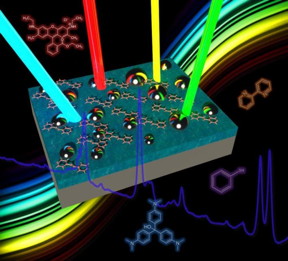 |
| The technology (depicted above) consists of a thin film of silver or aluminum that acts as a mirror, and a dielectric layer of silica or alumina. The dielectric separates the mirror with tiny metal nanoparticles randomly spaced at the top of the substrate. CREDIT: Qiaoqiang Gan. |
Abstract:
From airport security detecting explosives to art historians authenticating paintings, society's thirst for powerful sensors is growing.
New sensing tech could help detect diseases, fraudulent art, chemical weapons
Buffalo, NY | Posted on June 1st, 2015Given that, few sensing techniques can match the buzz created by surface-enhanced Raman spectroscopy (SERS).
Discovered in the 1970s, SERS is a sensing technique prized for its ability to identify chemical and biological molecules in a wide range of fields. It has been commercialized, but not widely, because the materials required to perform the sensing are consumed upon use, relatively expensive and complicated to fabricate.
That may soon change.
An international research team led by University at Buffalo engineers has developed nanotechnology that promises to make SERS simpler and more affordable.
Described in a research paper published today in the journal Advanced Materials Interfaces, the photonics advancement aims to improve our ability to detect trace amounts of molecules in diseases, chemical warfare agents, fraudulent paintings, environmental contaminants and more.
"The technology we're developing - a universal substrate for SERS - is a unique and, potentially, revolutionary feature. It allows us to rapidly identify and measure chemical and biological molecules using a broadband nanostructure that traps wide range of light," said Qiaoqiang Gan, UB assistant professor of electrical engineering and the study's lead author.
Additional authors of the study are: UB PhD candidates in electrical engineering Nan Zhang, Kai Liu, Haomin Song, Xie Zeng, Dengxin Ji and Alec Cheney; and Suhua Jiang, associate professor of materials science, and Zhejun Liu, PhD candidate, both at Fudan University in China.
When a powerful laser interacts chemical and biological molecules, the process can excite vibrational modes of these molecules and produce inelastic scattering, also called Raman scattering, of light. As the beam hits these molecules, it can produce photons that have a different frequency from the laser light. While rich in details, the signal from scattering is weak and difficult to read without a very powerful laser.
SERS addresses the problem by utilizing a nanopatterned substrate that significantly enhances the light field at the surface and, therefore, the Raman scattering intensity. Unfortunately, traditional substrates are typically designed for only a very narrow range of wavelengths.
This is problematic because different substrates are needed if scientists want to use a different laser to test the same molecules. In turn, this requires more chemical molecules and substrates, increasing costs and time to perform the test.
The universal substrate solves the problem because it can trap a wide range of wavelengths and squeeze them into very small gaps to create a strongly enhanced light field.
The technology consists of a thin film of silver or aluminum that acts as a mirror, and a dielectric layer of silica or alumina. The dielectric separates the mirror with tiny metal nanoparticles randomly spaced at the top of the substrate.
"It acts similar to a skeleton key. Instead of needing all these different substrates to measure Raman signals excited by different wavelengths, you'll eventually need just one. Just like a skeleton key that opens many doors," Zhang said.
"The applications of such a device are far-reaching," said Kai Liu. "The ability to detect even smaller amounts of chemical and biological molecules could be helpful with biosensors that are used to detect cancer, Malaria, HIV and other illnesses."
It could be useful identifying chemicals used in certain types of paint. This could be helpful detecting forged pieces of art as well as restoring aging pieces of art. Also, the technology could improve scientists' ability to detect trace amounts of toxins in the air, water or other spaces that are causes for health concerns. And it could aid in the detection of chemical weapons.
The National Science Foundation supported the research in a grant to develop a real-time in-vivo biosensing system. Gan shares the grant with Josep M. Jornet and Zhi Sun, both assistant professors of electrical engineering at UB.
####
For more information, please click here
Contacts:
Cory Nealon
716-645-4614
Copyright © University at Buffalo
If you have a comment, please Contact us.Issuers of news releases, not 7th Wave, Inc. or Nanotechnology Now, are solely responsible for the accuracy of the content.
Bookmark:


| Related News Press |
News and information
 Quantum computer improves AI predictions April 17th, 2026
Flexible sensor gains sensitivity under pressure April 17th, 2026
A reusable chip for particulate matter sensing April 17th, 2026
Detecting vibrational quantum beating in the predissociation dynamics of SF6 using time-resolved photoelectron spectroscopy April 17th, 2026
Law enforcement/Anti-Counterfeiting/Security/Loss prevention
Chainmail-like material could be the future of armor: First 2D mechanically interlocked polymer exhibits exceptional flexibility and strength January 17th, 2025
With VECSELs towards the quantum internet Fraunhofer: IAF achieves record output power with VECSEL for quantum frequency converters April 5th, 2024
Researchers’ approach may protect quantum computers from attacks March 8th, 2024
Govt.-Legislation/Regulation/Funding/Policy
Quantum computer improves AI predictions April 17th, 2026
Metasurfaces smooth light to boost magnetic sensing precision January 30th, 2026
New imaging approach transforms study of bacterial biofilms August 8th, 2025
Nanomedicine
A fundamentally new therapeutic approach to cystic fibrosis: Nanobody repairs cellular defect April 17th, 2026
New molecular technology targets tumors and simultaneously silences two ‘undruggable’ cancer genes August 8th, 2025
New imaging approach transforms study of bacterial biofilms August 8th, 2025
Electrifying results shed light on graphene foam as a potential material for lab grown cartilage June 6th, 2025
Sensors
Flexible sensor gains sensitivity under pressure April 17th, 2026
Tiny nanosheets, big leap: A new sensor detects ethanol at ultra-low levels January 30th, 2026
From sensors to smart systems: the rise of AI-driven photonic noses January 30th, 2026
Sensors innovations for smart lithium-based batteries: advancements, opportunities, and potential challenges August 8th, 2025
Discoveries
Quantum computer improves AI predictions April 17th, 2026
Flexible sensor gains sensitivity under pressure April 17th, 2026
A reusable chip for particulate matter sensing April 17th, 2026
Detecting vibrational quantum beating in the predissociation dynamics of SF6 using time-resolved photoelectron spectroscopy April 17th, 2026
Announcements
A fundamentally new therapeutic approach to cystic fibrosis: Nanobody repairs cellular defect April 17th, 2026
UC Irvine physicists discover method to reverse ‘quantum scrambling’ : The work addresses the problem of information loss in quantum computing system April 17th, 2026
Interviews/Book Reviews/Essays/Reports/Podcasts/Journals/White papers/Posters
A fundamentally new therapeutic approach to cystic fibrosis: Nanobody repairs cellular defect April 17th, 2026
UC Irvine physicists discover method to reverse ‘quantum scrambling’ : The work addresses the problem of information loss in quantum computing system April 17th, 2026
Tools
Metasurfaces smooth light to boost magnetic sensing precision January 30th, 2026
From sensors to smart systems: the rise of AI-driven photonic noses January 30th, 2026
Japan launches fully domestically produced quantum computer: Expo visitors to experience quantum computing firsthand August 8th, 2025
Homeland Security
The picture of health: Virginia Tech researchers enhance bioimaging and sensing with quantum photonics June 30th, 2023
Sensors developed at URI can identify threats at the molecular level: More sensitive than a dog's nose and the sensors don't get tired May 21st, 2021
Highly sensitive dopamine detector uses 2D materials August 7th, 2020
Military
Quantum engineers ‘squeeze’ laser frequency combs to make more sensitive gas sensors January 17th, 2025
Chainmail-like material could be the future of armor: First 2D mechanically interlocked polymer exhibits exceptional flexibility and strength January 17th, 2025
Single atoms show their true color July 5th, 2024
NRL charters Navy’s quantum inertial navigation path to reduce drift April 5th, 2024
Environment
A reusable chip for particulate matter sensing April 17th, 2026
Researchers unveil a groundbreaking clay-based solution to capture carbon dioxide and combat climate change June 6th, 2025
Human Interest/Art
New 2D multifractal tools delve into Pollock's expressionism January 17th, 2025
Drawing data in nanometer scale September 30th, 2022
Scientists prepare for the world’s smallest race: Nanocar Race II March 18th, 2022
Graphene nanotubes revolutionize touch screen use for prosthetic hands August 3rd, 2021
 |
||
 |
||
| The latest news from around the world, FREE | ||
 |
||
|
|
||
| Premium Products | ||
 |
||
|
Only the news you want to read!
Learn More |
||
 |
||
|
Full-service, expert consulting
Learn More |
||
|
|
||