Home > Press > Graphite + water = the future of energy storage
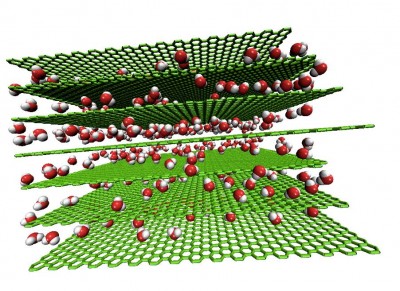 |
| Graphene sheets. Credit: Gengping Jiang |
Abstract:
A combination of two ordinary materials - graphite and water - could produce energy storage systems that perform on par with lithium ion batteries, but recharge in a matter of seconds and have an almost indefinite lifespan.
Graphite + water = the future of energy storage
Melbourne, Australia | Posted on July 15th, 2011Dr Dan Li, of the Monash University Department of Materials Engineering, and his research team have been working with a material called graphene, which could form the basis of the next generation of ultrafast energy storage systems.
"Once we can properly manipulate this material, your iPhone, for example, could charge in a few seconds, or possibly faster." said Dr Li.
Graphene is the result of breaking down graphite, a cheap, readily available material commonly used in pencils, into layers one atom thick. In this form, it has remarkable properties.
Graphene is strong, chemically stable, an excellent conductor of electricity and, importantly, has an extremely high surface area.
Dr Li said these qualities make graphene highly suitable for energy storage applications.
"The reason graphene isn't being used everywhere is that these very thin sheets, when stacked into a usable macrostructure, immediately bond together, reforming graphite. When graphene restacks, most of the surface area is lost and it doesn't behave like graphene anymore."
Now, Dr Li and his team have discovered the key to maintaining the remarkable properties of separate graphene sheets: water. Keeping graphene moist - in gel form - provides repulsive forces between the sheets and prevents re-stacking, making it ready for real-world application.
"The technique is very simple and can easily be scaled up. When we discovered it, we thought it was unbelievable. We're taking two basic, inexpensive materials - water and graphite - and making this new nanomaterial with amazing properties," said Dr Li.
When used in energy devices, graphene gel significantly outperforms current carbon-based technology, both in terms of the amount of charge stored and how fast the charges can be delivered.
Dr Li said the benefits of developing this new nanotechnology extend beyond consumer electronics.
"High-speed, reliable and cost-effective energy storage systems are critical for the future viability of electricity from renewable resources. These systems are also the key to large-scale adoption of electrical vehicles.
"Graphene gel is also showing promise for use in water purification membranes, biomedical devices and sensors."
Dr Li has been working with graphene since 2006 and his team's research findings have recently been published in a number of prestigious journals including Advanced Materials, Angewandte Chemie and Chemical Communications.
####
For more information, please click here
Contacts:
Telephone +61 3 9903 4840
Email:
Copyright © Monash University
If you have a comment, please Contact us.Issuers of news releases, not 7th Wave, Inc. or Nanotechnology Now, are solely responsible for the accuracy of the content.
Bookmark:


| Related News Press |
News and information
 Quantum computer improves AI predictions April 17th, 2026
Flexible sensor gains sensitivity under pressure April 17th, 2026
A reusable chip for particulate matter sensing April 17th, 2026
Detecting vibrational quantum beating in the predissociation dynamics of SF6 using time-resolved photoelectron spectroscopy April 17th, 2026
Graphene/ Graphite
Electrifying results shed light on graphene foam as a potential material for lab grown cartilage June 6th, 2025
Breakthrough in proton barrier films using pore-free graphene oxide: Kumamoto University researchers achieve new milestone in advanced coating technologies September 13th, 2024
Nanomedicine
A fundamentally new therapeutic approach to cystic fibrosis: Nanobody repairs cellular defect April 17th, 2026
New molecular technology targets tumors and simultaneously silences two ‘undruggable’ cancer genes August 8th, 2025
New imaging approach transforms study of bacterial biofilms August 8th, 2025
Electrifying results shed light on graphene foam as a potential material for lab grown cartilage June 6th, 2025
Sensors
Flexible sensor gains sensitivity under pressure April 17th, 2026
Tiny nanosheets, big leap: A new sensor detects ethanol at ultra-low levels January 30th, 2026
From sensors to smart systems: the rise of AI-driven photonic noses January 30th, 2026
Sensors innovations for smart lithium-based batteries: advancements, opportunities, and potential challenges August 8th, 2025
Discoveries
Quantum computer improves AI predictions April 17th, 2026
Flexible sensor gains sensitivity under pressure April 17th, 2026
A reusable chip for particulate matter sensing April 17th, 2026
Detecting vibrational quantum beating in the predissociation dynamics of SF6 using time-resolved photoelectron spectroscopy April 17th, 2026
Announcements
A fundamentally new therapeutic approach to cystic fibrosis: Nanobody repairs cellular defect April 17th, 2026
UC Irvine physicists discover method to reverse ‘quantum scrambling’ : The work addresses the problem of information loss in quantum computing system April 17th, 2026
Energy
Sensors innovations for smart lithium-based batteries: advancements, opportunities, and potential challenges August 8th, 2025
Simple algorithm paired with standard imaging tool could predict failure in lithium metal batteries August 8th, 2025
Water
Taking salt out of the water equation October 7th, 2022
Automotive/Transportation
Decoding hydrogen‑bond network of electrolyte for cryogenic durable aqueous zinc‑ion batteries January 30th, 2026
Sensors innovations for smart lithium-based batteries: advancements, opportunities, and potential challenges August 8th, 2025
Simple algorithm paired with standard imaging tool could predict failure in lithium metal batteries August 8th, 2025
Battery Technology/Capacitors/Generators/Piezoelectrics/Thermoelectrics/Energy storage
Decoding hydrogen‑bond network of electrolyte for cryogenic durable aqueous zinc‑ion batteries January 30th, 2026
COF scaffold membrane with gate‑lane nanostructure for efficient Li+/Mg2+ separation January 30th, 2026
MXene nanomaterials enter a new dimension Multilayer nanomaterial: MXene flakes created at Drexel University show new promise as 1D scrolls January 30th, 2026
 |
||
 |
||
| The latest news from around the world, FREE | ||
 |
||
|
|
||
| Premium Products | ||
 |
||
|
Only the news you want to read!
Learn More |
||
 |
||
|
Full-service, expert consulting
Learn More |
||
|
|
||