Home > Press > Piecework at the nano assembly line: Electric fields drive nano-motors a 100,000 times faster than previous methods
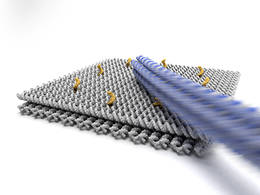 |
| Scientists at the Technical University of Munich (TUM) have developed a novel electric propulsion technology for nanorobots. Electric fields drive molecular machines to move a hundred thousand times faster than with the biochemical processes used to date. This makes nanorobots fast enough to do assembly line work in future molecular factories. CREDIT Enzo Kopperger / TUM |
Abstract:
Scientists at the Technical University of Munich (TUM) have developed a novel electric propulsion technology for nanorobots. It allows molecular machines to move a hundred thousand times faster than with the biochemical processes used to date. This makes nanobots fast enough to do assembly line work in molecular factories. The new research results appeared today as the cover story in the renowned scientific journal Science.
Piecework at the nano assembly line: Electric fields drive nano-motors a 100,000 times faster than previous methods
Munich, Germany | Posted on January 22nd, 2018Up and down, up and down. The points of light alternate back and forth in lockstep. They are produced by glowing molecules affixed to the ends of tiny robot arms. Prof. Friedrich Simmel observes the movement of the nanomachines on the monitor of a fluorescence microscope. A simple mouse click is all it takes for the points of light to move in another direction.
"By applying electric fields, we can arbitrarily rotate the arms in a plane," explains the head of the Chair of Physics of Synthetic Biological Systems at TU Munich. His team has for the first time managed to control nanobots electrically and has at the same time set a record: The new technique is 100 000 times faster than all previous methods.
DNA-Origami robots for the manufacturing plants of tomorrow
Scientists around the world are working on new technologies for the nanofactories of the future. They hope these will one day be used to analyse biochemical samples or produce active medical agents. The required miniature machines can already be produced cost-effectively using the DNA-origami technique.
One reason these molecular machines have not been deployed on a large scale to date is that they are too slow. The building blocks are activated with enzymes, strands of DNA or light to then perform specific tasks, for example to gather and transport molecules.
However, traditional nanobots take minutes to carry out these actions, sometimes even hours. Therefore, efficient molecular assembly lines cannot, for all practical intents and purposes, be implemented using these methodologies.
Electronic speed boost
"Building up a nanotechnological assembly line calls for a different kind of propulsion technology. We came up with the idea of dropping biochemical nanomachine switching completely in favour of the interactions between DNA structures and electric fields," explains TUM researcher Simmel, who is also the co-coordinator of the Excellence Cluster Nanosystems Initiative Munich (NIM).
The principle behind the propulsion technology is simple: DNA molecules have negative charges. The biomolecules can thus be moved by applying electric fields. Theoretically, this should allow nanobots made of DNA to be steered using electrical fields.
Robotic movement under the microscope
To determine whether and how fast the robot arms would line up with an electric field, the researchers affixed several million nanobot arms to a glass substrate and placed this into a sample holder with electrical contacts designed specifically for the purpose.
Each of the miniature machines produced by the lead author Enzo Kopperger comprises a 400 nanometer arm attached to a rigid 55 by 55 nanometer base plate with a flexible joint made of unpaired bases. This construction ensures that the arms can rotate arbitrarily in the horizontal plane.
In collaboration with fluorescence specialists headed by Prof. Don C. Lamb of the Ludwig Maximillians University Munich, the researchers marked the tips of the robot arms using dye molecules. They observed their motion using a fluorescence microscope. They then changed the direction of the electric field. This allowed the researchers to arbitrarily alter the orientation of the arms and control the locomotion process.
"The experiment demonstrated that molecular machines can be moved, and thus also driven electrically," says Simmel. "Thanks to the electronic control process, we can now initiate movements on a millisecond time scale and are thus 100 000 times faster than with previously used biochemical approaches."
On the road to a nanofactory
The new control technology is suited not only for moving around dye molecules and nanoparticles. The arms of the miniature robots can also apply force to molecules. These interactions can be utilized for diagnostics and in pharmaceutical development, emphasizes Simmel. "Nanobots are small and economical. Millions of them could work in parallel to look for specific substances in samples or to synthesize complex molecules - not unlike an assembly line.
###
The research was funded by the Collaborative Research Program SFB 1032 "Nanoagents" by the German Research Foundation and the International Graduate School of Science and Engineering at TUM, as well as the Center for Nano Science and the BioImaging Network at the Ludwig Maximillians University in Munich.
####
For more information, please click here
Contacts:
Dr. Andreas Battenberg
49-892-891-0510
Copyright © Technical University of Munich (TUM)
If you have a comment, please Contact us.Issuers of news releases, not 7th Wave, Inc. or Nanotechnology Now, are solely responsible for the accuracy of the content.
Bookmark:


| Related Links |
| Related News Press |
News and information
 Quantum computer improves AI predictions April 17th, 2026
Flexible sensor gains sensitivity under pressure April 17th, 2026
A reusable chip for particulate matter sensing April 17th, 2026
Detecting vibrational quantum beating in the predissociation dynamics of SF6 using time-resolved photoelectron spectroscopy April 17th, 2026
Imaging
Simple algorithm paired with standard imaging tool could predict failure in lithium metal batteries August 8th, 2025
First real-time observation of two-dimensional melting process: Researchers at Mainz University unveil new insights into magnetic vortex structures August 8th, 2025
New imaging approach transforms study of bacterial biofilms August 8th, 2025
Videos/Movies
ICFO researchers overcome long-standing bottleneck in single photon detection with twisted 2D materials August 8th, 2025
Nanofabrication
Self-propelled protein-based nanomotors for enhanced cancer therapy by inducing ferroptosis June 6th, 2025
Multiphoton polymerization: A promising technology for precision medicine February 28th, 2025
New chip opens door to AI computing at light speed February 16th, 2024
Researchers develop technique to synthesize water-soluble alloy nanoclusters January 12th, 2024
Robotics
Nanofibrous metal oxide semiconductor for sensory face November 8th, 2024
Govt.-Legislation/Regulation/Funding/Policy
Quantum computer improves AI predictions April 17th, 2026
Metasurfaces smooth light to boost magnetic sensing precision January 30th, 2026
New imaging approach transforms study of bacterial biofilms August 8th, 2025
Possible Futures
A fundamentally new therapeutic approach to cystic fibrosis: Nanobody repairs cellular defect April 17th, 2026
UC Irvine physicists discover method to reverse ‘quantum scrambling’ : The work addresses the problem of information loss in quantum computing system April 17th, 2026
Molecular Machines
First electric nanomotor made from DNA material: Synthetic rotary motors at the nanoscale perform mechanical work July 22nd, 2022
Nanotech scientists create world's smallest origami bird March 17th, 2021
Giant nanomachine aids the immune system: Theoretical chemistry August 28th, 2020
Molecular Nanotechnology
Quantum pumping in molecular junctions August 16th, 2024
Scientists push the boundaries of manipulating light at the submicroscopic level March 3rd, 2023
First electric nanomotor made from DNA material: Synthetic rotary motors at the nanoscale perform mechanical work July 22nd, 2022
Discoveries
Quantum computer improves AI predictions April 17th, 2026
Flexible sensor gains sensitivity under pressure April 17th, 2026
A reusable chip for particulate matter sensing April 17th, 2026
Detecting vibrational quantum beating in the predissociation dynamics of SF6 using time-resolved photoelectron spectroscopy April 17th, 2026
Announcements
A fundamentally new therapeutic approach to cystic fibrosis: Nanobody repairs cellular defect April 17th, 2026
UC Irvine physicists discover method to reverse ‘quantum scrambling’ : The work addresses the problem of information loss in quantum computing system April 17th, 2026
Interviews/Book Reviews/Essays/Reports/Podcasts/Journals/White papers/Posters
A fundamentally new therapeutic approach to cystic fibrosis: Nanobody repairs cellular defect April 17th, 2026
UC Irvine physicists discover method to reverse ‘quantum scrambling’ : The work addresses the problem of information loss in quantum computing system April 17th, 2026
Tools
Metasurfaces smooth light to boost magnetic sensing precision January 30th, 2026
From sensors to smart systems: the rise of AI-driven photonic noses January 30th, 2026
Japan launches fully domestically produced quantum computer: Expo visitors to experience quantum computing firsthand August 8th, 2025
 |
||
 |
||
| The latest news from around the world, FREE | ||
 |
||
|
|
||
| Premium Products | ||
 |
||
|
Only the news you want to read!
Learn More |
||
 |
||
|
Full-service, expert consulting
Learn More |
||
|
|
||