Home > Press > Nanofibrous metal oxide semiconductor for sensory face
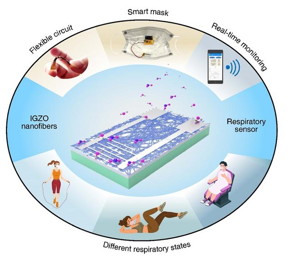 |
| IGZO nanofibre-based sensors are integrated with a flexible circuit to create a sensory face mask, thus featuring wireless and real-time monitoring capabilities. Credit Qing, M., et al. |
Abstract:
Room-temperature (RT) gas sensors with high sensitivity are essential in low-power Internet-of-Things (IoT) applications, such as smart sensors, wearable devices and mobile robots. Among these, metal oxide semiconductor-based gas sensors are valued for their low production cost, high sensitivity and ease of use, making them suitable for detecting flammable, explosive, toxic, and exhaled gases. However, further fiber diameter reduction and real-time monitoring integration remain underexplored.
Nanofibrous metal oxide semiconductor for sensory face
Beijing, China | Posted on November 8th, 2024In a study published in the KeAi journal Wearable Electronics, a group of researchers from China and South Korea described a new sensor they have developed — ultrathin (~88 nm) amorphous indium gallium zinc oxide (IGZO) nanofibres for wireless and real-time human breath monitoring.
"IGZO nanofibres were created as the charge transport layer to enhance the surface area for gas diffusion using an electrospinning approach,” explains the study's lead author, Qing Ma, a post-doctoral fellow at the School of Electronic Science and Engineering at Southeast University. “The resulting field-effect properties demonstrated an average mobility of 2.2 cm²/V·s and an on/off ratio of 10⁵.”
Notably, the team successfully recorded human breath in fast, normal and deep states, showing the sensor’s fast response and recovery times and stable operation. “By integrating the sensor with a flexible circuit board and mounting them on a face mask, we achieved wireless and real-time monitoring of respiratory status, highlighting its potential for practical applications in health monitoring,” says Ma.
The researchers also found that electrical transport in IGZO nanofibres is driven by oxygen vacancies, water vapor and temperature significantly affect its conductivity. When a voltage is applied, the sensor’s current significantly decreases and quickly recovers during a breath cycle, with a fast response and recovery time of approximately 0.7 seconds.
According to senior and co-corresponding author Binghao Wang, this is a promising solution in the field of personalised healthcare and pandemic prevention.
“An IGZO NF-based sensor integrated into a flexible circuit achieved a compact size of 15 × 35 mm², marking significant progress in the miniaturisation efforts for smart mask technology,” says Wang. “The recorded electrical signals can be visualised via a smartphone equipped with a customised mobile app, underscoring the potential for the widespread adoption of IGZO TFT-based sensors in wearable technology."
####
About KeAi Communications Co., Ltd.
The publisher KeAi was established by Elsevier and China Science Publishing & Media Ltd to unfold quality research globally. In 2013, our focus shifted to open access publishing. We now proudly publish more than 100 world-class, open access, English language journals, spanning all scientific disciplines. Many of these are titles we publish in partnership with prestigious societies and academic institutions, such as the National Natural Science Foundation of China (NSFC).
For more information, please click here
Contacts:
Ye He
KeAi Communications Co., Ltd.
Office: 521-098-1577
Contact the author: Binghao Wang, School of Electronic Science and Engineering, Southeast University, No. 2 Southeast University Road, Jiangning, Nanjing, Jiangsu 211189, China.
Haoyang Wang, School of Electronic Science and Engineering, Southeast University, No. 2 Southeast University Road, Jiangning, Nanjing, Jiangsu 211189, China.
Copyright © KeAi Communications Co., Ltd.
If you have a comment, please Contact us.Issuers of news releases, not 7th Wave, Inc. or Nanotechnology Now, are solely responsible for the accuracy of the content.
Bookmark:


| Related Links |
| Related News Press |
News and information
 Quantum computer improves AI predictions April 17th, 2026
Flexible sensor gains sensitivity under pressure April 17th, 2026
A reusable chip for particulate matter sensing April 17th, 2026
Detecting vibrational quantum beating in the predissociation dynamics of SF6 using time-resolved photoelectron spectroscopy April 17th, 2026
Wearable electronics
Breakthrough brings body-heat powered wearable devices closer to reality December 13th, 2024
Beyond wires: Bubble technology powers next-generation electronics:New laser-based bubble printing technique creates ultra-flexible liquid metal circuits November 8th, 2024
CityU awarded invention: Soft, ultrathin photonic material cools down wearable electronic devices June 30th, 2023
Robotics
Femtosecond laser technique births "dancing microrobots": USTC's breakthrough in multi-material microfabrication August 11th, 2023
Internet-of-Things
New nanowire sensors are the next step in the Internet of Things January 6th, 2023
New chip ramps up AI computing efficiency August 19th, 2022
Lightening up the nanoscale long-wavelength optoelectronics May 13th, 2022
Thin-film, high-frequency antenna array offers new flexibility for wireless communications November 5th, 2021
Possible Futures
A fundamentally new therapeutic approach to cystic fibrosis: Nanobody repairs cellular defect April 17th, 2026
UC Irvine physicists discover method to reverse ‘quantum scrambling’ : The work addresses the problem of information loss in quantum computing system April 17th, 2026
Chip Technology
A reusable chip for particulate matter sensing April 17th, 2026
Metasurfaces smooth light to boost magnetic sensing precision January 30th, 2026
Sensors
Flexible sensor gains sensitivity under pressure April 17th, 2026
Tiny nanosheets, big leap: A new sensor detects ethanol at ultra-low levels January 30th, 2026
From sensors to smart systems: the rise of AI-driven photonic noses January 30th, 2026
Sensors innovations for smart lithium-based batteries: advancements, opportunities, and potential challenges August 8th, 2025
Discoveries
Quantum computer improves AI predictions April 17th, 2026
Flexible sensor gains sensitivity under pressure April 17th, 2026
A reusable chip for particulate matter sensing April 17th, 2026
Detecting vibrational quantum beating in the predissociation dynamics of SF6 using time-resolved photoelectron spectroscopy April 17th, 2026
Announcements
A fundamentally new therapeutic approach to cystic fibrosis: Nanobody repairs cellular defect April 17th, 2026
UC Irvine physicists discover method to reverse ‘quantum scrambling’ : The work addresses the problem of information loss in quantum computing system April 17th, 2026
Interviews/Book Reviews/Essays/Reports/Podcasts/Journals/White papers/Posters
A fundamentally new therapeutic approach to cystic fibrosis: Nanobody repairs cellular defect April 17th, 2026
UC Irvine physicists discover method to reverse ‘quantum scrambling’ : The work addresses the problem of information loss in quantum computing system April 17th, 2026
 |
||
 |
||
| The latest news from around the world, FREE | ||
 |
||
|
|
||
| Premium Products | ||
 |
||
|
Only the news you want to read!
Learn More |
||
 |
||
|
Full-service, expert consulting
Learn More |
||
|
|
||