Home > Press > UCLA chemists synthesize narrow ribbons of graphene using only light and heat: Tiny structures could be next-generation solution for smaller electronic devices
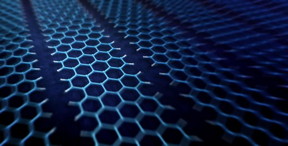 |
| Illustration of the molecular structure of the graphene nanoribbons prepared by UCLA chemistry professor Yves Rubin and colleagues. CREDIT Courtesy of Yves Rubin |
Abstract:
Silicon -- the shiny, brittle metal commonly used to make semiconductors -- is an essential ingredient of modern-day electronics. But as electronic devices have become smaller and smaller, creating tiny silicon components that fit inside them has become more challenging and more expensive.
UCLA chemists synthesize narrow ribbons of graphene using only light and heat: Tiny structures could be next-generation solution for smaller electronic devices
Los Angeles, CA | Posted on December 8th, 2017Now, UCLA chemists have developed a new method to produce nanoribbons of graphene, next-generation structures that many scientists believe will one day power electronic devices.
This research is published online in the Journal of the American Chemical Society.
The nanoribbons are extremely narrow strips of graphene, the width of just a few carbon atoms. They're useful because they possess a bandgap, which means that electrons must be "pushed" to flow through them to create electrical current, said Yves Rubin, a professor of chemistry in the UCLA College and the lead author of the research.
"A material that has no bandgap lets electrons flow through unhindered and cannot be used to build logic circuits," he said.
Rubin and his research team constructed graphene nanoribbons molecule by molecule using a simple reaction based on ultraviolet light and exposure to 600-degree heat.
"Nobody else has been able to do that, but it will be important if one wants to build these molecules on an industrial scale," said Rubin, who also is a member of the California NanoSystems Institute at UCLA.
The process improves upon other existing methods for creating graphene nanoribbons, one of which involves snipping open tubes of graphene known as carbon nanotubes. That particular approach is imprecise and produces ribbons of inconsistent sizes -- a problem because the value of a nanoribbon's bandgap depends on its width, Rubin said.
To create the nanoribbons, the scientists started by growing crystals of four different colorless molecules. The crystals locked the molecules into the perfect orientation to react, and the team then used light to stitch the molecules into polymers, which are large structures made of repeating units of carbon and hydrogen atoms.
The scientists then placed the shiny, deep blue polymers in an oven containing only argon gas and heated them to 600 degrees Celsius. The heat provided the necessary boost of energy for the polymers to form the final bonds that gave the nanoribbons their final shape: hexagonal rings composed of carbon atoms, and hydrogen atoms along the edges of the ribbons.
"We're essentially charring the polymers, but we're doing it in a controlled way," Rubin said.
The process, which took about an hour, yielded graphene nanoribbons just eight carbon atoms wide but thousands of atoms long. The scientists verified the molecular structure of the nanoribbons, which were deep black in color and lustrous, by shining light of different wavelengths at them.
"We looked at what wavelengths of light were absorbed," Rubin said. "This reveals signatures of the structure and composition of the ribbons."
The researchers have filed a patent application for the process.
Rubin said the team now is studying how to better manipulate the nanoribbons -- a challenge because they tend to stick together.
"Right now, they are bundles of fibers," Rubin said. "The next step will be able to handle each nanoribbon one by one."
###
The study's co-authors include Richard Kaner, a UCLA distinguished professor of chemistry and biochemistry, and of materials science and engineering; Kendall Houk, UCLA's Saul Winstein Professor of Organic Chemistry; Robert Jordan, a former UCLA graduate student; UCLA graduate students Yolanda Li, Cheng-Wei Lin, Janice Lin and Kris Marsh; and Ryan McCurdy, a UCLA undergraduate student.
The research was funded by the National Science Foundation.
####
For more information, please click here
Contacts:
Stuart Wolpert
310-206-0511
Copyright © University of California - Los Angeles
If you have a comment, please Contact us.Issuers of news releases, not 7th Wave, Inc. or Nanotechnology Now, are solely responsible for the accuracy of the content.
Bookmark:


| Related News Press |
News and information
 Quantum computer improves AI predictions April 17th, 2026
Flexible sensor gains sensitivity under pressure April 17th, 2026
A reusable chip for particulate matter sensing April 17th, 2026
Detecting vibrational quantum beating in the predissociation dynamics of SF6 using time-resolved photoelectron spectroscopy April 17th, 2026
Chemistry
Projecting light to dispense liquids: A new route to ultra-precise microdroplets January 30th, 2026
From sensors to smart systems: the rise of AI-driven photonic noses January 30th, 2026
"Nanoreactor" cage uses visible light for catalytic and ultra-selective cross-cycloadditions October 3rd, 2025
Cambridge chemists discover simple way to build bigger molecules – one carbon at a time June 6th, 2025
Single-atom catalysts change spin state when boosted by a magnetic field June 4th, 2025
Graphene/ Graphite
Electrifying results shed light on graphene foam as a potential material for lab grown cartilage June 6th, 2025
Breakthrough in proton barrier films using pore-free graphene oxide: Kumamoto University researchers achieve new milestone in advanced coating technologies September 13th, 2024
Hardware
The present and future of computing get a boost from new research July 21st, 2023
A Carbon Nanotube Microprocessor Mature Enough to Say Hello: Three new breakthroughs make commercial nanotube processors possible March 2nd, 2020
Powering the future: Smallest all-digital circuit opens doors to 5 nm next-gen semiconductor February 11th, 2020
Possible Futures
A fundamentally new therapeutic approach to cystic fibrosis: Nanobody repairs cellular defect April 17th, 2026
UC Irvine physicists discover method to reverse ‘quantum scrambling’ : The work addresses the problem of information loss in quantum computing system April 17th, 2026
Chip Technology
A reusable chip for particulate matter sensing April 17th, 2026
Metasurfaces smooth light to boost magnetic sensing precision January 30th, 2026
Discoveries
Quantum computer improves AI predictions April 17th, 2026
Flexible sensor gains sensitivity under pressure April 17th, 2026
A reusable chip for particulate matter sensing April 17th, 2026
Detecting vibrational quantum beating in the predissociation dynamics of SF6 using time-resolved photoelectron spectroscopy April 17th, 2026
Announcements
A fundamentally new therapeutic approach to cystic fibrosis: Nanobody repairs cellular defect April 17th, 2026
UC Irvine physicists discover method to reverse ‘quantum scrambling’ : The work addresses the problem of information loss in quantum computing system April 17th, 2026
Interviews/Book Reviews/Essays/Reports/Podcasts/Journals/White papers/Posters
A fundamentally new therapeutic approach to cystic fibrosis: Nanobody repairs cellular defect April 17th, 2026
UC Irvine physicists discover method to reverse ‘quantum scrambling’ : The work addresses the problem of information loss in quantum computing system April 17th, 2026
 |
||
 |
||
| The latest news from around the world, FREE | ||
 |
||
|
|
||
| Premium Products | ||
 |
||
|
Only the news you want to read!
Learn More |
||
 |
||
|
Full-service, expert consulting
Learn More |
||
|
|
||