Home > Press > Engineers create a better way to boil water -- with industrial, electronics applications
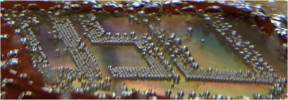 |
| Researchers at Oregon State University using new technology to control the formation and release of bubbles illustrate it with the letters "OSU" being printed on a substrate. CREDIT: Oregon State University |
Abstract:
Engineers at Oregon State University have found a new way to induce and control boiling bubble formation, that may allow everything from industrial-sized boilers to advanced electronics to work better and last longer.
Engineers create a better way to boil water -- with industrial, electronics applications
Corvallis, OR | Posted on May 5th, 2016Advances in this technology have been published in Scientific Reports and a patent application filed.
The concept could be useful in two ways, researchers say - either to boil water and create steam more readily, like in a boiler or a clothing iron; or with a product such as an electronics device to release heat more readily while working at a cooler temperature.
"One of the key limitations for electronic devices is the heat they generate, and something that helps dissipate that heat will help them operate at faster speeds and prevent failure," said Chih-hung Chang, a professor of electrical engineering in the OSU College of Engineering. "The more bubbles you can generate, the more cooling you can achieve.
"On the other hand, if you want to create steam at a lower surface temperature, this approach should be very useful in boilers and improve their efficiency. We've already shown that it can be done on large surfaces and should be able to scale up in size to commercial use."
The new approach is based on the use of piezoelectric inkjet printing to create hydrophobic polymer "dots" on a substrate, and then deposit a hydrophilic zinc oxide nanostructure on top of that. The zinc oxide nanostructure only grows in the area without dots. By controlling both the hydrophobic and hydrophilic structure of the material, bubble formation can be precisely controlled and manipulated for the desired goal.
This technology allows researchers to control both boiling and condensation processes, as well as spatial bubble nucleation sites, bubble onset and departure frequency, heat transfer coefficient and critical heat flux for the first time.
In electronics, engineers say this technology may have applications with some types of solar energy, advanced lasers, radars, and power electronics - anywhere it's necessary to dissipate high heat levels.
In industry, a significant possibility is more efficient operation of the steam boilers used to produce electricity in large electric generating facilities.
###
This work was supported by the OSU Venture Development Fund and the Scalable Nanomanufacturing Program of the National Science Foundation.
####
For more information, please click here
Contacts:
Chih-hung Chang
541-737-8548
Copyright © Oregon State University
If you have a comment, please Contact us.Issuers of news releases, not 7th Wave, Inc. or Nanotechnology Now, are solely responsible for the accuracy of the content.
Bookmark:


| Related News Press |
News and information
 Quantum computer improves AI predictions April 17th, 2026
Flexible sensor gains sensitivity under pressure April 17th, 2026
A reusable chip for particulate matter sensing April 17th, 2026
Detecting vibrational quantum beating in the predissociation dynamics of SF6 using time-resolved photoelectron spectroscopy April 17th, 2026
Hardware
The present and future of computing get a boost from new research July 21st, 2023
A Carbon Nanotube Microprocessor Mature Enough to Say Hello: Three new breakthroughs make commercial nanotube processors possible March 2nd, 2020
Powering the future: Smallest all-digital circuit opens doors to 5 nm next-gen semiconductor February 11th, 2020
Govt.-Legislation/Regulation/Funding/Policy
Quantum computer improves AI predictions April 17th, 2026
Metasurfaces smooth light to boost magnetic sensing precision January 30th, 2026
New imaging approach transforms study of bacterial biofilms August 8th, 2025
Possible Futures
A fundamentally new therapeutic approach to cystic fibrosis: Nanobody repairs cellular defect April 17th, 2026
UC Irvine physicists discover method to reverse ‘quantum scrambling’ : The work addresses the problem of information loss in quantum computing system April 17th, 2026
Chip Technology
A reusable chip for particulate matter sensing April 17th, 2026
Metasurfaces smooth light to boost magnetic sensing precision January 30th, 2026
Discoveries
Quantum computer improves AI predictions April 17th, 2026
Flexible sensor gains sensitivity under pressure April 17th, 2026
A reusable chip for particulate matter sensing April 17th, 2026
Detecting vibrational quantum beating in the predissociation dynamics of SF6 using time-resolved photoelectron spectroscopy April 17th, 2026
Announcements
A fundamentally new therapeutic approach to cystic fibrosis: Nanobody repairs cellular defect April 17th, 2026
UC Irvine physicists discover method to reverse ‘quantum scrambling’ : The work addresses the problem of information loss in quantum computing system April 17th, 2026
Interviews/Book Reviews/Essays/Reports/Podcasts/Journals/White papers/Posters
A fundamentally new therapeutic approach to cystic fibrosis: Nanobody repairs cellular defect April 17th, 2026
UC Irvine physicists discover method to reverse ‘quantum scrambling’ : The work addresses the problem of information loss in quantum computing system April 17th, 2026
Energy
Sensors innovations for smart lithium-based batteries: advancements, opportunities, and potential challenges August 8th, 2025
Simple algorithm paired with standard imaging tool could predict failure in lithium metal batteries August 8th, 2025
Water
Taking salt out of the water equation October 7th, 2022
Industrial
Tiny nanosheets, big leap: A new sensor detects ethanol at ultra-low levels January 30th, 2026
Quantum interference in molecule-surface collisions February 28th, 2025
Boron nitride nanotube fibers get real: Rice lab creates first heat-tolerant, stable fibers from wet-spinning process June 24th, 2022
 |
||
 |
||
| The latest news from around the world, FREE | ||
 |
||
|
|
||
| Premium Products | ||
 |
||
|
Only the news you want to read!
Learn More |
||
 |
||
|
Full-service, expert consulting
Learn More |
||
|
|
||