Home > Press > A small connection with big implications: Wiring up carbon-based electronics: Research carried out at UPV/EHU, DIPC and CNRS advances the understanding of electric contacts in future carbon-based nanoelectronics
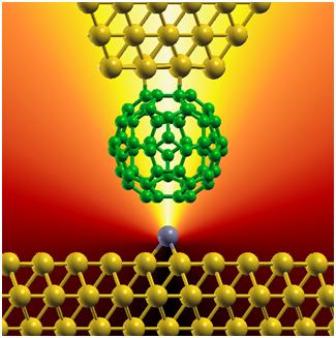 |
| Artistic view of an electric connection between a carbon-based "football" molecule and a single metallic atom (gray ball). The researchers were able to quantify how the current depends on the chemical nature of the contacting atom. |
Abstract:
Carbon-based nanostructures such as nanotubes, graphene sheets, and nanoribbons are unique building blocks showing versatile nanomechanical and nanoelectronic properties. These materials which are ordered in the nanoscale, that is, in the dimension of a millionth of millimetre, are promising candidates to envision applications in nanoscale devices, ranging from energy conversion to nano-electronic transistors. A good connection between carbon-based materials and external metallic leads is of major importance in nanodevice performance, an aspect where an important step has been surmounted by researchers from UPV/EHU, DIPC and CNRS by studying contacts of carbon nanostructures with atoms of different chemical nature.
A small connection with big implications: Wiring up carbon-based electronics: Research carried out at UPV/EHU, DIPC and CNRS advances the understanding of electric contacts in future carbon-based nanoelectronics
Alava, Spain | Posted on April 30th, 2014The chemical nature of contacting leads is of major importance as it affects the electronic properties and the geometry of the contact. The impact of these two aspects on the transport properties are entangled and this group studied these two parameters for contacts shrunk to the limit of individual atoms as for large structures it is challenging to address them separately.
In close collaboration, the researchers used a prototype carbon-based molecule made of 60 carbon atoms arranged in a sphere that can be viewed as a graphene sheet rolled into a tiny ball. The experimental team in Strasbourg led by Guillaume Schull, attached this molecule to the apex of an extremely tiny metal needle of a scanning tunnelling microscope. The molecule-terminated needle was then cautiously approached to individual metallic atoms of different chemical nature up to the formation of a robust connection. By simultaneously measuring the electrical current passing through these connections, they could deduce which of the individual metallic atom is injecting charges to the carbon-made molecule with the greatest efficiency.
Large-scale computer simulations performed by the theoretical team in San Sebastian led by Thomas Frederiksen, Ikerbasque Research Professor at the DIPC, revealed a fascinating and unexpected aspect of these extremely tiny connections: their electric and mechanical properties are in fact representative for much larger carbon-based materials.
These results, published in the prestigious journal Nature Communications, set the bases to find extremely efficient contacts in the near future. The study paves the way to probe a great number of different metallic species (as well as tiny alloys made of two or three different metallic atoms), allowing for a systematic classification of their abilities to inject electrons into emerging carbon-based electronic devices.
Full research publication (open access)
Chemical control of electrical contact to sp2 carbon atoms
T. Frederiksen, G. Foti, F. Scheurer, V. Speisser, & G. Schul. Nature Communications (2014).
DOI: 10.1038/ncomms4659
####
For more information, please click here
Contacts:
Thomas Frederiksen
34-635-811-640
Copyright © Universidad del País Vasco
If you have a comment, please Contact us.Issuers of news releases, not 7th Wave, Inc. or Nanotechnology Now, are solely responsible for the accuracy of the content.
Bookmark:


| Related News Press |
News and information
 Quantum computer improves AI predictions April 17th, 2026
Flexible sensor gains sensitivity under pressure April 17th, 2026
A reusable chip for particulate matter sensing April 17th, 2026
Detecting vibrational quantum beating in the predissociation dynamics of SF6 using time-resolved photoelectron spectroscopy April 17th, 2026
Chemistry
Projecting light to dispense liquids: A new route to ultra-precise microdroplets January 30th, 2026
From sensors to smart systems: the rise of AI-driven photonic noses January 30th, 2026
"Nanoreactor" cage uses visible light for catalytic and ultra-selective cross-cycloadditions October 3rd, 2025
Cambridge chemists discover simple way to build bigger molecules – one carbon at a time June 6th, 2025
Single-atom catalysts change spin state when boosted by a magnetic field June 4th, 2025
Graphene/ Graphite
Electrifying results shed light on graphene foam as a potential material for lab grown cartilage June 6th, 2025
Breakthrough in proton barrier films using pore-free graphene oxide: Kumamoto University researchers achieve new milestone in advanced coating technologies September 13th, 2024
Chip Technology
A reusable chip for particulate matter sensing April 17th, 2026
Metasurfaces smooth light to boost magnetic sensing precision January 30th, 2026
Nanotubes/Buckyballs/Fullerenes/Nanorods/Nanostrings/Nanosheets
Tiny nanosheets, big leap: A new sensor detects ethanol at ultra-low levels January 30th, 2026
Enhancing power factor of p- and n-type single-walled carbon nanotubes April 25th, 2025
Chainmail-like material could be the future of armor: First 2D mechanically interlocked polymer exhibits exceptional flexibility and strength January 17th, 2025
Innovative biomimetic superhydrophobic coating combines repair and buffering properties for superior anti-erosion December 13th, 2024
Nanoelectronics
Lab to industry: InSe wafer-scale breakthrough for future electronics August 8th, 2025
Interdisciplinary: Rice team tackles the future of semiconductors Multiferroics could be the key to ultralow-energy computing October 6th, 2023
Key element for a scalable quantum computer: Physicists from Forschungszentrum Jülich and RWTH Aachen University demonstrate electron transport on a quantum chip September 23rd, 2022
Reduced power consumption in semiconductor devices September 23rd, 2022
Discoveries
Quantum computer improves AI predictions April 17th, 2026
Flexible sensor gains sensitivity under pressure April 17th, 2026
A reusable chip for particulate matter sensing April 17th, 2026
Detecting vibrational quantum beating in the predissociation dynamics of SF6 using time-resolved photoelectron spectroscopy April 17th, 2026
Materials/Metamaterials/Magnetoresistance
First real-time observation of two-dimensional melting process: Researchers at Mainz University unveil new insights into magnetic vortex structures August 8th, 2025
Researchers unveil a groundbreaking clay-based solution to capture carbon dioxide and combat climate change June 6th, 2025
A 1960s idea inspires NBI researchers to study hitherto inaccessible quantum states June 6th, 2025
Institute for Nanoscience hosts annual proposal planning meeting May 16th, 2025
Announcements
A fundamentally new therapeutic approach to cystic fibrosis: Nanobody repairs cellular defect April 17th, 2026
UC Irvine physicists discover method to reverse ‘quantum scrambling’ : The work addresses the problem of information loss in quantum computing system April 17th, 2026
 |
||
 |
||
| The latest news from around the world, FREE | ||
 |
||
|
|
||
| Premium Products | ||
 |
||
|
Only the news you want to read!
Learn More |
||
 |
||
|
Full-service, expert consulting
Learn More |
||
|
|
||