Home > Press > Return on investment for kit and promotion materials
 |
| Your T-shirt?s ringing: telecommunications in the spaser age |
Abstract:
A new version of "spaser" technology being investigated could mean that mobile phones become so small, efficient, and flexible they could be printed on clothing.
Return on investment for kit and promotion materials
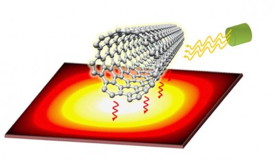
Clayton, Australia | Posted on April 24th, 2014A team of researchers from Monash University's Department of Electrical and Computer Systems Engineering (ECSE) has modelled the world's first spaser (surface plasmon amplification by stimulated emission of radiation) to be made completely of carbon.
A spaser is effectively a nanoscale laser or nanolaser. It emits a beam of light through the vibration of free electrons, rather than the space-consuming electromagnetic wave emission process of a traditional laser.
PhD student and lead researcher Chanaka Rupasinghe said the modelled spaser design using carbon would offer many advantages.
"Other spasers designed to date are made of gold or silver nanoparticles and semiconductor quantum dots while our device would be comprised of a graphene resonator and a carbon nanotube gain element," Chanaka said.
"The use of carbon means our spaser would be more robust and flexible, would operate at high temperatures, and be eco-friendly.
"Because of these properties, there is the possibility that in the future an extremely thin mobile phone could be printed on clothing."
Spaser-based devices can be used as an alternative to current transistor-based devices such as microprocessors, memory, and displays to overcome current miniaturising and bandwidth limitations.
The researchers chose to develop the spaser using graphene and carbon nanotubes. They are more than a hundred times stronger than steel and can conduct heat and electricity much better than copper. They can also withstand high temperatures.
Their research showed for the first time that graphene and carbon nanotubes can interact and transfer energy to each other through light. These optical interactions are very fast and energy-efficient, and so are suitable for applications such as computer chips.
"Graphene and carbon nanotubes can be used in applications where you need strong, lightweight, conducting, and thermally stable materials due to their outstanding mechanical, electrical and optical properties. They have been tested as nanoscale antennas, electric conductors and waveguides," Chanaka said.
Chanaka said a spaser generated high-intensity electric fields concentrated into a nanoscale space. These are much stronger than those generated by illuminating metal nanoparticles by a laser in applications such as cancer therapy.
"Scientists have already found ways to guide nanoparticles close to cancer cells. We can move graphene and carbon nanotubes following those techniques and use the high concentrate fields generated through the spasing phenomena to destroy individual cancer cells without harming the healthy cells in the body," Chanaka said
####
For more information, please click here
Contacts:
Glynis Smalley
61-408-027-848
Copyright © Monash University
If you have a comment, please Contact us.Issuers of news releases, not 7th Wave, Inc. or Nanotechnology Now, are solely responsible for the accuracy of the content.
Bookmark:


| Related Links |
 The paper has been published in ACS Nano:
| Related News Press |
News and information
Quantum computer improves AI predictions April 17th, 2026
Flexible sensor gains sensitivity under pressure April 17th, 2026
A reusable chip for particulate matter sensing April 17th, 2026
Detecting vibrational quantum beating in the predissociation dynamics of SF6 using time-resolved photoelectron spectroscopy April 17th, 2026
Graphene/ Graphite
Electrifying results shed light on graphene foam as a potential material for lab grown cartilage June 6th, 2025
Breakthrough in proton barrier films using pore-free graphene oxide: Kumamoto University researchers achieve new milestone in advanced coating technologies September 13th, 2024
Chip Technology
A reusable chip for particulate matter sensing April 17th, 2026
Metasurfaces smooth light to boost magnetic sensing precision January 30th, 2026
Nanotubes/Buckyballs/Fullerenes/Nanorods/Nanostrings/Nanosheets
Tiny nanosheets, big leap: A new sensor detects ethanol at ultra-low levels January 30th, 2026
Enhancing power factor of p- and n-type single-walled carbon nanotubes April 25th, 2025
Chainmail-like material could be the future of armor: First 2D mechanically interlocked polymer exhibits exceptional flexibility and strength January 17th, 2025
Innovative biomimetic superhydrophobic coating combines repair and buffering properties for superior anti-erosion December 13th, 2024
Nanomedicine
A fundamentally new therapeutic approach to cystic fibrosis: Nanobody repairs cellular defect April 17th, 2026
New molecular technology targets tumors and simultaneously silences two ‘undruggable’ cancer genes August 8th, 2025
New imaging approach transforms study of bacterial biofilms August 8th, 2025
Electrifying results shed light on graphene foam as a potential material for lab grown cartilage June 6th, 2025
Discoveries
Quantum computer improves AI predictions April 17th, 2026
Flexible sensor gains sensitivity under pressure April 17th, 2026
A reusable chip for particulate matter sensing April 17th, 2026
Detecting vibrational quantum beating in the predissociation dynamics of SF6 using time-resolved photoelectron spectroscopy April 17th, 2026
Announcements
A fundamentally new therapeutic approach to cystic fibrosis: Nanobody repairs cellular defect April 17th, 2026
UC Irvine physicists discover method to reverse ‘quantum scrambling’ : The work addresses the problem of information loss in quantum computing system April 17th, 2026
Interviews/Book Reviews/Essays/Reports/Podcasts/Journals/White papers/Posters
A fundamentally new therapeutic approach to cystic fibrosis: Nanobody repairs cellular defect April 17th, 2026
UC Irvine physicists discover method to reverse ‘quantum scrambling’ : The work addresses the problem of information loss in quantum computing system April 17th, 2026
Textiles/Clothing
Protective equipment with graphene nanotubes meets the strictest ESD safety standards March 25th, 2022
Polymer fibers with graphene nanotubes make it possible to heat hard-to-reach, complex-shaped items February 11th, 2022
Flexible material shows potential for use in fabrics to heat, cool July 3rd, 2020
Photonics/Optics/Lasers
Metasurfaces smooth light to boost magnetic sensing precision January 30th, 2026
From sensors to smart systems: the rise of AI-driven photonic noses January 30th, 2026
 |
||
 |
||
| The latest news from around the world, FREE | ||
 |
||
|
|
||
| Premium Products | ||
 |
||
|
Only the news you want to read!
Learn More |
||
 |
||
|
Full-service, expert consulting
Learn More |
||
|
|
||