Home > Press > MIT scientists observe single ions moving through tiny carbon-nanotube channel
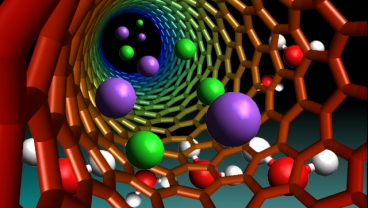 |
| MIT chemical engineers built tiny channels out of carbon nanotubes — hollow tubes whose walls are made of lattices of carbon atoms. Small molecules such as sodium ions and protons can flow through the channels. Graphic: Patrick Gillooly |
Abstract:
Channels could be used for sensitive detectors or water-desalination systems
By Anne Trafton, MIT News Office
MIT scientists observe single ions moving through tiny carbon-nanotube channel
Cambridge, MA | Posted on September 10th, 2010For the first time, a team of MIT chemical engineers has observed single ions marching through a tiny carbon-nanotube channel. Such channels could be used as extremely sensitive detectors or as part of a new water-desalination system. They could also allow scientists to study chemical reactions at the single-molecule level.
Carbon nanotubes — tiny, hollow cylinders whose walls are lattices of carbon atoms — are about 10,000 times thinner than a human hair. Since their discovery nearly 20 years ago, researchers have experimented with them as batteries, transistors, sensors and solar cells, among other applications.
In the Sept. 10 issue of Science, MIT researchers report that charged molecules, such as the sodium and chloride ions that form when salt is dissolved in water, can not only flow rapidly through carbon nanotubes, but also can, under some conditions, do so one at a time, like people taking turns crossing a bridge. The research was led by associate professor Michael Strano.
The new system allows passage of much smaller molecules, over greater distances (up to half a millimeter), than any existing nanochannel. Currently, the most commonly studied nanochannel is a silicon nanopore, made by drilling a hole through a silicon membrane. However, these channels are much shorter than the new nanotube channels (the nanotubes are about 20,000 times longer), so they only permit passage of large molecules such as DNA or polymers — anything smaller would move too quickly to be detected.
Strano and his co-authors — recent PhD recipient Chang Young Lee, graduate student Wonjoon Choi and postdoctoral associate Jae-Hee Han — built their new nanochannel by growing a nanotube across a one-centimeter-by-one-centimeter plate, connecting two water reservoirs. Each reservoir contains an electrode, one positive and one negative. Because electricity can flow only if protons — positively charged hydrogen ions, which make up the electric current — can travel from one electrode to the other, the researchers can easily determine whether ions are traveling through the nanotube.
They found that protons do flow steadily across the nanotube, carrying an electric current. Protons flow easily through the nanochannel because they are so small, but the researchers observed that other positively charged ions, such as sodium, can also get through but only if enough electric field is applied. Sodium ions are much larger than protons, so they take longer to cross once they enter. While they travel across the channel, they block protons from flowing, leading to a brief disruption in current known as the Coulter effect.
Strano believes that the channels allow only positively charged ions to flow through them because the ends of the tubes contain negative charges, which attract positive ions. However, he plans to build channels that attract negative ions by adding positive charges to the tube.
Once the researchers have these two types of channels, they hope to embed them in a membrane that could also be used for water desalination. More than 97 percent of Earth's water is in the oceans, but that vast reservoir is undrinkable unless the salt is removed. The current desalination methods, distillation and reverse osmosis, are expensive and require lots of energy. So a nanotube membrane that allows both sodium and chloride ions (which are negatively charged) to flow out of seawater could become a cheaper way to desalinate water.
This study marks the first time that individual ions dissolved in water have been observed at room temperature. This means the nanochannels could also detect impurities, such as arsenic or mercury, in drinking water. (Ions can be identified by how long it takes them to cross the channel, which depends on their size). "If a single arsenic ion is floating in solution, you could detect it," says Strano.
Source: "Coherence Resonance in a Single Walled Carbon Nanotube Ion Channel" by Chang Young Lee, Wonjoon Choi, Jae-Hee Han, and Michael S. Strano. Science, 9 September, 2010.
Funding: Institute for Soldier Nanotechnology at MIT, U.S. Army Research Office, and a fellowship from the Sloan Foundation
####
For more information, please click here
Contacts:
Jen Hirsch
MIT News Office
T: 617-253-1682
Copyright © MIT
If you have a comment, please Contact us.Issuers of news releases, not 7th Wave, Inc. or Nanotechnology Now, are solely responsible for the accuracy of the content.
Bookmark:


| Related News Press |
News and information
 Quantum computer improves AI predictions April 17th, 2026
Flexible sensor gains sensitivity under pressure April 17th, 2026
A reusable chip for particulate matter sensing April 17th, 2026
Detecting vibrational quantum beating in the predissociation dynamics of SF6 using time-resolved photoelectron spectroscopy April 17th, 2026
Chemistry
Projecting light to dispense liquids: A new route to ultra-precise microdroplets January 30th, 2026
From sensors to smart systems: the rise of AI-driven photonic noses January 30th, 2026
"Nanoreactor" cage uses visible light for catalytic and ultra-selective cross-cycloadditions October 3rd, 2025
Cambridge chemists discover simple way to build bigger molecules – one carbon at a time June 6th, 2025
Govt.-Legislation/Regulation/Funding/Policy
Quantum computer improves AI predictions April 17th, 2026
Metasurfaces smooth light to boost magnetic sensing precision January 30th, 2026
New imaging approach transforms study of bacterial biofilms August 8th, 2025
Possible Futures
A fundamentally new therapeutic approach to cystic fibrosis: Nanobody repairs cellular defect April 17th, 2026
UC Irvine physicists discover method to reverse ‘quantum scrambling’ : The work addresses the problem of information loss in quantum computing system April 17th, 2026
Academic/Education
Rice University launches Rice Synthetic Biology Institute to improve lives January 12th, 2024
Multi-institution, $4.6 million NSF grant to fund nanotechnology training September 9th, 2022
Nanotubes/Buckyballs/Fullerenes/Nanorods/Nanostrings/Nanosheets
Tiny nanosheets, big leap: A new sensor detects ethanol at ultra-low levels January 30th, 2026
Enhancing power factor of p- and n-type single-walled carbon nanotubes April 25th, 2025
Chainmail-like material could be the future of armor: First 2D mechanically interlocked polymer exhibits exceptional flexibility and strength January 17th, 2025
Innovative biomimetic superhydrophobic coating combines repair and buffering properties for superior anti-erosion December 13th, 2024
Sensors
Flexible sensor gains sensitivity under pressure April 17th, 2026
Tiny nanosheets, big leap: A new sensor detects ethanol at ultra-low levels January 30th, 2026
From sensors to smart systems: the rise of AI-driven photonic noses January 30th, 2026
Sensors innovations for smart lithium-based batteries: advancements, opportunities, and potential challenges August 8th, 2025
Announcements
A fundamentally new therapeutic approach to cystic fibrosis: Nanobody repairs cellular defect April 17th, 2026
UC Irvine physicists discover method to reverse ‘quantum scrambling’ : The work addresses the problem of information loss in quantum computing system April 17th, 2026
Water
Taking salt out of the water equation October 7th, 2022
 |
||
 |
||
| The latest news from around the world, FREE | ||
 |
||
|
|
||
| Premium Products | ||
 |
||
|
Only the news you want to read!
Learn More |
||
 |
||
|
Full-service, expert consulting
Learn More |
||
|
|
||