Home > Press > Generation and Manipulation of spin currents for advanced electronic devices
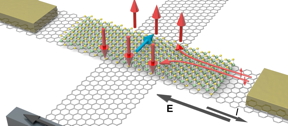 |
| Schematic representation of a graphene-based heterostructure in which spin currents are generated and tuned by proximity effect with a transition metal dichalcogenide strip. |
Abstract:
ICN2 researchers, in the framework of the Graphene Flagship, demonstrate that spin currents can be generated and manipulated in graphene-based heterostructures at room temperature. The results of this study, published in Nature Materials, provide relevant information on the fundamental physics of the phenomena involved and open the door to new applications, such as the development of ultra-compact electronic and low energy consumption devices and magnetic memories.
Generation and Manipulation of spin currents for advanced electronic devices
Barcelona, Spain | Posted on January 9th, 2020Graphene-based heterostructures of the van der Waals class could be used to design ultra-compact and low-energy electronic devices and magnetic memories. This is what a paper published in the latest issue of the Nature Materials journal suggests. The results have shown that it is possible to perform an efficient and tunable spin-charge conversion in these structures and, for the first time, even at room temperature.
The work has been led by ICREA Prof. Sergio O. Valenzuela, head of the ICN2 Physics and Engineering of Nanodevices Group. The first authors are L. Antonio Benítez and Williams Savero Torres, of the same group. Members of the ICN2 Theoretical and Computational Nanoscience Group, as its head, ICREA Prof. Stephan Roche, also signed the paper. This study has been developed within the framework of the Graphene Flagship, a broad European Project in which researchers of the Catalan Institute of Nanoscience and Nanotechnology (ICN2) play a leadership role. The results complement recent researches carried out within this same initiative, such as the one published in 2019 in NanoLetters by scientists from the University of Groningen (RUG).
The electronics that use spin - a property of electrons - to store, manipulate and transfer information, called spintronics, are driving important markets, such as those of motion sensors and information storage technologies. However, the development of efficient and versatile spin-based technologies requires high-quality materials that allow long-distance spin transfer, as well as methods to generate and manipulate spin currents, i.e. electron movements with their spin oriented in a given direction.
The spin currents are usually produced and detected using ferromagnetic materials. As an alternative, spin-orbit interactions allow the generation and control of spin currents exclusively through electric fields, providing a much more versatile tool for the implementation of large-scale spin devices.
Graphene is a unique material for long distance spin transport. The present work demonstrates that this transport can be manipulated in graphene by proximity effects. To induce these effects, transition metal dichalcogenides have been used, which are two-dimensional materials as graphene. Researchers have demonstrated a good efficiency of spin-charge interconversion at room temperature, which is comparable to the best performance of traditional materials.
These advances are the result of a joint effort by experimental and theoretical researchers, who worked side by side in the framework of the Graphene Flagship. The outcomes of this study are of great relevance for the communities of spintronics and two-dimensional materials, as they provide relevant information on the fundamental physics of the phenomena involved and open the door to new applications.
Article posted by the Graphene Flagship:
Layered heterostructures put a spin on magnetic memory devices
####
For more information, please click here
Contacts:
Institut Catalŕ de Nanocičncia i Nanotecnologia (ICN2)
Marketing and Communication Department
Dr Virginia Greco, Science Writer
+34 937 375 719
Ŕlex Argemí, Head of Marketing and Communication
+34 937 372 607; +34 635 861 543
Copyright © ICN2
If you have a comment, please Contact us.Issuers of news releases, not 7th Wave, Inc. or Nanotechnology Now, are solely responsible for the accuracy of the content.
Bookmark:


| Related Links |
| Related News Press |
News and information
 Quantum computer improves AI predictions April 17th, 2026
Flexible sensor gains sensitivity under pressure April 17th, 2026
A reusable chip for particulate matter sensing April 17th, 2026
Detecting vibrational quantum beating in the predissociation dynamics of SF6 using time-resolved photoelectron spectroscopy April 17th, 2026
2 Dimensional Materials
Flexible sensor gains sensitivity under pressure April 17th, 2026
MXene nanomaterials enter a new dimension Multilayer nanomaterial: MXene flakes created at Drexel University show new promise as 1D scrolls January 30th, 2026
ICFO researchers overcome long-standing bottleneck in single photon detection with twisted 2D materials August 8th, 2025
Magnetism/Magnons
Metasurfaces smooth light to boost magnetic sensing precision January 30th, 2026
Researchers develop molecular qubits that communicate at telecom frequencies October 3rd, 2025
Magnetism in new exotic material opens the way for robust quantum computers June 4th, 2025
Graphene/ Graphite
Electrifying results shed light on graphene foam as a potential material for lab grown cartilage June 6th, 2025
Possible Futures
A fundamentally new therapeutic approach to cystic fibrosis: Nanobody repairs cellular defect April 17th, 2026
UC Irvine physicists discover method to reverse ‘quantum scrambling’ : The work addresses the problem of information loss in quantum computing system April 17th, 2026
Spintronics
Quantum materials: Electron spin measured for the first time June 9th, 2023
Chip Technology
A reusable chip for particulate matter sensing April 17th, 2026
Metasurfaces smooth light to boost magnetic sensing precision January 30th, 2026
Memory Technology
Researchers tackle the memory bottleneck stalling quantum computing October 3rd, 2025
First real-time observation of two-dimensional melting process: Researchers at Mainz University unveil new insights into magnetic vortex structures August 8th, 2025
Utilizing palladium for addressing contact issues of buried oxide thin film transistors April 5th, 2024
Discoveries
Quantum computer improves AI predictions April 17th, 2026
Flexible sensor gains sensitivity under pressure April 17th, 2026
A reusable chip for particulate matter sensing April 17th, 2026
Detecting vibrational quantum beating in the predissociation dynamics of SF6 using time-resolved photoelectron spectroscopy April 17th, 2026
Announcements
A fundamentally new therapeutic approach to cystic fibrosis: Nanobody repairs cellular defect April 17th, 2026
UC Irvine physicists discover method to reverse ‘quantum scrambling’ : The work addresses the problem of information loss in quantum computing system April 17th, 2026
Interviews/Book Reviews/Essays/Reports/Podcasts/Journals/White papers/Posters
A fundamentally new therapeutic approach to cystic fibrosis: Nanobody repairs cellular defect April 17th, 2026
UC Irvine physicists discover method to reverse ‘quantum scrambling’ : The work addresses the problem of information loss in quantum computing system April 17th, 2026
 |
||
 |
||
| The latest news from around the world, FREE | ||
 |
||
|
|
||
| Premium Products | ||
 |
||
|
Only the news you want to read!
Learn More |
||
 |
||
|
Full-service, expert consulting
Learn More |
||
|
|
||