Home > Press > A firefly's flash inspires new nanolaser light
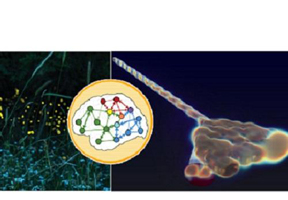 |
| The complex flashing patterns of fireflies (left) led KAUST researchers to develop anapole lasers that use interactions between energy-storing nanodisks (center) to generate high-speed pulses of light on microchips (right). CREDIT Reproduced with permission from ref 1. © 2017 Gongora et al. |
Abstract:
A reinvented, low-cost laser source that stores light energy inside nanoscale disks could underpin the development of optically powered neurocomputers, reveals a simulation study led by KAUST researchers.
A firefly's flash inspires new nanolaser light
Thuwal, Saudi Arabi | Posted on July 18th, 2017Photonic devices that use controlled laser pulses to manipulate data switches, biomedical implants and solar cells are sought-after because they are lightning quick compared to traditional electronics; however, current prototypes have not been commercialized because of the difficulty in making lasers small enough to fit onto computer circuit boards, while also retaining pulse-shaping capabilities.
"The challenge of reducing an optical source down to the nanoscale is that it starts to emit energy strongly in all directions," explained Andrea Fratalocchi, an Associate Professor of Electrical Engineering. "This makes it almost impossible to control."
A partnership with Yuri Kivshar's group at the Australian National University revealed paths to beat optical diffraction limits with unconventional anapole lasers. Being made from semiconductors shaped into precisely sized nanodisks, anapoles respond to light stimulation by producing electromagnetic waves that either radiate or rotate in donut-shaped toroid distributions.
At specific excitation frequencies, interference between the two fields produces a state--the anapole--which does not emit energy in any direction and traps light inside the nanodisk.
"You can think of this laser as an energy tank--once the laser is on, it stores light and doesn't let it go until you want to collect it," said Fratalocchi.
To unlock the potential of this new light source, the KAUST team simulated various engineering architectures using quantum-based algorithms.
These calculations, along with improved microchip integration and thousand-fold enhancements in coupling to optical routers, predict that anapole nanolasers can generate ultrafast light pulses that are uniquely suited for studying natural patterns of signaling and neural connections.
Fratalocchi notes that the nanolasers would appear invisible to an observer until perturbed by a nearby object. Consequently, arranging the cylindrical light sources into a loop could be used to produce a chain reaction of light emissions, tunable down to as small as femtosecond pulse times.
"It's really like a population of fireflies, where the individuals synchronize their emissions into beautiful patterns," he explained "When we place the nanolasers close together, we can get similar control over the pulses."
The team's models suggest that integrating different loops of anapole nanolasers may produce oscillating, dynamic patterns useful for reproducing brain-like activities, such as machine learning and memory retrieval at low cost because the platform needs only inexpensive silicon wafers to work.
####
About King Abdullah University of Science and Technology
For more information, please click here
Contacts:
Michelle D'Antoni
Copyright © King Abdullah University of Science and Technology
If you have a comment, please Contact us.Issuers of news releases, not 7th Wave, Inc. or Nanotechnology Now, are solely responsible for the accuracy of the content.
Bookmark:


| Related Links |
| Related News Press |
News and information
 Quantum computer improves AI predictions April 17th, 2026
Flexible sensor gains sensitivity under pressure April 17th, 2026
A reusable chip for particulate matter sensing April 17th, 2026
Detecting vibrational quantum beating in the predissociation dynamics of SF6 using time-resolved photoelectron spectroscopy April 17th, 2026
Brain-Computer Interfaces
Taking salt out of the water equation October 7th, 2022
New brain-like computing device simulates human learning: Researchers conditioned device to learn by association, like Pavlov's dog April 30th, 2021
Possible Futures
A fundamentally new therapeutic approach to cystic fibrosis: Nanobody repairs cellular defect April 17th, 2026
UC Irvine physicists discover method to reverse ‘quantum scrambling’ : The work addresses the problem of information loss in quantum computing system April 17th, 2026
Chip Technology
A reusable chip for particulate matter sensing April 17th, 2026
Metasurfaces smooth light to boost magnetic sensing precision January 30th, 2026
Memory Technology
Researchers tackle the memory bottleneck stalling quantum computing October 3rd, 2025
First real-time observation of two-dimensional melting process: Researchers at Mainz University unveil new insights into magnetic vortex structures August 8th, 2025
Utilizing palladium for addressing contact issues of buried oxide thin film transistors April 5th, 2024
Optical computing/Photonic computing
ICFO researchers overcome long-standing bottleneck in single photon detection with twisted 2D materials August 8th, 2025
Programmable electron-induced color router array May 14th, 2025
Nanoelectronics
Lab to industry: InSe wafer-scale breakthrough for future electronics August 8th, 2025
Interdisciplinary: Rice team tackles the future of semiconductors Multiferroics could be the key to ultralow-energy computing October 6th, 2023
Key element for a scalable quantum computer: Physicists from Forschungszentrum Jülich and RWTH Aachen University demonstrate electron transport on a quantum chip September 23rd, 2022
Reduced power consumption in semiconductor devices September 23rd, 2022
Announcements
A fundamentally new therapeutic approach to cystic fibrosis: Nanobody repairs cellular defect April 17th, 2026
UC Irvine physicists discover method to reverse ‘quantum scrambling’ : The work addresses the problem of information loss in quantum computing system April 17th, 2026
Interviews/Book Reviews/Essays/Reports/Podcasts/Journals/White papers/Posters
A fundamentally new therapeutic approach to cystic fibrosis: Nanobody repairs cellular defect April 17th, 2026
UC Irvine physicists discover method to reverse ‘quantum scrambling’ : The work addresses the problem of information loss in quantum computing system April 17th, 2026
 |
||
 |
||
| The latest news from around the world, FREE | ||
 |
||
|
|
||
| Premium Products | ||
 |
||
|
Only the news you want to read!
Learn More |
||
 |
||
|
Full-service, expert consulting
Learn More |
||
|
|
||