Home > Press > On the path toward molecular robots: Scientists at Japan's Hokkaido University have developed light-powered molecular motors that repetitively bend and unbend, bringing us closer to molecular robots.
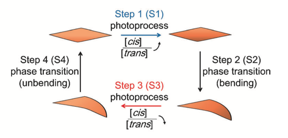 |
| Schematic illustration of each step of the self-oscillatory motion. Credit: Ikegami T. et. al., Angewandte Chemie International Edition, May 19, 2016 |
Abstract:
Researchers are working on mimicking cellular systems to develop molecular motors that can move or even deliver drugs to target tissues. Engineering such motors may ultimately lead to molecular robots that can execute more complex tasks. To this end, researchers must find ways to convert motion at the molecular level to motion at the macroscopic level. They also must find ways to cause chemical reactions to repeat autonomously and continuously.
On the path toward molecular robots: Scientists at Japan's Hokkaido University have developed light-powered molecular motors that repetitively bend and unbend, bringing us closer to molecular robots.
Hokkaido, Japan | Posted on July 8th, 2016Yoshiyuki Kageyama, Sadamu Takeda and colleagues at Hokkaido University's Department of Chemistry have successfully created a chemical compound, or a crystalline assembly, which autonomously repeated flipping under blue light.
The team made crystals composed of an organic compound, called azobenzene, commonly used in dye manufacturing, and oleic acid, commonly found in cooking oil. Azobenzene molecules take two structurally different forms: cis and trans. They repetitively convert from one form to the other under blue right. The scientists tested if this would influence the structure of the azobenzene-oleic acid crystal, which contained unequal amounts of cis- and trans-azobenzene.
By applying blue light to the crystals in solution, the team observed, under a microscope, an oscillatory bending-unbending motion of the thin crystals, suggesting the existence of two stable structures, bent or unbent, depending on the cis/trans ratio. The frequency of the motion increased when the light intensity was increased. Some crystal complexes even exhibited 'swimming-like' motions in the water. Previously reported light-responsive materials have been limited in their ability to deform. The properties of the compounds in the Hokkaido University-developed crystals, however, allowed for a two-step switching mechanism, resulting in regular repetitive oscillations.
"The ability to self-organize rhythmic motions, such as the repetitive flipping motion we observed, is one of the fundamental characteristics of living organisms", says Kageyama. "This mechanism can be used in the future to develop bio-inspired molecular motors and robots that will find applications in wide areas, including medicine".
####
For more information, please click here
Contacts:
Naoki NAMBA
81-117-068-034
Copyright © Hokkaido University
If you have a comment, please Contact us.Issuers of news releases, not 7th Wave, Inc. or Nanotechnology Now, are solely responsible for the accuracy of the content.
Bookmark:


| Related Links |
| Related News Press |
News and information
 Quantum computer improves AI predictions April 17th, 2026
Flexible sensor gains sensitivity under pressure April 17th, 2026
A reusable chip for particulate matter sensing April 17th, 2026
Detecting vibrational quantum beating in the predissociation dynamics of SF6 using time-resolved photoelectron spectroscopy April 17th, 2026
Videos/Movies
ICFO researchers overcome long-standing bottleneck in single photon detection with twisted 2D materials August 8th, 2025
Robotics
Nanofibrous metal oxide semiconductor for sensory face November 8th, 2024
Femtosecond laser technique births "dancing microrobots": USTC's breakthrough in multi-material microfabrication August 11th, 2023
Govt.-Legislation/Regulation/Funding/Policy
Quantum computer improves AI predictions April 17th, 2026
Metasurfaces smooth light to boost magnetic sensing precision January 30th, 2026
New imaging approach transforms study of bacterial biofilms August 8th, 2025
Possible Futures
A fundamentally new therapeutic approach to cystic fibrosis: Nanobody repairs cellular defect April 17th, 2026
UC Irvine physicists discover method to reverse ‘quantum scrambling’ : The work addresses the problem of information loss in quantum computing system April 17th, 2026
Molecular Machines
First electric nanomotor made from DNA material: Synthetic rotary motors at the nanoscale perform mechanical work July 22nd, 2022
Nanotech scientists create world's smallest origami bird March 17th, 2021
Giant nanomachine aids the immune system: Theoretical chemistry August 28th, 2020
Molecular Nanotechnology
Quantum pumping in molecular junctions August 16th, 2024
Scientists push the boundaries of manipulating light at the submicroscopic level March 3rd, 2023
First electric nanomotor made from DNA material: Synthetic rotary motors at the nanoscale perform mechanical work July 22nd, 2022
Nanomedicine
A fundamentally new therapeutic approach to cystic fibrosis: Nanobody repairs cellular defect April 17th, 2026
New molecular technology targets tumors and simultaneously silences two ‘undruggable’ cancer genes August 8th, 2025
New imaging approach transforms study of bacterial biofilms August 8th, 2025
Electrifying results shed light on graphene foam as a potential material for lab grown cartilage June 6th, 2025
Discoveries
Quantum computer improves AI predictions April 17th, 2026
Flexible sensor gains sensitivity under pressure April 17th, 2026
A reusable chip for particulate matter sensing April 17th, 2026
Detecting vibrational quantum beating in the predissociation dynamics of SF6 using time-resolved photoelectron spectroscopy April 17th, 2026
Announcements
A fundamentally new therapeutic approach to cystic fibrosis: Nanobody repairs cellular defect April 17th, 2026
UC Irvine physicists discover method to reverse ‘quantum scrambling’ : The work addresses the problem of information loss in quantum computing system April 17th, 2026
Interviews/Book Reviews/Essays/Reports/Podcasts/Journals/White papers/Posters
A fundamentally new therapeutic approach to cystic fibrosis: Nanobody repairs cellular defect April 17th, 2026
UC Irvine physicists discover method to reverse ‘quantum scrambling’ : The work addresses the problem of information loss in quantum computing system April 17th, 2026
Grants/Sponsored Research/Awards/Scholarships/Gifts/Contests/Honors/Records
Quantum computer improves AI predictions April 17th, 2026
Detecting vibrational quantum beating in the predissociation dynamics of SF6 using time-resolved photoelectron spectroscopy April 17th, 2026
Metasurfaces smooth light to boost magnetic sensing precision January 30th, 2026
Photonics/Optics/Lasers
Metasurfaces smooth light to boost magnetic sensing precision January 30th, 2026
From sensors to smart systems: the rise of AI-driven photonic noses January 30th, 2026
 |
||
 |
||
| The latest news from around the world, FREE | ||
 |
||
|
|
||
| Premium Products | ||
 |
||
|
Only the news you want to read!
Learn More |
||
 |
||
|
Full-service, expert consulting
Learn More |
||
|
|
||