Home > Press > Laser-burned graphene gains metallic powers: Rice University scientists find possible replacement for platinum as catalyst
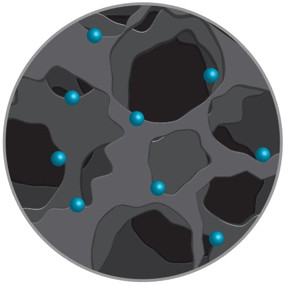 |
| Rice University chemists have found a way to embed metallic nanoparticles into laser-induced graphene. The particles turn the material into a useful catalyst for fuel cell and other applications. Credit: Tour Group/Rice University |
Abstract:
Rice University chemists who developed a unique form of graphene have found a way to embed metallic nanoparticles that turn the material into a useful catalyst for fuel cells and other applications.
Laser-burned graphene gains metallic powers: Rice University scientists find possible replacement for platinum as catalyst
Houston, TX | Posted on August 20th, 2015Laser-induced graphene, created by the Rice lab of chemist James Tour last year, is a flexible film with a surface of porous graphene made by exposing a common plastic known as polyimide to a commercial laser-scribing beam. The researchers have now found a way to enhance the product with reactive metals.
The research appears this month in the American Chemical Society journal ACS Nano.
With the discovery, the material that the researchers call "metal oxide-laser induced graphene" (MO-LIG) becomes a new candidate to replace expensive metals like platinum in catalytic fuel-cell applications in which oxygen and hydrogen are converted to water and electricity.
"The wonderful thing about this process is that we can use commercial polymers, with simple inexpensive metal salts added," Tour said. "We then subject them to the commercial laser scriber, which generates metal nanoparticles embedded in graphene. So much of the chemistry is done by the laser, which generates graphene in the open air at room temperature.
"These composites, which have less than 1 percent metal, respond as 'super catalysts' for fuel-cell applications. Other methods to do this take far more steps and require expensive metals and expensive carbon precursors."
Initially, the researchers made laser-induced graphene with commercially available polyimide sheets. Later, they infused liquid polyimide with boron to produce laser-induced graphene with a greatly increased capacity to store an electrical charge, which made it an effective supercapacitor.
For the latest iteration, they mixed the liquid and one of three concentrations containing cobalt, iron or molybdenum metal salts. After condensing each mixture into a film, they treated it with an infrared laser and then heated it in argon gas for half an hour at 750 degrees Celsius.
That process produced robust MO-LIGs with metallic, 10-nanometer particles spread evenly through the graphene. Tests showed their ability to catalyze oxygen reduction, an essential chemical reaction in fuel cells. Further doping of the material with sulfur allowed for hydrogen evolution, another catalytic process that converts water into hydrogen, Tour said.
"Remarkably, simple treatment of the graphene-molybdenum oxides with sulfur, which converted the metal oxides to metal sulfides, afforded a hydrogen evolution reaction catalyst, underscoring the broad utility of this approach," he said.
Rice graduate student Ruquan Ye and Rice alumnus Zhiwei Peng, now a postdoctoral researcher at the University of Maryland, are lead authors of the paper. Co-authors are Rice graduate students Tuo Wang, Jibo Zhang and Lizanne Nilewski; Rice undergraduate Yunong Xu; and Rice alumnus Jian Lin, an assistant professor of mechanical and aerospace engineering at the University of Missouri. Tour is the T.T. and W.F. Chao Chair in Chemistry as well as a professor of materials science and nanoengineering and of computer science and a member of Rice's Smalley-Curl Institute.
The Air Force Office of Scientific Research and its Multidisciplinary University Research Initiative supported the research.
####
About Rice University
Located on a 300-acre forested campus in Houston, Rice University is consistently ranked among the nation’s top 20 universities by U.S. News & World Report. Rice has highly respected schools of Architecture, Business, Continuing Studies, Engineering, Humanities, Music, Natural Sciences and Social Sciences and is home to the Baker Institute for Public Policy. With 3,888 undergraduates and 2,610 graduate students, Rice’s undergraduate student-to-faculty ratio is 6-to-1. Its residential college system builds close-knit communities and lifelong friendships, just one reason why Rice is ranked No. 1 for best quality of life and for lots of race/class interaction by the Princeton Review. Rice is also rated as a best value among private universities by Kiplinger’s Personal Finance.
Follow Rice News and Media Relations via Twitter @RiceUNews
For more information, please click here
Contacts:
Jeff Falk
713-348-6775
Mike Williams
713-348-6728
Copyright © Rice University
If you have a comment, please Contact us.Issuers of news releases, not 7th Wave, Inc. or Nanotechnology Now, are solely responsible for the accuracy of the content.
Bookmark:


| Related Links |
 Wiess School of Natural Sciences:
| Related News Press |
News and information
Quantum computer improves AI predictions April 17th, 2026
Flexible sensor gains sensitivity under pressure April 17th, 2026
A reusable chip for particulate matter sensing April 17th, 2026
Detecting vibrational quantum beating in the predissociation dynamics of SF6 using time-resolved photoelectron spectroscopy April 17th, 2026
Chemistry
Projecting light to dispense liquids: A new route to ultra-precise microdroplets January 30th, 2026
From sensors to smart systems: the rise of AI-driven photonic noses January 30th, 2026
"Nanoreactor" cage uses visible light for catalytic and ultra-selective cross-cycloadditions October 3rd, 2025
Cambridge chemists discover simple way to build bigger molecules – one carbon at a time June 6th, 2025
Single-atom catalysts change spin state when boosted by a magnetic field June 4th, 2025
Graphene/ Graphite
Electrifying results shed light on graphene foam as a potential material for lab grown cartilage June 6th, 2025
Breakthrough in proton barrier films using pore-free graphene oxide: Kumamoto University researchers achieve new milestone in advanced coating technologies September 13th, 2024
Govt.-Legislation/Regulation/Funding/Policy
Quantum computer improves AI predictions April 17th, 2026
Metasurfaces smooth light to boost magnetic sensing precision January 30th, 2026
New imaging approach transforms study of bacterial biofilms August 8th, 2025
Discoveries
Quantum computer improves AI predictions April 17th, 2026
Flexible sensor gains sensitivity under pressure April 17th, 2026
A reusable chip for particulate matter sensing April 17th, 2026
Detecting vibrational quantum beating in the predissociation dynamics of SF6 using time-resolved photoelectron spectroscopy April 17th, 2026
Materials/Metamaterials/Magnetoresistance
First real-time observation of two-dimensional melting process: Researchers at Mainz University unveil new insights into magnetic vortex structures August 8th, 2025
Researchers unveil a groundbreaking clay-based solution to capture carbon dioxide and combat climate change June 6th, 2025
A 1960s idea inspires NBI researchers to study hitherto inaccessible quantum states June 6th, 2025
Institute for Nanoscience hosts annual proposal planning meeting May 16th, 2025
Announcements
A fundamentally new therapeutic approach to cystic fibrosis: Nanobody repairs cellular defect April 17th, 2026
UC Irvine physicists discover method to reverse ‘quantum scrambling’ : The work addresses the problem of information loss in quantum computing system April 17th, 2026
Interviews/Book Reviews/Essays/Reports/Podcasts/Journals/White papers/Posters
A fundamentally new therapeutic approach to cystic fibrosis: Nanobody repairs cellular defect April 17th, 2026
UC Irvine physicists discover method to reverse ‘quantum scrambling’ : The work addresses the problem of information loss in quantum computing system April 17th, 2026
Military
Quantum engineers ‘squeeze’ laser frequency combs to make more sensitive gas sensors January 17th, 2025
Chainmail-like material could be the future of armor: First 2D mechanically interlocked polymer exhibits exceptional flexibility and strength January 17th, 2025
Single atoms show their true color July 5th, 2024
NRL charters Navy’s quantum inertial navigation path to reduce drift April 5th, 2024
Energy
Sensors innovations for smart lithium-based batteries: advancements, opportunities, and potential challenges August 8th, 2025
Simple algorithm paired with standard imaging tool could predict failure in lithium metal batteries August 8th, 2025
Fuel Cells
Deciphering local microstrain-induced optimization of asymmetric Fe single atomic sites for efficient oxygen reduction August 8th, 2025
Current and Future Developments in Nanomaterials and Carbon Nanotubes: Applications of Nanomaterials in Energy Storage and Electronics October 28th, 2022
Photonics/Optics/Lasers
Metasurfaces smooth light to boost magnetic sensing precision January 30th, 2026
From sensors to smart systems: the rise of AI-driven photonic noses January 30th, 2026
Research partnerships
Lab to industry: InSe wafer-scale breakthrough for future electronics August 8th, 2025
HKU physicists uncover hidden order in the quantum world through deconfined quantum critical points April 25th, 2025
 |
||
 |
||
| The latest news from around the world, FREE | ||
 |
||
|
|
||
| Premium Products | ||
 |
||
|
Only the news you want to read!
Learn More |
||
 |
||
|
Full-service, expert consulting
Learn More |
||
|
|
||