Home > Press > Mesoporous Particles for the Development of Drug Delivery System Safe to Human Bodies
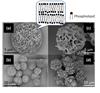 |
| External views of porous phospholipid particles (electron micrographs). (a, b) Particles created in organic (non-aqueous) solvent, (c, d) particles created in organic solvent in the presence of small amount of water. Only hydrogenated soybean lecithin was used to create them. The shape of the particles varies greatly depending on the presence/absence of water in the solvent. |
Abstract:
A research group led by MANA Scientist Kohsaku Kawakami, postdoctoral researcher Shaoling Zhang and MANA Principal Investigator Katsuhiko Ariga, at the International Center for Materials Nanoarchitectonics (MANA), NIMS (Sukekatsu Ushioda, President), succeeded in developing porous particles (mesoporous particles) consisting solely of phospholipids, a biological component, that are suitable for use as a drug delivery system.
Mesoporous Particles for the Development of Drug Delivery System Safe to Human Bodies
Tsukuba, Japan | Posted on June 9th, 2015Mesoporous materials are a type of material capable of serving as a drug delivery system. In conventional studies, hard materials such as silica and carbon materials have been used for such purposes, posing safety concerns to patients. The mesoporous material developed in this study consists exclusively of biologically-derived materials and is therefore expected to be very safe for humans.
Acquisition of official approval is one of the hurdles in the development of materials for use as a drug delivery system. To develop a certified pharmaceutical product, it is necessary to demonstrate the safety of the additive to be used before investigating the safety of the product itself. For this reason, pharmaceutical companies tend to avoid using new additives, which had been slowing the development of new drug carriers. However, the phospholipids examined in this study have already been used as emulsions and liposomes, and thus are not regarded as new additives. This fact is a great advantage of this material in view of commercialization.
This material comprises highly uniform mesoporous particles with diameters ranging between 5 and 20 μm, depending on their composition. It is a very lightweight material with a bulk density of about 0.02 g/cm3, from which an aerodynamic diameter of 1 to 3 μm is calculated. These are ideal features for this material to be used as a powder inhalation carrier.
Since this material consists of lipid bilayer membranes that are similar to biological membranes, it possesses the characteristics of both mesoporous particles and liposomes. For example, it can be used with both hydrophobic and hydrophilic drugs. Hydrophobic drugs can be embedded in a lipid bilayer membrane, and hydrophilic drugs can be inserted into hydrophilic regions between lipid bilayer membranes. Furthermore, as it is also feasible for the material to hold drugs in its mesopores, the material is capable of carrying drugs with various physical properties. Since phospholipids can be easily modified, it is conceivable that various kinds of surface modifications can be applied to the material.
This material is suited for industrial production as it can be easily prepared through freeze-drying. And it is expected to be useful as a drug carrier assuming any administration route and as a cosmetic ingredient. The unique shape of the particles also may add value to the commercial product.
This study had been published in the Journal of Physical Chemistry C issued by the American Chemical Society. It was also presented at the MANA Symposium at the Tsukuba International Congress Center.
####
About National Institute for Materials Science (NIMS)
Public research institution for materials science in Japan.
For more information, please click here
Contacts:
(Regarding this research)
Kohsaku Kawakami, MANA Scientist
International Center for Materials Nanoarchitectonics
National Institute for Materials Science
Tel: 029-860-4424
Email: KAWAKAMI.Kohsaku=nims.go.jp
(Please change "=" to
(Regarding public relations)
Public Relations Office
National Institute for Materials Science
1-2-1 Sengen, Tsukuba, Ibaraki, 305-0047, JAPAN
Tel: 029-859-2026, Fax: 029-859-2017
Email: pressrelease=ml.nims.go.jp
(Please change "=" to
Copyright © AlphaGalileo
If you have a comment, please Contact us.Issuers of news releases, not 7th Wave, Inc. or Nanotechnology Now, are solely responsible for the accuracy of the content.
Bookmark:


| Related Links |
 Full bibliographic information
| Related News Press |
News and information
Quantum computer improves AI predictions April 17th, 2026
Flexible sensor gains sensitivity under pressure April 17th, 2026
A reusable chip for particulate matter sensing April 17th, 2026
Detecting vibrational quantum beating in the predissociation dynamics of SF6 using time-resolved photoelectron spectroscopy April 17th, 2026
Chemistry
Projecting light to dispense liquids: A new route to ultra-precise microdroplets January 30th, 2026
From sensors to smart systems: the rise of AI-driven photonic noses January 30th, 2026
"Nanoreactor" cage uses visible light for catalytic and ultra-selective cross-cycloadditions October 3rd, 2025
Cambridge chemists discover simple way to build bigger molecules – one carbon at a time June 6th, 2025
Single-atom catalysts change spin state when boosted by a magnetic field June 4th, 2025
Laboratories
Researchers develop molecular qubits that communicate at telecom frequencies October 3rd, 2025
Govt.-Legislation/Regulation/Funding/Policy
Quantum computer improves AI predictions April 17th, 2026
Metasurfaces smooth light to boost magnetic sensing precision January 30th, 2026
New imaging approach transforms study of bacterial biofilms August 8th, 2025
Nanomedicine
A fundamentally new therapeutic approach to cystic fibrosis: Nanobody repairs cellular defect April 17th, 2026
New molecular technology targets tumors and simultaneously silences two ‘undruggable’ cancer genes August 8th, 2025
New imaging approach transforms study of bacterial biofilms August 8th, 2025
Electrifying results shed light on graphene foam as a potential material for lab grown cartilage June 6th, 2025
Discoveries
Quantum computer improves AI predictions April 17th, 2026
Flexible sensor gains sensitivity under pressure April 17th, 2026
A reusable chip for particulate matter sensing April 17th, 2026
Detecting vibrational quantum beating in the predissociation dynamics of SF6 using time-resolved photoelectron spectroscopy April 17th, 2026
Materials/Metamaterials/Magnetoresistance
First real-time observation of two-dimensional melting process: Researchers at Mainz University unveil new insights into magnetic vortex structures August 8th, 2025
Researchers unveil a groundbreaking clay-based solution to capture carbon dioxide and combat climate change June 6th, 2025
A 1960s idea inspires NBI researchers to study hitherto inaccessible quantum states June 6th, 2025
Institute for Nanoscience hosts annual proposal planning meeting May 16th, 2025
Announcements
A fundamentally new therapeutic approach to cystic fibrosis: Nanobody repairs cellular defect April 17th, 2026
UC Irvine physicists discover method to reverse ‘quantum scrambling’ : The work addresses the problem of information loss in quantum computing system April 17th, 2026
Interviews/Book Reviews/Essays/Reports/Podcasts/Journals/White papers/Posters
A fundamentally new therapeutic approach to cystic fibrosis: Nanobody repairs cellular defect April 17th, 2026
UC Irvine physicists discover method to reverse ‘quantum scrambling’ : The work addresses the problem of information loss in quantum computing system April 17th, 2026
Personal Care/Cosmetics
DGIST and New Life Group launched a research project on "Functional beauty and health products using the latest nanotechnology" May 12th, 2023
A Comprehensive Guide: The Future of Nanotechnology September 13th, 2018
Graphene finds new application as anti-static hair dye: New formula works as well as commercial permanent dyes without chemically altering hairs March 22nd, 2018
Programmable materials find strength in molecular repetition May 23rd, 2016
Events/Classes
Institute for Nanoscience hosts annual proposal planning meeting May 16th, 2025
A New Blue: Mysterious origin of the ribbontail ray’s electric blue spots revealed July 5th, 2024
Researchers demonstrate co-propagation of quantum and classical signals: Study shows that quantum encryption can be implemented in existing fiber networks January 20th, 2023
 |
||
 |
||
| The latest news from around the world, FREE | ||
 |
||
|
|
||
| Premium Products | ||
 |
||
|
Only the news you want to read!
Learn More |
||
 |
||
|
Full-service, expert consulting
Learn More |
||
|
|
||