Home > Press > Crumpled graphene could provide an unconventional energy storage: Two-dimensional carbon “paper” can form stretchable supercapacitors to power flexible electronic devices
 |
Abstract:
When someone crumples a sheet of paper, that usually means it's about to be thrown away. But researchers have now found that crumpling a piece of graphene "paper" — a material formed by bonding together layers of the two-dimensional form of carbon — can actually yield new properties that could be useful for creating extremely stretchable supercapacitors to store energy for flexible electronic devices.
Crumpled graphene could provide an unconventional energy storage: Two-dimensional carbon “paper” can form stretchable supercapacitors to power flexible electronic devices
Cambridge, MA | Posted on October 4th, 2014 The finding is reported in the journal Scientific Reports by MIT's Xuanhe Zhao, an assistant professor of mechanical engineering and civil and environmental engineering, and four other authors. The new, flexible supercapacitors should be easy and inexpensive to fabricate, the team says.
"Many people are exploring graphene paper: It's a good candidate for making supercapacitors, because of its large surface area per mass," Zhao says. Now, he says, the development of flexible electronic devices, such as wearable or implantable biomedical sensors or monitoring devices, will require flexible power-storage systems.
Like batteries, supercapacitors can store electrical energy, but they primarily do so electrostatically, rather than chemically — meaning they can deliver their energy faster than batteries can. Now Zhao and his team have demonstrated that by crumpling a sheet of graphene paper into a chaotic mass of folds, they can make a supercapacitor that can easily be bent, folded, or stretched to as much as 800 percent of its original size. The team has made a simple supercapacitor using this method as a proof of principle.
The material can be crumpled and flattened up to 1,000 times, the team has demonstrated, without a significant loss of performance. "The graphene paper is pretty robust," Zhao says, "and we can achieve very large deformations over multiple cycles." Graphene, a structure of pure carbon just one atom thick with its carbon atoms arranged in a hexagonal array, is one of the strongest materials known.
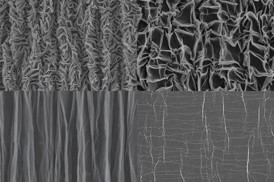
To make the crumpled graphene paper, a sheet of the material was placed in a mechanical device that first compressed it in one direction, creating a series of parallel folds or pleats, and then in the other direction, leading to a chaotic, rumpled surface. When stretched, the material's folds simply smooth themselves out.
Forming a capacitor requires two conductive layers — in this case, two sheets of crumpled graphene paper — with an insulating layer in between, which in this demonstration was made from a hydrogel material. Like the crumpled graphene, the hydrogel is highly deformable and stretchable, so the three layers remain in contact even while being flexed and pulled.
Though this initial demonstration was specifically to make a supercapacitor, the same crumpling technique could be applied to other uses, Zhao says. For example, the crumpled graphene material might be used as one electrode in a flexible battery, or could be used to make a stretchable sensor for specific chemical or biological molecules.
"This work is really exciting and amazing to me," says Dan Li, a professor of materials engineering at Monash University in Australia who was not involved in this research. He says the team "provides an extremely simple but highly effective concept to make stretchable electrodes for supercapacitors by controlled crumpling of multilayered graphene films." While other groups have made flexible supercapacitors, he says, "Making supercapacitors stretchable has been a great challenge. This paper provides a very smart way to tackle this challenge, which I believe will bring wearable energy storage devices closer."
The research team also included Jianfeng Zang at Huazhong University of Science and Technology and Changyang Cao, Yaying Feng, and Jie Liu at Duke University. The work was supported by the Office of Naval Research, the National Science Foundation, and the National 1000 Talents Program of China.
####
For more information, please click here
Copyright © Massachusetts Institute of Technology
If you have a comment, please Contact us.Issuers of news releases, not 7th Wave, Inc. or Nanotechnology Now, are solely responsible for the accuracy of the content.
Bookmark:


| Related News Press |
News and information
 Quantum computer improves AI predictions April 17th, 2026
Flexible sensor gains sensitivity under pressure April 17th, 2026
A reusable chip for particulate matter sensing April 17th, 2026
Detecting vibrational quantum beating in the predissociation dynamics of SF6 using time-resolved photoelectron spectroscopy April 17th, 2026
Flexible Electronics
Flexible sensor gains sensitivity under pressure April 17th, 2026
Flexible electronics integrated with paper-thin structure for use in space January 17th, 2025
Graphene/ Graphite
Electrifying results shed light on graphene foam as a potential material for lab grown cartilage June 6th, 2025
Govt.-Legislation/Regulation/Funding/Policy
Quantum computer improves AI predictions April 17th, 2026
Metasurfaces smooth light to boost magnetic sensing precision January 30th, 2026
New imaging approach transforms study of bacterial biofilms August 8th, 2025
Sensors
Flexible sensor gains sensitivity under pressure April 17th, 2026
Tiny nanosheets, big leap: A new sensor detects ethanol at ultra-low levels January 30th, 2026
From sensors to smart systems: the rise of AI-driven photonic noses January 30th, 2026
Sensors innovations for smart lithium-based batteries: advancements, opportunities, and potential challenges August 8th, 2025
Discoveries
Quantum computer improves AI predictions April 17th, 2026
Flexible sensor gains sensitivity under pressure April 17th, 2026
A reusable chip for particulate matter sensing April 17th, 2026
Detecting vibrational quantum beating in the predissociation dynamics of SF6 using time-resolved photoelectron spectroscopy April 17th, 2026
Announcements
A fundamentally new therapeutic approach to cystic fibrosis: Nanobody repairs cellular defect April 17th, 2026
UC Irvine physicists discover method to reverse ‘quantum scrambling’ : The work addresses the problem of information loss in quantum computing system April 17th, 2026
Interviews/Book Reviews/Essays/Reports/Podcasts/Journals/White papers/Posters
A fundamentally new therapeutic approach to cystic fibrosis: Nanobody repairs cellular defect April 17th, 2026
UC Irvine physicists discover method to reverse ‘quantum scrambling’ : The work addresses the problem of information loss in quantum computing system April 17th, 2026
Military
Quantum engineers ‘squeeze’ laser frequency combs to make more sensitive gas sensors January 17th, 2025
Chainmail-like material could be the future of armor: First 2D mechanically interlocked polymer exhibits exceptional flexibility and strength January 17th, 2025
Single atoms show their true color July 5th, 2024
NRL charters Navy’s quantum inertial navigation path to reduce drift April 5th, 2024
Energy
Sensors innovations for smart lithium-based batteries: advancements, opportunities, and potential challenges August 8th, 2025
Simple algorithm paired with standard imaging tool could predict failure in lithium metal batteries August 8th, 2025
Battery Technology/Capacitors/Generators/Piezoelectrics/Thermoelectrics/Energy storage
Decoding hydrogen‑bond network of electrolyte for cryogenic durable aqueous zinc‑ion batteries January 30th, 2026
COF scaffold membrane with gate‑lane nanostructure for efficient Li+/Mg2+ separation January 30th, 2026
MXene nanomaterials enter a new dimension Multilayer nanomaterial: MXene flakes created at Drexel University show new promise as 1D scrolls January 30th, 2026
Research partnerships
Lab to industry: InSe wafer-scale breakthrough for future electronics August 8th, 2025
HKU physicists uncover hidden order in the quantum world through deconfined quantum critical points April 25th, 2025
 |
||
 |
||
| The latest news from around the world, FREE | ||
 |
||
|
|
||
| Premium Products | ||
 |
||
|
Only the news you want to read!
Learn More |
||
 |
||
|
Full-service, expert consulting
Learn More |
||
|
|
||