Home > Press > A new form of carbon: Grossly warped 'nanographene': Bucking planarity, contorted sheets of graphene alter physical, optical and electronic properties of new material
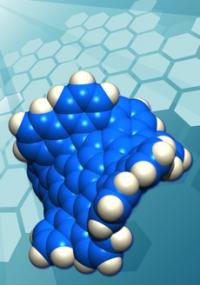 |
| Chemists at Boston College and Nagoya University in Japan have synthesized the first example of a new form of carbon. The new material consists of multiple identical pieces of "grossly warped graphene," each containing exactly 80 carbon atoms joined together in a network of 26 rings, with 30 hydrogen atoms decorating the rim. Because they measure slightly more than a nanometer across, these individual molecules are referred to generically as "nanocarbons."
Credit: Nature Chemistry |
Abstract:
Chemists at Boston College and Nagoya University in Japan have synthesized the first example of a new form of carbon, the team reports in the most recent online edition of the journal Nature Chemistry.
A new form of carbon: Grossly warped 'nanographene': Bucking planarity, contorted sheets of graphene alter physical, optical and electronic properties of new material
Chestnut Hill, MA | Posted on July 15th, 2013The new material consists of multiple identical pieces of grossly warped graphene, each containing exactly 80 carbon atoms joined together in a network of 26 rings, with 30 hydrogen atoms decorating the rim. Because they measure slightly more than a nanometer across, these individual molecules are referred to generically as "nanocarbons," or more specifically in this case as "grossly warped nanographenes."
Until recently, scientists had identified only two forms of pure carbon: diamond and graphite. Then in 1985, chemists were stunned by the discovery that carbon atoms could also join together to form hollow balls, known as fullerenes. Since then, scientists have also learned how to make long, ultra-thin, hollow tubes of carbon atoms, known as carbon nanotubes, and large flat single sheets of carbon atoms, known as graphene. The discovery of fullerenes was awarded the Nobel Prize in Chemistry in 1996, and the preparation of graphene was awarded the Nobel Prize in Physics in 2010.
Graphene sheets prefer planar, 2-dimensional geometries as a consequence of the hexagonal, chicken wire-like, arrangements of trigonal carbon atoms comprising their two-dimensional networks. The new form of carbon just reported in Nature Chemistry, however, is wildly distorted from planarity as a consequence of the presence of five 7-membered rings and one 5-membered ring embedded in the hexagonal lattice of carbon atoms.
Odd-membered-ring defects such as these not only distort the sheets of atoms away from planarity, they also alter the physical, optical, and electronic properties of the material, according to one of the principle authors, Lawrence T. Scott, the Jim and Louise Vanderslice and Family Professor of Chemistry at Boston College.
"Our new grossly warped nanographene is dramatically more soluble than a planar nanographene of comparable size," said Scott, "and the two differ significantly in color, as well. Electrochemical measurements revealed that the planar and the warped nanographenes are equally easily oxidized, but the warped nanographene is more difficult to reduce."
Graphene has been highly touted as a revolutionary material for nanoscale electronics. By introducing multiple odd-membered ring defects into the graphene lattice, Scott and his collaborators have experimentally demonstrated that the electronic properties of graphene can be modified in a predictable manner through precisely controlled chemical synthesis.
The leader of the team in Japan, Professor Kenichiro Itami, is Director of the Institute of Transformative Bio-Molecules at the University of Nagoya. The other authors of this paper include Dr. Yasutomo Segawa, an assistant professor at the University of Nagoya, Dr. Qianyan Zhang, a post-doctoral researcher at Boston College, and Katsuaki Kawasumi, a Ph.D. student from Nagoya who worked for three months during the course of this project as a visiting student at Boston College with a fellowship from the Japan Society for the Promotion of Science.
####
For more information, please click here
Contacts:
Ed Hayward
617-552-4826
Copyright © Boston College
If you have a comment, please Contact us.Issuers of news releases, not 7th Wave, Inc. or Nanotechnology Now, are solely responsible for the accuracy of the content.
Bookmark:


| Related News Press |
News and information
 Quantum computer improves AI predictions April 17th, 2026
Flexible sensor gains sensitivity under pressure April 17th, 2026
A reusable chip for particulate matter sensing April 17th, 2026
Detecting vibrational quantum beating in the predissociation dynamics of SF6 using time-resolved photoelectron spectroscopy April 17th, 2026
Chemistry
Projecting light to dispense liquids: A new route to ultra-precise microdroplets January 30th, 2026
From sensors to smart systems: the rise of AI-driven photonic noses January 30th, 2026
"Nanoreactor" cage uses visible light for catalytic and ultra-selective cross-cycloadditions October 3rd, 2025
Cambridge chemists discover simple way to build bigger molecules – one carbon at a time June 6th, 2025
Single-atom catalysts change spin state when boosted by a magnetic field June 4th, 2025
Graphene/ Graphite
Electrifying results shed light on graphene foam as a potential material for lab grown cartilage June 6th, 2025
Breakthrough in proton barrier films using pore-free graphene oxide: Kumamoto University researchers achieve new milestone in advanced coating technologies September 13th, 2024
Discoveries
Quantum computer improves AI predictions April 17th, 2026
Flexible sensor gains sensitivity under pressure April 17th, 2026
A reusable chip for particulate matter sensing April 17th, 2026
Detecting vibrational quantum beating in the predissociation dynamics of SF6 using time-resolved photoelectron spectroscopy April 17th, 2026
Materials/Metamaterials/Magnetoresistance
First real-time observation of two-dimensional melting process: Researchers at Mainz University unveil new insights into magnetic vortex structures August 8th, 2025
Researchers unveil a groundbreaking clay-based solution to capture carbon dioxide and combat climate change June 6th, 2025
A 1960s idea inspires NBI researchers to study hitherto inaccessible quantum states June 6th, 2025
Institute for Nanoscience hosts annual proposal planning meeting May 16th, 2025
Announcements
A fundamentally new therapeutic approach to cystic fibrosis: Nanobody repairs cellular defect April 17th, 2026
UC Irvine physicists discover method to reverse ‘quantum scrambling’ : The work addresses the problem of information loss in quantum computing system April 17th, 2026
Interviews/Book Reviews/Essays/Reports/Podcasts/Journals/White papers/Posters
A fundamentally new therapeutic approach to cystic fibrosis: Nanobody repairs cellular defect April 17th, 2026
UC Irvine physicists discover method to reverse ‘quantum scrambling’ : The work addresses the problem of information loss in quantum computing system April 17th, 2026
Photonics/Optics/Lasers
Metasurfaces smooth light to boost magnetic sensing precision January 30th, 2026
From sensors to smart systems: the rise of AI-driven photonic noses January 30th, 2026
Research partnerships
Lab to industry: InSe wafer-scale breakthrough for future electronics August 8th, 2025
HKU physicists uncover hidden order in the quantum world through deconfined quantum critical points April 25th, 2025
 |
||
 |
||
| The latest news from around the world, FREE | ||
 |
||
|
|
||
| Premium Products | ||
 |
||
|
Only the news you want to read!
Learn More |
||
 |
||
|
Full-service, expert consulting
Learn More |
||
|
|
||