Home > Press > Bringing down the cost of fuel cells: New catalyst dramatically cheaper without sacrificing performance
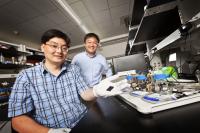 |
| Zhen (Jason) He, assistant professor of civil engineering (left), and Junhong Chen, professor of mechanical engineering, display a strip of carbon that contains the novel nanorod catalyst material they developed for microbial fuel cells.
Credit: Troye Fox |
Abstract:
Engineers at the University of Wisconsin-Milwaukee (UWM) have identified a catalyst that provides the same level of efficiency in microbial fuel cells (MFCs) as the currently used platinum catalyst, but at 5% of the cost.
Bringing down the cost of fuel cells: New catalyst dramatically cheaper without sacrificing performance
Milwaukee, WI | Posted on June 25th, 2012Since more than 60% of the investment in making microbial fuel cells is the cost of platinum, the discovery may lead to much more affordable energy conversion and storage devices.
The material - nitrogen-enriched iron-carbon nanorods - also has the potential to replace the platinum catalyst used in hydrogen-producing microbial electrolysis cells (MECs), which use organic matter to generate a possible alternative to fossil fuels.
"Fuel cells are capable of directly converting fuel into electricity," says UWM Professor Junhong Chen, who created the nanorods and is testing them with Assistant Professor Zhen (Jason) He. "With fuel cells, electrical power from renewable energy sources can be delivered where and when required, cleanly, efficiently and sustainably."
The scientists also found that the nanorod catalyst outperformed a graphene-based alternative being developed elsewhere. In fact, the pair tested the material against two other contenders to replace platinum and found the nanorods' performance consistently superior over a six-month period.
The nanorods have been proved stable and are scalable, says Chen, but more investigation is needed to determine how easily they can be mass-produced. More study is also required to determine the exact interaction responsible for the nanorods' performance.
The work was published in March in the journal Advanced Materials ("Nitrogen-Enriched Core-Shell Structured Fe/Fe3C-C Nanorods as Advanced Catalysts for Oxygen Reduction Reaction").
The right recipe
MFCs generate electricity while removing organic contaminants from wastewater. On the anode electrode of an MFC, colonies of bacteria feed on organic matter, releasing electrons that create a current as they break down the waste.
On the cathode side, the most important reaction in MFCs is the oxygen reduction reaction (ORR). Platinum speeds this slow reaction, increasing efficiency of the cell, but it is expensive.
Microbial electrolysis cells (MECs) are related to MFCs. However, instead of electricity, MECs produce hydrogen. In addition to harnessing microorganisms at the anode, MECS also use decomposition of organic matter and platinum in a catalytic process at their cathodes.
Chen and He's nanorods incorporate the best characteristics of other reactive materials, with nitrogen attached to the surface of the carbon rod and a core of iron carbide. Nitrogen's effectiveness at improving the carbon catalyst is already well known. Iron carbide, also known for its catalytic capabilities, interacts with the carbon on the rod surface, providing "communication" with the core. Also, the material's unique structure is optimal for electron transport, which is necessary for ORR.
When the nanorods were tested for potential use in MECs, the material did a better job than the graphene-based catalyst material, but it was still not as efficient as platinum.
"But it shows that there could be more diverse applications for this material, compared to graphene," says He. "And it gave us clues for why the nanorods performed differently in MECs."
Research with MECs was published in June in the journal Nano Energy ("Carbon/Iron-based Nanorod Catalysts for Hydrogen Production in Microbial Electrolysis Cells").
####
For more information, please click here
Contacts:
Jason He
414-229-5846
Copyright © University of Wisconsin - Milwaukee
If you have a comment, please Contact us.Issuers of news releases, not 7th Wave, Inc. or Nanotechnology Now, are solely responsible for the accuracy of the content.
Bookmark:


| Related News Press |
News and information
 Quantum computer improves AI predictions April 17th, 2026
Flexible sensor gains sensitivity under pressure April 17th, 2026
A reusable chip for particulate matter sensing April 17th, 2026
Detecting vibrational quantum beating in the predissociation dynamics of SF6 using time-resolved photoelectron spectroscopy April 17th, 2026
Chemistry
Projecting light to dispense liquids: A new route to ultra-precise microdroplets January 30th, 2026
From sensors to smart systems: the rise of AI-driven photonic noses January 30th, 2026
"Nanoreactor" cage uses visible light for catalytic and ultra-selective cross-cycloadditions October 3rd, 2025
Cambridge chemists discover simple way to build bigger molecules – one carbon at a time June 6th, 2025
Single-atom catalysts change spin state when boosted by a magnetic field June 4th, 2025
Graphene/ Graphite
Electrifying results shed light on graphene foam as a potential material for lab grown cartilage June 6th, 2025
Breakthrough in proton barrier films using pore-free graphene oxide: Kumamoto University researchers achieve new milestone in advanced coating technologies September 13th, 2024
Discoveries
Quantum computer improves AI predictions April 17th, 2026
Flexible sensor gains sensitivity under pressure April 17th, 2026
A reusable chip for particulate matter sensing April 17th, 2026
Detecting vibrational quantum beating in the predissociation dynamics of SF6 using time-resolved photoelectron spectroscopy April 17th, 2026
Announcements
A fundamentally new therapeutic approach to cystic fibrosis: Nanobody repairs cellular defect April 17th, 2026
UC Irvine physicists discover method to reverse ‘quantum scrambling’ : The work addresses the problem of information loss in quantum computing system April 17th, 2026
Energy
Sensors innovations for smart lithium-based batteries: advancements, opportunities, and potential challenges August 8th, 2025
Simple algorithm paired with standard imaging tool could predict failure in lithium metal batteries August 8th, 2025
Automotive/Transportation
Decoding hydrogen‑bond network of electrolyte for cryogenic durable aqueous zinc‑ion batteries January 30th, 2026
Sensors innovations for smart lithium-based batteries: advancements, opportunities, and potential challenges August 8th, 2025
Simple algorithm paired with standard imaging tool could predict failure in lithium metal batteries August 8th, 2025
Battery Technology/Capacitors/Generators/Piezoelectrics/Thermoelectrics/Energy storage
Decoding hydrogen‑bond network of electrolyte for cryogenic durable aqueous zinc‑ion batteries January 30th, 2026
COF scaffold membrane with gate‑lane nanostructure for efficient Li+/Mg2+ separation January 30th, 2026
MXene nanomaterials enter a new dimension Multilayer nanomaterial: MXene flakes created at Drexel University show new promise as 1D scrolls January 30th, 2026
Fuel Cells
Deciphering local microstrain-induced optimization of asymmetric Fe single atomic sites for efficient oxygen reduction August 8th, 2025
Current and Future Developments in Nanomaterials and Carbon Nanotubes: Applications of Nanomaterials in Energy Storage and Electronics October 28th, 2022
 |
||
 |
||
| The latest news from around the world, FREE | ||
 |
||
|
|
||
| Premium Products | ||
 |
||
|
Only the news you want to read!
Learn More |
||
 |
||
|
Full-service, expert consulting
Learn More |
||
|
|
||