Home > Press > Better biosensor technology created for stem cells: Rutgers innovation may help guide treatment of Alzheimer's, Parkinson's diseases
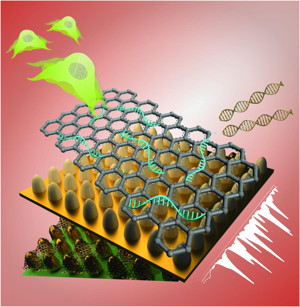 |
| This unique biosensing platform consists of an array of ultrathin graphene layers and gold nanostructures. The platform, combined with high-tech imaging (Raman spectroscopy), detects genetic material (RNA) and characterizes different kinds of stem cells with greater reliability, selectivity and sensitivity than today's biosensors. CREDIT Letao Yang, KiBum Lee, Jin-Ho Lee and Sy-Tsong (Dean) Chueng |
Abstract:
A Rutgers-led team has created better biosensor technology that may help lead to safe stem cell therapies for treating Alzheimer's and Parkinson's diseases and other neurological disorders.
Better biosensor technology created for stem cells: Rutgers innovation may help guide treatment of Alzheimer's, Parkinson's diseases
New Brunswick, NJ | Posted on November 12th, 2019The technology, which features a unique graphene and gold-based platform and high-tech imaging, monitors the fate of stem cells by detecting genetic material (RNA) involved in turning such cells into brain cells (neurons), according to a study in the journal Nano Letters.
Stem cells can become many different types of cells. As a result, stem cell therapy shows promise for regenerative treatment of neurological disorders such as Alzheimer's, Parkinson's, stroke and spinal cord injury, with diseased cells needing replacement or repair. But characterizing stem cells and controlling their fate must be resolved before they could be used in treatments. The formation of tumors and uncontrolled transformation of stem cells remain key barriers.
"A critical challenge is ensuring high sensitivity and accuracy in detecting biomarkers - indicators such as modified genes or proteins - within the complex stem cell microenvironment," said senior author KiBum Lee, a professor in the Department of Chemistry and Chemical Biology in the School of Arts and Sciences at Rutgers University-New Brunswick. "Our technology, which took four years to develop, has demonstrated great potential for analyzing a variety of interactions in stem cells."
The team's unique biosensing platform consists of an array of ultrathin graphene layers and gold nanostructures. The platform, combined with high-tech imaging (Raman spectroscopy), detects genes and characterizes different kinds of stem cells with greater reliability, selectivity and sensitivity than today's biosensors.
The team believes the technology can benefit a range of applications. By developing simple, rapid and accurate sensing platforms, Lee's group aims to facilitate treatment of neurological disorders through stem cell therapy.
Stem cells may become a renewable source of replacement cells and tissues to treat diseases including macular degeneration, spinal cord injury, stroke, burns, heart disease, diabetes, osteoarthritis and rheumatoid arthritis, according to the National Institutes of Health.
###
The study's co-lead authors are Letao Yang and Jin-Ho Lee, postdoctoral researchers in Lee's group. Rutgers co-authors include doctoral students Christopher Rathnam and Yannan Hou. A scientist at Sogang University in South Korea contributed to the study.
####
For more information, please click here
Contacts:
Todd Bates
848-932-0550
@RutgersU
Copyright © Rutgers University
If you have a comment, please Contact us.Issuers of news releases, not 7th Wave, Inc. or Nanotechnology Now, are solely responsible for the accuracy of the content.
Bookmark:


| Related Links |
| Related News Press |
News and information
 Quantum computer improves AI predictions April 17th, 2026
Flexible sensor gains sensitivity under pressure April 17th, 2026
A reusable chip for particulate matter sensing April 17th, 2026
Detecting vibrational quantum beating in the predissociation dynamics of SF6 using time-resolved photoelectron spectroscopy April 17th, 2026
2 Dimensional Materials
Flexible sensor gains sensitivity under pressure April 17th, 2026
Graphene/ Graphite
Electrifying results shed light on graphene foam as a potential material for lab grown cartilage June 6th, 2025
Breakthrough in proton barrier films using pore-free graphene oxide: Kumamoto University researchers achieve new milestone in advanced coating technologies September 13th, 2024
Govt.-Legislation/Regulation/Funding/Policy
Quantum computer improves AI predictions April 17th, 2026
Metasurfaces smooth light to boost magnetic sensing precision January 30th, 2026
New imaging approach transforms study of bacterial biofilms August 8th, 2025
Possible Futures
A fundamentally new therapeutic approach to cystic fibrosis: Nanobody repairs cellular defect April 17th, 2026
UC Irvine physicists discover method to reverse ‘quantum scrambling’ : The work addresses the problem of information loss in quantum computing system April 17th, 2026
Nanomedicine
A fundamentally new therapeutic approach to cystic fibrosis: Nanobody repairs cellular defect April 17th, 2026
New molecular technology targets tumors and simultaneously silences two ‘undruggable’ cancer genes August 8th, 2025
New imaging approach transforms study of bacterial biofilms August 8th, 2025
Electrifying results shed light on graphene foam as a potential material for lab grown cartilage June 6th, 2025
Sensors
Flexible sensor gains sensitivity under pressure April 17th, 2026
Tiny nanosheets, big leap: A new sensor detects ethanol at ultra-low levels January 30th, 2026
From sensors to smart systems: the rise of AI-driven photonic noses January 30th, 2026
Sensors innovations for smart lithium-based batteries: advancements, opportunities, and potential challenges August 8th, 2025
Discoveries
Quantum computer improves AI predictions April 17th, 2026
Flexible sensor gains sensitivity under pressure April 17th, 2026
A reusable chip for particulate matter sensing April 17th, 2026
Detecting vibrational quantum beating in the predissociation dynamics of SF6 using time-resolved photoelectron spectroscopy April 17th, 2026
Announcements
A fundamentally new therapeutic approach to cystic fibrosis: Nanobody repairs cellular defect April 17th, 2026
UC Irvine physicists discover method to reverse ‘quantum scrambling’ : The work addresses the problem of information loss in quantum computing system April 17th, 2026
Interviews/Book Reviews/Essays/Reports/Podcasts/Journals/White papers/Posters
A fundamentally new therapeutic approach to cystic fibrosis: Nanobody repairs cellular defect April 17th, 2026
UC Irvine physicists discover method to reverse ‘quantum scrambling’ : The work addresses the problem of information loss in quantum computing system April 17th, 2026
Grants/Sponsored Research/Awards/Scholarships/Gifts/Contests/Honors/Records
Quantum computer improves AI predictions April 17th, 2026
Detecting vibrational quantum beating in the predissociation dynamics of SF6 using time-resolved photoelectron spectroscopy April 17th, 2026
Metasurfaces smooth light to boost magnetic sensing precision January 30th, 2026
Nanobiotechnology
A fundamentally new therapeutic approach to cystic fibrosis: Nanobody repairs cellular defect April 17th, 2026
New molecular technology targets tumors and simultaneously silences two ‘undruggable’ cancer genes August 8th, 2025
New imaging approach transforms study of bacterial biofilms August 8th, 2025
Electrifying results shed light on graphene foam as a potential material for lab grown cartilage June 6th, 2025
Research partnerships
Lab to industry: InSe wafer-scale breakthrough for future electronics August 8th, 2025
HKU physicists uncover hidden order in the quantum world through deconfined quantum critical points April 25th, 2025
 |
||
 |
||
| The latest news from around the world, FREE | ||
 |
||
|
|
||
| Premium Products | ||
 |
||
|
Only the news you want to read!
Learn More |
||
 |
||
|
Full-service, expert consulting
Learn More |
||
|
|
||