Home > Press > Self-powered wearable tech
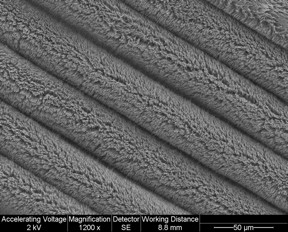 |
| For emerging wearable tech to advance, it needs improved power sources. Now researchers from Michigan State University have provided a potential solution via crumpled carbon nanotube forests, or CNT forests. CREDIT Courtesy of MSU |
Abstract:
For emerging wearable tech to advance, it needs improved power sources. Now researchers from Michigan State University have provided a potential solution via crumpled carbon nanotube forests, or CNT forests.
Self-powered wearable tech
East Lansing, MI | Posted on May 8th, 2019Changyong Cao, director of MSU's Soft Machines and Electronics Laboratory, led a team of scientists in creating highly stretchable supercapacitors for powering wearable electronics. The newly developed supercapacitor has demonstrated solid performance and stability, even when it is stretched to 800% of its original size for thousands of stretching/relaxing cycles.
The team's results, published in the journal Advanced Energy Materials, may spur the development of new stretchable energy electronic systems, implantable biomedical devices, as well as smart packaging systems.
"The key to success is the innovative approach of crumpling vertically aligned CNT arrays, or CNT forests," said Cao, MSU School of Packaging assistant professor. "Instead of having a flat thin film strictly constrained during fabrication, our design enables the three-dimensionally interconnected CNT forest to maintain good electrical conductivity, making it much more efficient, reliable and robust."
Most people know wearable tech in its basic form as iWatches that communicate with smartphones. In this example, that's two pieces of technology that need batteries. Now imagine patches of smart skin for burn victims that can monitor healing while powering themselves - that's the future that Cao's invention can create.
In the medical field, stretchable/wearable electronics are being developed that are capable of extreme contortions and can conform to complicated, uneven surfaces. In the future, these innovations could be integrated into biological tissues and organs to detect disease, monitor improvement and even communicate with medical practitioners.
The vexing problem, however, has been a complementary wearable power source - one that lasts and is durable. Why develop cool new patches if they have to run off bulky battery packs that get hot and require recharging? (That's extreme, but you get the idea.)
Cao's discovery is the first to use crumpled standing CNTs for stretchable energy storage applications, which grow like trees with their canopies tangled on wafers. This forest, however, is merely 10-30 micrometers high. After transferred and crumpled, the CNT forest forms impressive stretchable patterns, like a blanket. The 3D interconnected CNT forest has a larger surface area and can be easily modified with nanoparticles or adapted to other designs.
"It's more robust; it's truly a design breakthrough," said Cao, who's also an assistant professor in mechanical engineering and electrical and computer engineering. "Even when it's stretched up to 300% along each direction, it still conducts efficiently. Other designs lose efficiency, can usually be stretched in only one direction or malfunction completely when they are stretched at much lower levels."
In terms of its ability to collect and store energy, Cao's crumpled nano-forests outperformed most other CNT-based supercapacitors that are known to exist. Even though the top-performing technology can endure thousands of stretching/relaxing cycles, there's still room for improvement.
Metal oxide nanoparticles can be easily impregnated into the crumpled CNTs so that the invention's efficiency improves much more. The newly invented approach should spark the advancement of self-powered stretchable electronic systems, Cao added.
###
Co-authors contributing to this research include: Yihao Zhou, Jeffrey Glass, Philemon Henry and Charles Parker, Duke University; Stephen Ubnoske, U.S. Naval Research Laboratory; Jianfeng Zang, Huazhong University of Science and Technology (China); and Yunteng Cao, Massachusetts Institute of Technology.
This research was funded in part by the United State Department of Agriculture and the National Science Foundation.
####
About Michigan State University
Michigan State University has been working to advance the common good in uncommon ways for 160 years. One of the top research universities in the world, MSU focuses its vast resources on creating solutions to some of the world's most pressing challenges, while providing life-changing opportunities to a diverse and inclusive academic community through more than 200 programs of study in 17 degree-granting colleges.
For MSU news on the Web, go to MSUToday. Follow MSU News on Twitter at twitter.com/MSUnews.
For more information, please click here
Contacts:
Layne Cameron
517-353-8819
Copyright © Michigan State University
If you have a comment, please Contact us.Issuers of news releases, not 7th Wave, Inc. or Nanotechnology Now, are solely responsible for the accuracy of the content.
Bookmark:


| Related Links |
| Related News Press |
News and information
 Quantum computer improves AI predictions April 17th, 2026
Flexible sensor gains sensitivity under pressure April 17th, 2026
A reusable chip for particulate matter sensing April 17th, 2026
Detecting vibrational quantum beating in the predissociation dynamics of SF6 using time-resolved photoelectron spectroscopy April 17th, 2026
Laboratories
Researchers develop molecular qubits that communicate at telecom frequencies October 3rd, 2025
Wearable electronics
Breakthrough brings body-heat powered wearable devices closer to reality December 13th, 2024
Beyond wires: Bubble technology powers next-generation electronics:New laser-based bubble printing technique creates ultra-flexible liquid metal circuits November 8th, 2024
Nanofibrous metal oxide semiconductor for sensory face November 8th, 2024
Govt.-Legislation/Regulation/Funding/Policy
Quantum computer improves AI predictions April 17th, 2026
Metasurfaces smooth light to boost magnetic sensing precision January 30th, 2026
New imaging approach transforms study of bacterial biofilms August 8th, 2025
Possible Futures
A fundamentally new therapeutic approach to cystic fibrosis: Nanobody repairs cellular defect April 17th, 2026
UC Irvine physicists discover method to reverse ‘quantum scrambling’ : The work addresses the problem of information loss in quantum computing system April 17th, 2026
Nanotubes/Buckyballs/Fullerenes/Nanorods/Nanostrings/Nanosheets
Tiny nanosheets, big leap: A new sensor detects ethanol at ultra-low levels January 30th, 2026
Enhancing power factor of p- and n-type single-walled carbon nanotubes April 25th, 2025
Chainmail-like material could be the future of armor: First 2D mechanically interlocked polymer exhibits exceptional flexibility and strength January 17th, 2025
Innovative biomimetic superhydrophobic coating combines repair and buffering properties for superior anti-erosion December 13th, 2024
Discoveries
Quantum computer improves AI predictions April 17th, 2026
Flexible sensor gains sensitivity under pressure April 17th, 2026
A reusable chip for particulate matter sensing April 17th, 2026
Detecting vibrational quantum beating in the predissociation dynamics of SF6 using time-resolved photoelectron spectroscopy April 17th, 2026
Announcements
A fundamentally new therapeutic approach to cystic fibrosis: Nanobody repairs cellular defect April 17th, 2026
UC Irvine physicists discover method to reverse ‘quantum scrambling’ : The work addresses the problem of information loss in quantum computing system April 17th, 2026
Interviews/Book Reviews/Essays/Reports/Podcasts/Journals/White papers/Posters
A fundamentally new therapeutic approach to cystic fibrosis: Nanobody repairs cellular defect April 17th, 2026
UC Irvine physicists discover method to reverse ‘quantum scrambling’ : The work addresses the problem of information loss in quantum computing system April 17th, 2026
Military
Quantum engineers ‘squeeze’ laser frequency combs to make more sensitive gas sensors January 17th, 2025
Chainmail-like material could be the future of armor: First 2D mechanically interlocked polymer exhibits exceptional flexibility and strength January 17th, 2025
Single atoms show their true color July 5th, 2024
NRL charters Navy’s quantum inertial navigation path to reduce drift April 5th, 2024
Battery Technology/Capacitors/Generators/Piezoelectrics/Thermoelectrics/Energy storage
Decoding hydrogen‑bond network of electrolyte for cryogenic durable aqueous zinc‑ion batteries January 30th, 2026
COF scaffold membrane with gate‑lane nanostructure for efficient Li+/Mg2+ separation January 30th, 2026
MXene nanomaterials enter a new dimension Multilayer nanomaterial: MXene flakes created at Drexel University show new promise as 1D scrolls January 30th, 2026
Grants/Sponsored Research/Awards/Scholarships/Gifts/Contests/Honors/Records
Quantum computer improves AI predictions April 17th, 2026
Detecting vibrational quantum beating in the predissociation dynamics of SF6 using time-resolved photoelectron spectroscopy April 17th, 2026
Metasurfaces smooth light to boost magnetic sensing precision January 30th, 2026
 |
||
 |
||
| The latest news from around the world, FREE | ||
 |
||
|
|
||
| Premium Products | ||
 |
||
|
Only the news you want to read!
Learn More |
||
 |
||
|
Full-service, expert consulting
Learn More |
||
|
|
||