Home > Press > Math gets real in strong, lightweight structures: Rice University researchers use 3-D printers to turn century-old theory into complex schwarzites
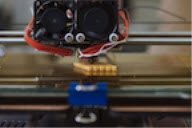 |
| A 3-D printer sketches out a schwarzite in a Rice University laboratory. The curved surface of a schwarzite repeats throughout the structure, which shows excellent strength and deformation characteristics. (Credit: Brandon Martin/Rice University) |
Abstract:
Rice University engineers are using 3-D printers to turn structures that have until now existed primarily in theory into strong, light and durable materials with complex, repeating patterns.
Video produced by Brandon Martin/Rice University
Math gets real in strong, lightweight structures: Rice University researchers use 3-D printers to turn century-old theory into complex schwarzites
Houston, TX | Posted on November 16th, 2017The porous structures called schwarzites are designed with computer algorithms, but Rice researchers found they could send data from the programs to printers and make macroscale, polymer models for testing. Their samples strive to use as little material as possible and still provide strength and compressibility.
The results reported in Advanced Materials are works of art that may someday lead to nanoscale electronic devices, catalysts, molecular sieves and battery components, and on the macroscale could become high-load-bearing, impact-resistant components for buildings, cars and aircraft.
It may someday be possible, they said, to print an entire building as one schwarzite "brick."
Schwarzites, named after German scientist Hermann Schwarz, who hypothesized the structures in the 1880s, are mathematical marvels that have inspired a large number of organic and inorganic constructs and materials. The discovery at Rice of the Nobel Prize-winning buckminsterfullerene (or buckyball) provided further inspiration for scientists to explore the design of 3-D forms from 2-D surfaces.
Such structures remained theoretical until 3-D printers provided the first practical way to make them. The Rice lab of materials scientist Pulickel Ajayan, in collaboration with researchers at the University of Campinas, São Paulo, investigated the bottom-up construction of schwarzites through molecular dynamics simulations and then printed those simulations in the shapes of polymer cubes.
"The geometries of these are really complex; everything is curved, the internal surfaces have negative curvature and the morphologies are very interesting," said Rice postdoctoral researcher Chandra Sekhar Tiwary, who led an earlier study that showed how seashells protect soft bodies from extreme pressure by transferring stress throughout their structures.
"Schwarzite structures are very much the same," he said. "The theory shows that at the atomic scale, these materials can be very strong. It turns out that making the geometry bigger with polymer gives us a material with a high load-bearing capacity."
Schwarzites also displayed excellent deformation characteristics, he said. "The way a material breaks is important," Tiwary said. "You don't want things to break catastrophically; you want them to break slowly. These structures are beautiful because if you apply force to one side, they deform slowly, layer by layer.
"You can make a whole building out of this material, and if something falls on it, it's going to collapse slowly, so what's inside will be protected," he said.
Because they can take a variety of forms, the Rice team limited its investigation to primitive and gyroid structures, which have periodic minimal surfaces as originally conceived by Schwarz. In tests, both transferred loads across the entire geometry of the structures no matter which side was compressed. That held true in the atom-level simulations as well as for the printed models.
That was unexpected, said Douglas Galvão, a professor at the University of Campinas who studies nanostructures through molecular dynamics simulations. He suggested the project when Tiwary visited the Brazil campus as a research fellow through the American Physical Society and Brazilian Physical Society.
"It is a little surprising that some atomic-scale features are preserved in the printed structures," Galvão said. "We discussed that it would be nice if we could translate schwarzite atomic models into 3-D printed structures. After some tentatives, it worked quite well. This paper is a good example of an effective theory-experiment collaboration."
The researchers said their next step will be to refine the surfaces with higher-resolution printers and further minimize the amount of polymer to make the blocks even lighter. In the far future, they envision printing 3-D schwarzites with ceramic and metallic materials on a grander scale.
"There's no reason these have to be blocks," said co-author and Rice graduate student Peter Owuor. "We're basically making perfect crystals that start with a single cell that we can replicate in all directions."
Rice research assistant Seyed Mohammad Sajadi is lead author of the paper. Co-authors are Rice senior Steven Schara, Associate Research Professor Robert Vajtai and Jun Lou, a professor of materials science and nanoengineering, all of Rice; and postdoctoral researcher Cristiano Woellner and Professor Varlei Rodrigues of the University of Campinas. Ajayan is chair of Rice’s Department of Materials Science and NanoEngineering, the Benjamin M. and Mary Greenwood Anderson Professor in Engineering and a professor of chemistry.
The Air Force Office of Scientific Research and its Multidisciplinary University Research Initiative, the São Paulo Research Foundation and the Center for Computational Engineering and Sciences at the State University of Campinas supported the research.
-30-
####
About Rice University
Located on a 300-acre forested campus in Houston, Rice University is consistently ranked among the nation’s top 20 universities by U.S. News & World Report. Rice has highly respected schools of Architecture, Business, Continuing Studies, Engineering, Humanities, Music, Natural Sciences and Social Sciences and is home to the Baker Institute for Public Policy. With 3,879 undergraduates and 2,861 graduate students, Rice’s undergraduate student-to-faculty ratio is 6-to-1. Its residential college system builds close-knit communities and lifelong friendships, just one reason why Rice is ranked No. 1 for quality of life and for lots of race/class interaction and No. 2 for happiest students by the Princeton Review. Rice is also rated as a best value among private universities by Kiplinger’s Personal Finance. To read “What they’re saying about Rice,” go to http://tinyurl.com/RiceUniversityoverview .
Follow Rice News and Media Relations via Twitter @RiceUNews
For more information, please click here
Contacts:
David Ruth
713-348-6327
Mike Williams
713-348-6728
Copyright © Rice University
If you have a comment, please Contact us.Issuers of news releases, not 7th Wave, Inc. or Nanotechnology Now, are solely responsible for the accuracy of the content.
Bookmark:


| Related Links |
 Read the abstract at DOI: 10.1002/adma.201704820:
Rice Department of Materials Science and NanoEngineering:
| Related News Press |
News and information
Quantum computer improves AI predictions April 17th, 2026
Flexible sensor gains sensitivity under pressure April 17th, 2026
A reusable chip for particulate matter sensing April 17th, 2026
Detecting vibrational quantum beating in the predissociation dynamics of SF6 using time-resolved photoelectron spectroscopy April 17th, 2026
2 Dimensional Materials
Flexible sensor gains sensitivity under pressure April 17th, 2026
First real-time observation of two-dimensional melting process: Researchers at Mainz University unveil new insights into magnetic vortex structures August 8th, 2025
Lab to industry: InSe wafer-scale breakthrough for future electronics August 8th, 2025
Videos/Movies
ICFO researchers overcome long-standing bottleneck in single photon detection with twisted 2D materials August 8th, 2025
New X-ray imaging technique to study the transient phases of quantum materials December 29th, 2022
3D & 4D printing/Additive-manufacturing
Presenting: Ultrasound-based printing of 3D materials—potentially inside the body December 8th, 2023
Fiber sensing scientists invent 3D printed fiber microprobe for measuring in vivo biomechanical properties of tissue and even single cell February 10th, 2023
3D-printed decoder, AI-enabled image compression could enable higher-res displays December 9th, 2022
Possible Futures
A fundamentally new therapeutic approach to cystic fibrosis: Nanobody repairs cellular defect April 17th, 2026
UC Irvine physicists discover method to reverse ‘quantum scrambling’ : The work addresses the problem of information loss in quantum computing system April 17th, 2026
Discoveries
Quantum computer improves AI predictions April 17th, 2026
Flexible sensor gains sensitivity under pressure April 17th, 2026
A reusable chip for particulate matter sensing April 17th, 2026
Detecting vibrational quantum beating in the predissociation dynamics of SF6 using time-resolved photoelectron spectroscopy April 17th, 2026
Materials/Metamaterials/Magnetoresistance
First real-time observation of two-dimensional melting process: Researchers at Mainz University unveil new insights into magnetic vortex structures August 8th, 2025
Researchers unveil a groundbreaking clay-based solution to capture carbon dioxide and combat climate change June 6th, 2025
A 1960s idea inspires NBI researchers to study hitherto inaccessible quantum states June 6th, 2025
Institute for Nanoscience hosts annual proposal planning meeting May 16th, 2025
Announcements
A fundamentally new therapeutic approach to cystic fibrosis: Nanobody repairs cellular defect April 17th, 2026
UC Irvine physicists discover method to reverse ‘quantum scrambling’ : The work addresses the problem of information loss in quantum computing system April 17th, 2026
Interviews/Book Reviews/Essays/Reports/Podcasts/Journals/White papers/Posters
A fundamentally new therapeutic approach to cystic fibrosis: Nanobody repairs cellular defect April 17th, 2026
UC Irvine physicists discover method to reverse ‘quantum scrambling’ : The work addresses the problem of information loss in quantum computing system April 17th, 2026
Military
Quantum engineers ‘squeeze’ laser frequency combs to make more sensitive gas sensors January 17th, 2025
Chainmail-like material could be the future of armor: First 2D mechanically interlocked polymer exhibits exceptional flexibility and strength January 17th, 2025
Single atoms show their true color July 5th, 2024
NRL charters Navy’s quantum inertial navigation path to reduce drift April 5th, 2024
Grants/Sponsored Research/Awards/Scholarships/Gifts/Contests/Honors/Records
Quantum computer improves AI predictions April 17th, 2026
Detecting vibrational quantum beating in the predissociation dynamics of SF6 using time-resolved photoelectron spectroscopy April 17th, 2026
Metasurfaces smooth light to boost magnetic sensing precision January 30th, 2026
Photonics/Optics/Lasers
Metasurfaces smooth light to boost magnetic sensing precision January 30th, 2026
From sensors to smart systems: the rise of AI-driven photonic noses January 30th, 2026
Printing/Lithography/Inkjet/Inks/Bio-printing/Dyes
Presenting: Ultrasound-based printing of 3D materials—potentially inside the body December 8th, 2023
Simple ballpoint pen can write custom LEDs August 11th, 2023
Disposable electronics on a simple sheet of paper October 7th, 2022
 |
||
 |
||
| The latest news from around the world, FREE | ||
 |
||
|
|
||
| Premium Products | ||
 |
||
|
Only the news you want to read!
Learn More |
||
 |
||
|
Full-service, expert consulting
Learn More |
||
|
|
||