Home > Press > Three-dimensional graphene: Experiment at BESSY II shows that optical properties are tuneable
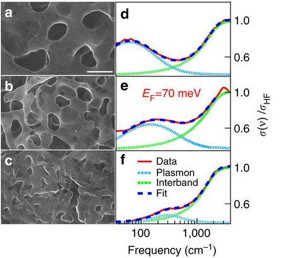 |
| SEM-images of 3-D graphene with different pore size (a,b,c, scale = 1μm) are shown. Optical properties (d,e,f) change with pore size. CREDIT Nature Communications: 10.1038/ncomms14885 |
Abstract:
Carbon is a very versatile element. It not only forms diamonds, graphite, and coal, but can also take a planar form as a hexagonal matrix - graphene. This material, consisting of only a single atomic layer, possesses many extreme properties. It is highly conductive, optically transparent, and is mechanically flexible as well as able to withstand loads. André Geim and Konstantin Novoselov received the 2010 Nobel Prize in Physics for the discovery of this exotic form of carbon. And just recently, a Japanese team has been successful in stacking two-dimensional graphene layers in a three-dimensional architecture with nanometre-sized pores.
Three-dimensional graphene: Experiment at BESSY II shows that optical properties are tuneable
Berlin, Germany | Posted on May 24th, 2017Tuneable plasmons
A research team operated by a group at Sapienza University in Rome has now for the first time made a detailed investigation of the optical properties of 3D graphene at BESSY II. The team was able to ascertain from the data how charge density oscillations, known as plasmons, propagate in three-dimensional graphene. In doing so, they determined that these plasmons follow the same physical laws as 2D graphene. However, the frequency of the plasmons in 3D graphene can be very precisely controlled, either by introducing atomic impurities (doping), by the size of the nanopores, or by attaching specific molecules in certain ways to the graphene. In this way, the novel material might also lend itself to manufacturing specific chemical sensors, as the authors write in Nature Communications. In addition, the new material is interesting as an electrode material for employment in solar cells.
Advantages provided by the IRIS beamline
The researchers used the IRIS beamline at the BESSY II synchrotron source in Berlin to their advantage for their investigations. Broad-band infrared is available there, which especially facilitates spectroscopic analysis of novel materials using terahertz radiation. "A special operating mode of the BESSY II storage ring called low-alpha allowed us to measure the optical conductivity of three-dimensional graphene with a particularly high signal-to-noise ratio. This is hardly possible with standard methods, especially in the terahertz region. However, it is exactly this region that is important for observing critical physical properties", says Dr. Ulrich Schade, head of the group at the infrared beamline.
####
For more information, please click here
Contacts:
Dr. Antonia Roetger
49-308-062-43733
Copyright © Helmholtz-Zentrum Berlin für Materialien und Energie
If you have a comment, please Contact us.Issuers of news releases, not 7th Wave, Inc. or Nanotechnology Now, are solely responsible for the accuracy of the content.
Bookmark:


| Related Links |
| Related News Press |
News and information
 Quantum computer improves AI predictions April 17th, 2026
Flexible sensor gains sensitivity under pressure April 17th, 2026
A reusable chip for particulate matter sensing April 17th, 2026
Detecting vibrational quantum beating in the predissociation dynamics of SF6 using time-resolved photoelectron spectroscopy April 17th, 2026
Graphene/ Graphite
Electrifying results shed light on graphene foam as a potential material for lab grown cartilage June 6th, 2025
Breakthrough in proton barrier films using pore-free graphene oxide: Kumamoto University researchers achieve new milestone in advanced coating technologies September 13th, 2024
NRL discovers two-dimensional waveguides February 16th, 2024
Plasmonics
Unveiling the power of hot carriers in plasmonic nanostructures August 16th, 2024
Possible Futures
A fundamentally new therapeutic approach to cystic fibrosis: Nanobody repairs cellular defect April 17th, 2026
UC Irvine physicists discover method to reverse ‘quantum scrambling’ : The work addresses the problem of information loss in quantum computing system April 17th, 2026
Discoveries
Quantum computer improves AI predictions April 17th, 2026
Flexible sensor gains sensitivity under pressure April 17th, 2026
A reusable chip for particulate matter sensing April 17th, 2026
Detecting vibrational quantum beating in the predissociation dynamics of SF6 using time-resolved photoelectron spectroscopy April 17th, 2026
Announcements
A fundamentally new therapeutic approach to cystic fibrosis: Nanobody repairs cellular defect April 17th, 2026
UC Irvine physicists discover method to reverse ‘quantum scrambling’ : The work addresses the problem of information loss in quantum computing system April 17th, 2026
Interviews/Book Reviews/Essays/Reports/Podcasts/Journals/White papers/Posters
A fundamentally new therapeutic approach to cystic fibrosis: Nanobody repairs cellular defect April 17th, 2026
UC Irvine physicists discover method to reverse ‘quantum scrambling’ : The work addresses the problem of information loss in quantum computing system April 17th, 2026
Energy
Sensors innovations for smart lithium-based batteries: advancements, opportunities, and potential challenges August 8th, 2025
Simple algorithm paired with standard imaging tool could predict failure in lithium metal batteries August 8th, 2025
Research partnerships
Lab to industry: InSe wafer-scale breakthrough for future electronics August 8th, 2025
HKU physicists uncover hidden order in the quantum world through deconfined quantum critical points April 25th, 2025
Solar/Photovoltaic
Spinel-type sulfide semiconductors to operate the next-generation LEDs and solar cells For solar-cell absorbers and green-LED source October 3rd, 2025
KAIST researchers introduce new and improved, next-generation perovskite solar cell November 8th, 2024
Groundbreaking precision in single-molecule optoelectronics August 16th, 2024
Development of zinc oxide nanopagoda array photoelectrode: photoelectrochemical water-splitting hydrogen production January 12th, 2024
 |
||
 |
||
| The latest news from around the world, FREE | ||
 |
||
|
|
||
| Premium Products | ||
 |
||
|
Only the news you want to read!
Learn More |
||
 |
||
|
Full-service, expert consulting
Learn More |
||
|
|
||