Home > Press > Molecular phenomenon discovered by advanced NMR facility: Cutting edge technology has shown a molecule self-assembling into different forms when passing between solution state to solid state, and back again - a curious phenomenon in science - says research by the University of Wa
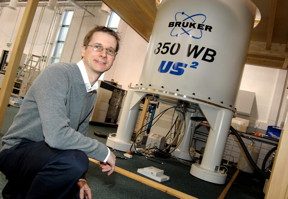 |
| Professor Steven Brown at the NMR facility is shown. CREDIT University of Warwick |
Abstract:
•Cutting edge tech shows molecule self-assembling into different forms passing from solution state to solid state and back again - a curious phenomenon in science - says University of Warwick research
•Phenomenon discovered using state-of-the-art national solid-state NMR facility at Warwick
•Research published by Chemistry: A European Journal - designated as 'Very Important Paper'
Molecular phenomenon discovered by advanced NMR facility: Cutting edge technology has shown a molecule self-assembling into different forms when passing between solution state to solid state, and back again - a curious phenomenon in science - says research by the University of Wa
Coventry, UK | Posted on February 22nd, 2017Cutting edge technology has shown a molecule self-assembling into different forms when passing between solution state to solid state, and back again - a curious phenomenon in science - says research by the University of Warwick.
Professor Steven P. Brown from the Department of Physics, with colleagues in the Department of Chemistry, have identified that the supramolecular structure of a guanosine derivative can be different upon passing from the solid state into the solution state and vice versa.
This defies chemical precedent, as self-assembled structures driven by the formation of specific intermolecular hydrogen bonds in solution would be expected to remain the same in the solid state.
The phenomenon was revealed by the state-of-the-art nuclear magnetic resonance (NMR) facility at Warwick.
In solution state, the guanosine derivative analysed by the researchers is constituted by quartet-like molecular structure - and scientific intuition would suggests that this should remain like this in the solid state.
However, upon changing into the solid state, the supramolecular assembly surprisingly contains both quartet and ribbon structures.
Professor Brown and his colleagues made this discovery using advanced NMR spectroscopy technology, which measures the magnetic response of nuclei at the centre of atoms.
The researchers identified the distinct supramolecular states by spotting varying peaks in spectra that identify close approach of these magnetic nuclei in atoms.
Professor Brown comments:
"Access to state-of-the-art NMR infrastructure has enabled us to see with chemical precision how the guanosine-based molecules self-assemble, thus revealing the surprising phenomenon of a change in self-assembly upon going changing from solution to solid and from solid to solution."
###
The University of Warwick's national solid-state NMR facility is directed by Professor Brown and a Facility Executive with scientists from 4 other UK universities - and was officially launched in 2010. The facility and this research is funded by the Engineering and Physical Sciences Research Council.
Professor Brown collaborated with researchers in Italy and the U.S.A.
####
For more information, please click here
Contacts:
Luke Walton
44-782-454-0863
Copyright © University of Warwick
If you have a comment, please Contact us.Issuers of news releases, not 7th Wave, Inc. or Nanotechnology Now, are solely responsible for the accuracy of the content.
Bookmark:


| Related Links |
| Related News Press |
News and information
 Quantum computer improves AI predictions April 17th, 2026
Flexible sensor gains sensitivity under pressure April 17th, 2026
A reusable chip for particulate matter sensing April 17th, 2026
Detecting vibrational quantum beating in the predissociation dynamics of SF6 using time-resolved photoelectron spectroscopy April 17th, 2026
Imaging
Chemistry
Projecting light to dispense liquids: A new route to ultra-precise microdroplets January 30th, 2026
From sensors to smart systems: the rise of AI-driven photonic noses January 30th, 2026
"Nanoreactor" cage uses visible light for catalytic and ultra-selective cross-cycloadditions October 3rd, 2025
Govt.-Legislation/Regulation/Funding/Policy
Quantum computer improves AI predictions April 17th, 2026
Metasurfaces smooth light to boost magnetic sensing precision January 30th, 2026
New imaging approach transforms study of bacterial biofilms August 8th, 2025
Self Assembly
Diamond glitter: A play of colors with artificial DNA crystals May 17th, 2024
Liquid crystal templated chiral nanomaterials October 14th, 2022
Nanoclusters self-organize into centimeter-scale hierarchical assemblies April 22nd, 2022
Atom by atom: building precise smaller nanoparticles with templates March 4th, 2022
Discoveries
Quantum computer improves AI predictions April 17th, 2026
Flexible sensor gains sensitivity under pressure April 17th, 2026
A reusable chip for particulate matter sensing April 17th, 2026
Detecting vibrational quantum beating in the predissociation dynamics of SF6 using time-resolved photoelectron spectroscopy April 17th, 2026
Materials/Metamaterials/Magnetoresistance
First real-time observation of two-dimensional melting process: Researchers at Mainz University unveil new insights into magnetic vortex structures August 8th, 2025
Researchers unveil a groundbreaking clay-based solution to capture carbon dioxide and combat climate change June 6th, 2025
A 1960s idea inspires NBI researchers to study hitherto inaccessible quantum states June 6th, 2025
Institute for Nanoscience hosts annual proposal planning meeting May 16th, 2025
Announcements
A fundamentally new therapeutic approach to cystic fibrosis: Nanobody repairs cellular defect April 17th, 2026
UC Irvine physicists discover method to reverse ‘quantum scrambling’ : The work addresses the problem of information loss in quantum computing system April 17th, 2026
Interviews/Book Reviews/Essays/Reports/Podcasts/Journals/White papers/Posters
A fundamentally new therapeutic approach to cystic fibrosis: Nanobody repairs cellular defect April 17th, 2026
UC Irvine physicists discover method to reverse ‘quantum scrambling’ : The work addresses the problem of information loss in quantum computing system April 17th, 2026
Tools
Metasurfaces smooth light to boost magnetic sensing precision January 30th, 2026
From sensors to smart systems: the rise of AI-driven photonic noses January 30th, 2026
Japan launches fully domestically produced quantum computer: Expo visitors to experience quantum computing firsthand August 8th, 2025
Research partnerships
Lab to industry: InSe wafer-scale breakthrough for future electronics August 8th, 2025
HKU physicists uncover hidden order in the quantum world through deconfined quantum critical points April 25th, 2025
 |
||
 |
||
| The latest news from around the world, FREE | ||
 |
||
|
|
||
| Premium Products | ||
 |
||
|
Only the news you want to read!
Learn More |
||
 |
||
|
Full-service, expert consulting
Learn More |
||
|
|
||