Home > Press > Nano-level lubricant tuning improves material for electronic devices and surface coatings
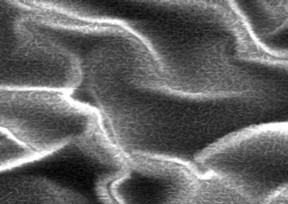 |
| This is a scanning electron microscope image of atomically-thin MoS2 with hierarchical, dual-scale structures. CREDIT SungWoo Nam, University of Illinois |
Abstract:
Molybdenum disulfide (MoS2), which is ubiquitously used as a solid lubricant, has recently been shown to have a two-dimensional (2D) form that is similar to graphene. But, when thinned down to less than a nanometer thick, MoS2 demonstrates properties with great promise as a functional material for electronic devices and surface coatings.
Nano-level lubricant tuning improves material for electronic devices and surface coatings
Urbana, IL | Posted on February 11th, 2017Researchers at the University of Illinois at Urbana-Champaign have developed a new approach to dynamically tune the micro- and nano-scale roughness of atomically thin MoS2, and consequently the appropriate degree of hydrophobicity for various potential MoS2-based applications.
"The knowledge of how new materials interact with water is a fundamental," explained SungWoo Nam, an assistant professor of mechanical science and engineering at Illinois. "Whereas the wettability of its more famous cousin, graphene, has been substantially investigated, that of atomically thin MoS2--in particular atomically thin MoS2 with micro- and nano-scale roughness--has remained relatively unexplored despite its strong potential for fundamental research and device applications. Notably, systematic study of how hierarchical microscale and nanoscale roughness of MoS2 influence its wettability has been lacking in the scientific community."
"This work will provide a new approach to dynamically tune the micro- and nano-scale roughness of atomically thin MoS2 and consequently the appropriate degree of hydrophobicity for various potential MoS2-based applications," stated Jonghyun Choi, a mechanical engineering graduate student and first author of the article, "Hierarchical, Dual-Scale Structures of Atomically Thin MoS2 for Tunable Wetting," appearing in the journal, Nano Letters. "These include waterproof electronic devices with superhydrophobicity with water contact angle greater than 150 degrees. It may also be useful for medical applications with reduced hydrophobicity (WCA less than 100 degrees) for effective contact with biological substances. "
According to the authors, this study, expands the toolkit to allow tunable wettability of 2D materials, many of which are just beginning to be discovered.
"When deformed and patterned to produce micro- and nano-scale structures, MoS2 shows promise as a functional material for hydrogen evolution catalysis systems, electrodes for alkali metal-ion batteries, and field-emission arrays," Nam added. "The results should also contribute to future MoS2-based applications, such as tunable wettability coatings for desalination and hydrogen evolution."
###
In addition to Nam and Choi, co-authors of the paper include graduate students Michael Cai Wang and Ali Ashraf (Illinois), Jihun Mun and Sang-Woo Kang (Korea Research Institute of Standards and Science, Korea).
####
For more information, please click here
Contacts:
SungWoo Nam
217-300-0267
Copyright © University of Illinois College of Engineering
If you have a comment, please Contact us.Issuers of news releases, not 7th Wave, Inc. or Nanotechnology Now, are solely responsible for the accuracy of the content.
Bookmark:


| Related Links |
| Related News Press |
News and information
 Quantum computer improves AI predictions April 17th, 2026
Flexible sensor gains sensitivity under pressure April 17th, 2026
A reusable chip for particulate matter sensing April 17th, 2026
Detecting vibrational quantum beating in the predissociation dynamics of SF6 using time-resolved photoelectron spectroscopy April 17th, 2026
2 Dimensional Materials
Flexible sensor gains sensitivity under pressure April 17th, 2026
MXene nanomaterials enter a new dimension Multilayer nanomaterial: MXene flakes created at Drexel University show new promise as 1D scrolls January 30th, 2026
Chemistry
Projecting light to dispense liquids: A new route to ultra-precise microdroplets January 30th, 2026
From sensors to smart systems: the rise of AI-driven photonic noses January 30th, 2026
"Nanoreactor" cage uses visible light for catalytic and ultra-selective cross-cycloadditions October 3rd, 2025
Possible Futures
A fundamentally new therapeutic approach to cystic fibrosis: Nanobody repairs cellular defect April 17th, 2026
UC Irvine physicists discover method to reverse ‘quantum scrambling’ : The work addresses the problem of information loss in quantum computing system April 17th, 2026
Chip Technology
A reusable chip for particulate matter sensing April 17th, 2026
Metasurfaces smooth light to boost magnetic sensing precision January 30th, 2026
Materials/Metamaterials/Magnetoresistance
First real-time observation of two-dimensional melting process: Researchers at Mainz University unveil new insights into magnetic vortex structures August 8th, 2025
Researchers unveil a groundbreaking clay-based solution to capture carbon dioxide and combat climate change June 6th, 2025
A 1960s idea inspires NBI researchers to study hitherto inaccessible quantum states June 6th, 2025
Institute for Nanoscience hosts annual proposal planning meeting May 16th, 2025
Announcements
A fundamentally new therapeutic approach to cystic fibrosis: Nanobody repairs cellular defect April 17th, 2026
UC Irvine physicists discover method to reverse ‘quantum scrambling’ : The work addresses the problem of information loss in quantum computing system April 17th, 2026
Interviews/Book Reviews/Essays/Reports/Podcasts/Journals/White papers/Posters
A fundamentally new therapeutic approach to cystic fibrosis: Nanobody repairs cellular defect April 17th, 2026
UC Irvine physicists discover method to reverse ‘quantum scrambling’ : The work addresses the problem of information loss in quantum computing system April 17th, 2026
Water
Taking salt out of the water equation October 7th, 2022
Battery Technology/Capacitors/Generators/Piezoelectrics/Thermoelectrics/Energy storage
Decoding hydrogen‑bond network of electrolyte for cryogenic durable aqueous zinc‑ion batteries January 30th, 2026
COF scaffold membrane with gate‑lane nanostructure for efficient Li+/Mg2+ separation January 30th, 2026
MXene nanomaterials enter a new dimension Multilayer nanomaterial: MXene flakes created at Drexel University show new promise as 1D scrolls January 30th, 2026
 |
||
 |
||
| The latest news from around the world, FREE | ||
 |
||
|
|
||
| Premium Products | ||
 |
||
|
Only the news you want to read!
Learn More |
||
 |
||
|
Full-service, expert consulting
Learn More |
||
|
|
||