Home > Press > NUS researchers achieve major breakthrough in flexible electronics: New classes of printable electrically conducting polymer materials make better electrodes for plastic electronics and advanced semiconductor devices
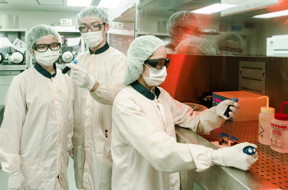 |
| Dr. Png Rui-Qi (left), Mervin Ang (middle) and Cindy Tang (right) working on conducting polymers that can provide unprecedented ohmic contacts for better performance in a wide range of organic semiconductor devices. CREDIT Seah Zong Long |
Abstract:
Semiconductors, which are the very basic components of electronic devices, have improved our lives in many ways. They can be found in lighting, displays, solar modules and microprocessors that are installed in almost all modern day devices, from mobile phones, washing machines, and cars, to the emerging Internet of Things. To innovate devices with better functionality and energy efficiency, researchers are constantly looking for better ways to make them, in particular from earth-abundant materials using eco-friendly processes. Plastic or organic electronics, which is made from organic carbon-based semiconductors, is one such group of technologies that can potentially provide flexible, light-weight, large-area and additively-manufactured devices, which are attractive for some types of applications.
NUS researchers achieve major breakthrough in flexible electronics: New classes of printable electrically conducting polymer materials make better electrodes for plastic electronics and advanced semiconductor devices
Singapore | Posted on January 14th, 2017To make high-performance devices however, good ohmic contacts with low electrical resistances are required to allow the maximum current to flow both ways between the electrode and the semiconductor layers. Recently, a team of scientists from the National University of Singapore (NUS) has successfully developed conducting polymer films that can provide unprecedented ohmic contacts to give superior performance in plastic electronics, including organic light-emitting diodes, solar cells and transistors. The research findings have been recently published in the journal Nature.
The key these researchers discovered is to be able to design polymer films with the desired extreme work functions needed to generally make ohmic contacts. Work function is the minimum amount of energy needed to liberate an electron from the film surface into vacuum. The researchers showed that work functions as high as 5.8 electron-volts and as low as 3.0 electron-volts can now be attained for films that can be processed from solutions at low cost.
"To design such materials, we developed the concept of doped conducting polymers with bonded ionic groups, in which the doped mobile charges - electrons and holes - cannot dissipate away because their counter-balancing ions are chemically bonded," explained Dr Png Rui-Qi, a senior research fellow from the Department of Physics at the NUS Faculty of Science, who led the device research team. "As a result, these conducting polymers can remain stable despite their extreme work functions and provide the desired ohmic contacts."
This breakthrough is the result of a collaboration with the materials chemistry team led by Associate Professor Chua Lay-Lay from the Department of Chemistry at the NUS Faculty of Science, the physics team led by Associate Professor Peter Ho from the Department of Physics from the same faculty, and scientists from Cambridge Display Technology Ltd, a subsidiary of Sumitomo Chemical Co., Ltd.
"The lack of a general approach to make ohmic contacts has been a key bottleneck in flexible electronics. Our work overcomes this challenge to open a path to better performance in a wide range of organic semiconductor devices," explained Dr Png Rui-Qi. "We are particularly thrilled about this Singapore-led innovation," she added.
Commenting on the significance of the work, Assoc Prof Chua said, "The close partnership of the chemists and physicists has made this innovation possible. We are now working with our industrial partner to further develop this technology."
####
For more information, please click here
Contacts:
Carolyn Fong
65-651-65399
Copyright © National University of Singapore (NUS)
If you have a comment, please Contact us.Issuers of news releases, not 7th Wave, Inc. or Nanotechnology Now, are solely responsible for the accuracy of the content.
Bookmark:


| Related Links |
| Related News Press |
News and information
 Quantum computer improves AI predictions April 17th, 2026
Flexible sensor gains sensitivity under pressure April 17th, 2026
A reusable chip for particulate matter sensing April 17th, 2026
Detecting vibrational quantum beating in the predissociation dynamics of SF6 using time-resolved photoelectron spectroscopy April 17th, 2026
Flexible Electronics
Flexible sensor gains sensitivity under pressure April 17th, 2026
MXene nanomaterials enter a new dimension Multilayer nanomaterial: MXene flakes created at Drexel University show new promise as 1D scrolls January 30th, 2026
Organic Electronics
3D & 4D printing/Additive-manufacturing
Presenting: Ultrasound-based printing of 3D materials—potentially inside the body December 8th, 2023
Fiber sensing scientists invent 3D printed fiber microprobe for measuring in vivo biomechanical properties of tissue and even single cell February 10th, 2023
3D-printed decoder, AI-enabled image compression could enable higher-res displays December 9th, 2022
Researchers design new inks for 3D-printable wearable bioelectronics: Potential uses include printing electronic tattoos for medical tracking applications August 19th, 2022
Possible Futures
A fundamentally new therapeutic approach to cystic fibrosis: Nanobody repairs cellular defect April 17th, 2026
UC Irvine physicists discover method to reverse ‘quantum scrambling’ : The work addresses the problem of information loss in quantum computing system April 17th, 2026
Chip Technology
A reusable chip for particulate matter sensing April 17th, 2026
Metasurfaces smooth light to boost magnetic sensing precision January 30th, 2026
Discoveries
Quantum computer improves AI predictions April 17th, 2026
Flexible sensor gains sensitivity under pressure April 17th, 2026
A reusable chip for particulate matter sensing April 17th, 2026
Detecting vibrational quantum beating in the predissociation dynamics of SF6 using time-resolved photoelectron spectroscopy April 17th, 2026
Materials/Metamaterials/Magnetoresistance
First real-time observation of two-dimensional melting process: Researchers at Mainz University unveil new insights into magnetic vortex structures August 8th, 2025
Researchers unveil a groundbreaking clay-based solution to capture carbon dioxide and combat climate change June 6th, 2025
A 1960s idea inspires NBI researchers to study hitherto inaccessible quantum states June 6th, 2025
Institute for Nanoscience hosts annual proposal planning meeting May 16th, 2025
Announcements
A fundamentally new therapeutic approach to cystic fibrosis: Nanobody repairs cellular defect April 17th, 2026
UC Irvine physicists discover method to reverse ‘quantum scrambling’ : The work addresses the problem of information loss in quantum computing system April 17th, 2026
Interviews/Book Reviews/Essays/Reports/Podcasts/Journals/White papers/Posters
A fundamentally new therapeutic approach to cystic fibrosis: Nanobody repairs cellular defect April 17th, 2026
UC Irvine physicists discover method to reverse ‘quantum scrambling’ : The work addresses the problem of information loss in quantum computing system April 17th, 2026
Printing/Lithography/Inkjet/Inks/Bio-printing/Dyes
Presenting: Ultrasound-based printing of 3D materials—potentially inside the body December 8th, 2023
Simple ballpoint pen can write custom LEDs August 11th, 2023
Disposable electronics on a simple sheet of paper October 7th, 2022
 |
||
 |
||
| The latest news from around the world, FREE | ||
 |
||
|
|
||
| Premium Products | ||
 |
||
|
Only the news you want to read!
Learn More |
||
 |
||
|
Full-service, expert consulting
Learn More |
||
|
|
||