Home > Press > Perovskite solar cells surpass 20 percent efficiency: EPFL researchers are pushing the limits of perovskite solar cell performance by exploring the best way to grow these crystals
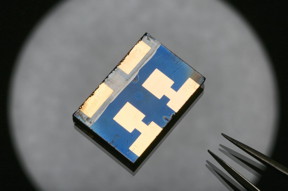 |
| This is a Perovskite solar cell prototype. CREDIT: Alain Herzog / EPFL |
Abstract:
EPFL researchers are pushing the limits of perovskite solar cell performance by exploring the best way to grow these crystals.
Perovskite solar cells surpass 20 percent efficiency: EPFL researchers are pushing the limits of perovskite solar cell performance by exploring the best way to grow these crystals
Lausanne, Switzerland | Posted on June 13th, 2016Michael Graetzel and his team found that, by briefly reducing the pressure while fabricating perovskite crystals, they were able to achieve the highest performance ever measured for larger-size perovskite solar cells, reaching over 20% efficiency and matching the performance of conventional thin-film solar cells of similar sizes. Their results are published in Science.
This is promising news for perovskite technology that is already low cost and under industrial development.
However, high performance in pervoskites does not necessarily herald the doom of silicon-based solar technology. Safety issues still need to be addressed regarding the lead content of current perovskite solar-cell prototypes in addition to determining the stability of actual devices.
Layering perovskites on top of silicon to make hybrid solar panels may actually boost the silicon solar-cell industry. Efficiency could exceed 30%, with the theoretical limit being around 44%. The improved performance would come from harnessing more solar energy: the higher energy light would be absorbed by the perovskite top layer, while lower energy sunlight passing through the perovskite would be absorbed by the silicon layer.
From dye solar cells to perovskite
Graetzel is known for his transparent dye-sensitized solar cells. It turns out that the first perovskite solar cells were dye-sensitized cells where the dye was replaced by small perovskite particles.
His lab's latest perovskite prototype, roughly the size of an SD card, looks like a piece of glass that is darkened on one side by a thin film of perovskite. Unlike the transparent dye-sensitized cells, the perovskite solar cell is opaque.
How to make a perovskite solar cell
To make a perovskite solar cell, the scientists must grow crystals that have a special structure, called "perovskite" after Russian mineralogist Lev Perovski who discovered it.
The scientists first dissolve a selection of compounds in a liquid to make some "ink". They then place the ink on a special type of glass that can conduct electricity. The ink dries up, leaving behind a thin film that crystallizes on top of the glass when mild heat is applied. The end result is a thin layer of perovskite crystals.
The tricky part is growing a thin film of perovskite crystals so that the resulting solar cell absorbs a maximum amount of light. Scientists are constantly looking for smooth and regular layers of perovskite with large crystal grain size in order to increase photovoltaic yields.
For instance, spinning the cell when the ink is still wet flattens the ink and wicks off some of the excess liquid, leading to more regular films. A new vacuum flash technique used by Graetzel and his team also selectively removes the volatile component of this excess liquid. At the same time, the burst of vacuum flash creates seeds for crystal formation, leading to very regular and shiny perovskite crystals of high electronic quality.
####
For more information, please click here
Contacts:
Hillary Sanctuary
41-216-937-022
Copyright © Ecole Polytechnique Fédérale de Lausanne
If you have a comment, please Contact us.Issuers of news releases, not 7th Wave, Inc. or Nanotechnology Now, are solely responsible for the accuracy of the content.
Bookmark:


| Related Links |
| Related News Press |
News and information
 Quantum computer improves AI predictions April 17th, 2026
Flexible sensor gains sensitivity under pressure April 17th, 2026
A reusable chip for particulate matter sensing April 17th, 2026
Detecting vibrational quantum beating in the predissociation dynamics of SF6 using time-resolved photoelectron spectroscopy April 17th, 2026
Thin films
Tiny nanosheets, big leap: A new sensor detects ethanol at ultra-low levels January 30th, 2026
Utilizing palladium for addressing contact issues of buried oxide thin film transistors April 5th, 2024
Understanding the mechanism of non-uniform formation of diamond film on tools: Paving the way to a dry process with less environmental impact March 24th, 2023
New study introduces the best graphite films: The work by Distinguished Professor Feng Ding at UNIST has been published in the October 2022 issue of Nature Nanotechnology November 4th, 2022
Possible Futures
A fundamentally new therapeutic approach to cystic fibrosis: Nanobody repairs cellular defect April 17th, 2026
UC Irvine physicists discover method to reverse ‘quantum scrambling’ : The work addresses the problem of information loss in quantum computing system April 17th, 2026
Discoveries
Quantum computer improves AI predictions April 17th, 2026
Flexible sensor gains sensitivity under pressure April 17th, 2026
A reusable chip for particulate matter sensing April 17th, 2026
Detecting vibrational quantum beating in the predissociation dynamics of SF6 using time-resolved photoelectron spectroscopy April 17th, 2026
Materials/Metamaterials/Magnetoresistance
First real-time observation of two-dimensional melting process: Researchers at Mainz University unveil new insights into magnetic vortex structures August 8th, 2025
Researchers unveil a groundbreaking clay-based solution to capture carbon dioxide and combat climate change June 6th, 2025
A 1960s idea inspires NBI researchers to study hitherto inaccessible quantum states June 6th, 2025
Institute for Nanoscience hosts annual proposal planning meeting May 16th, 2025
Announcements
A fundamentally new therapeutic approach to cystic fibrosis: Nanobody repairs cellular defect April 17th, 2026
UC Irvine physicists discover method to reverse ‘quantum scrambling’ : The work addresses the problem of information loss in quantum computing system April 17th, 2026
Interviews/Book Reviews/Essays/Reports/Podcasts/Journals/White papers/Posters
A fundamentally new therapeutic approach to cystic fibrosis: Nanobody repairs cellular defect April 17th, 2026
UC Irvine physicists discover method to reverse ‘quantum scrambling’ : The work addresses the problem of information loss in quantum computing system April 17th, 2026
Energy
Sensors innovations for smart lithium-based batteries: advancements, opportunities, and potential challenges August 8th, 2025
Simple algorithm paired with standard imaging tool could predict failure in lithium metal batteries August 8th, 2025
Solar/Photovoltaic
Spinel-type sulfide semiconductors to operate the next-generation LEDs and solar cells For solar-cell absorbers and green-LED source October 3rd, 2025
KAIST researchers introduce new and improved, next-generation perovskite solar cell November 8th, 2024
Groundbreaking precision in single-molecule optoelectronics August 16th, 2024
Development of zinc oxide nanopagoda array photoelectrode: photoelectrochemical water-splitting hydrogen production January 12th, 2024
Printing/Lithography/Inkjet/Inks/Bio-printing/Dyes
Presenting: Ultrasound-based printing of 3D materials—potentially inside the body December 8th, 2023
Simple ballpoint pen can write custom LEDs August 11th, 2023
Disposable electronics on a simple sheet of paper October 7th, 2022
 |
||
 |
||
| The latest news from around the world, FREE | ||
 |
||
|
|
||
| Premium Products | ||
 |
||
|
Only the news you want to read!
Learn More |
||
 |
||
|
Full-service, expert consulting
Learn More |
||
|
|
||