Home > Press > Unraveling truly one-dimensional carbon solids: Direct proof of stable ultra-long 1-D carbon chains as a route to carbyne
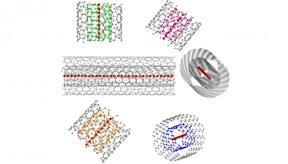 |
| Schematic representation of confined ultra-long acetylenic linear carbon chains inside different double walled carbon nanotubes.
Copyright: Lei Shi, Faculty of Physics, University of Vienna |
Abstract:
Even in its elemental form, the high bond versatility of carbon allows for many different well-known materials, including diamond and graphite. A single layer of graphite, termed graphene, can then be rolled or folded into carbon nanotubes or fullerenes, respectively. To date, Nobel prizes have been awarded for both graphene (2010) and fullerenes (1996). Although the existence of carbyne, an infinitely long carbon chain, was proposed in 1885 by Adolf von Baeyer (Nobel laureate for his overall contributions in organic chemistry, 1905), scientists have not yet been able to synthesize this material. Von Baeyer even suggested that carbyne would remain elusive as its high reactivity would always lead to its immediate destruction. Nevertheless, carbon chains of increasing length have been successfully synthesized over the last 50 years, with a record of around 100 carbon atoms (2003). This record has now been broken by more than one order of magnitude, with the demonstration of micrometer length-scale chains.
Unraveling truly one-dimensional carbon solids: Direct proof of stable ultra-long 1-D carbon chains as a route to carbyne
Vienna, Austria | Posted on April 5th, 2016The new record
Researchers from the University of Vienna, led by Thomas Pichler, have presented a novel approach to grow and stabilize carbon chains with a record length of 6,000 carbon atoms, improving the previous record by more than one order of magnitude. They use the confined space inside a double-walled carbon nanotube as a nano-reactor to grow ultra-long carbon chains on a bulk scale. In collaboration with the groups of Kazu Suenaga at the AIST Tsukuba in Japan, Lukas Novotny at the ETH Zürich in Switzerland and Angel Rubio at the MPI Hamburg in Germany and UPV/EHU San Sebastian in Spain, the existence of the chains has been unambiguously confirmed by using a multitude of sophisticated, complementary methods. These are temperature dependent near- and far-field Raman spectroscopy with different lasers (for the investigation of electronic and vibrational properties), high resolution transmission electron spectroscopy (for the direct observation of carbyne inside the carbon nanotubes) and x-ray scattering (for the confirmation of bulk chain growth).
The researchers present their study in the latest edition of Nature Materials. "The direct experimental proof of confined ultra-long linear carbon chains, which are more than an order of magnitude longer than the longest proven chains so far, can be seen as a promising step towards the final goal of unraveling the "holy grail" of carbon allotropes, carbyne", explains the lead author, Lei Shi.
Application potential
Carbyne is very stable inside double-walled carbon nanotubes. This property is crucial for its eventual application in future materials and devices. According to theoretical models, carbyne's mechanical properties exceed all known materials, outperforming both graphene and diamond. Carbyne's electrical properties suggest novel nanoelectronic applications in quantum spin transport and magnetic semiconductors.
###
The work was supported by FWF and the EU.
####
For more information, please click here
Contacts:
Thomas Pichler
43-664-602-775-1466
Copyright © University of Vienna
If you have a comment, please Contact us.Issuers of news releases, not 7th Wave, Inc. or Nanotechnology Now, are solely responsible for the accuracy of the content.
Bookmark:


| Related Links |
| Related News Press |
News and information
 Quantum computer improves AI predictions April 17th, 2026
Flexible sensor gains sensitivity under pressure April 17th, 2026
A reusable chip for particulate matter sensing April 17th, 2026
Detecting vibrational quantum beating in the predissociation dynamics of SF6 using time-resolved photoelectron spectroscopy April 17th, 2026
Quantum Physics
Detecting vibrational quantum beating in the predissociation dynamics of SF6 using time-resolved photoelectron spectroscopy April 17th, 2026
Beyond silicon: Electronics at the scale of a single molecule January 30th, 2026
MXene nanomaterials enter a new dimension Multilayer nanomaterial: MXene flakes created at Drexel University show new promise as 1D scrolls January 30th, 2026
Magnetism/Magnons
Metasurfaces smooth light to boost magnetic sensing precision January 30th, 2026
Researchers develop molecular qubits that communicate at telecom frequencies October 3rd, 2025
Magnetism in new exotic material opens the way for robust quantum computers June 4th, 2025
Graphene/ Graphite
Electrifying results shed light on graphene foam as a potential material for lab grown cartilage June 6th, 2025
Spintronics
Quantum materials: Electron spin measured for the first time June 9th, 2023
Chip Technology
A reusable chip for particulate matter sensing April 17th, 2026
Metasurfaces smooth light to boost magnetic sensing precision January 30th, 2026
Nanotubes/Buckyballs/Fullerenes/Nanorods/Nanostrings/Nanosheets
Tiny nanosheets, big leap: A new sensor detects ethanol at ultra-low levels January 30th, 2026
Enhancing power factor of p- and n-type single-walled carbon nanotubes April 25th, 2025
Chainmail-like material could be the future of armor: First 2D mechanically interlocked polymer exhibits exceptional flexibility and strength January 17th, 2025
Innovative biomimetic superhydrophobic coating combines repair and buffering properties for superior anti-erosion December 13th, 2024
Discoveries
Quantum computer improves AI predictions April 17th, 2026
Flexible sensor gains sensitivity under pressure April 17th, 2026
A reusable chip for particulate matter sensing April 17th, 2026
Detecting vibrational quantum beating in the predissociation dynamics of SF6 using time-resolved photoelectron spectroscopy April 17th, 2026
Materials/Metamaterials/Magnetoresistance
First real-time observation of two-dimensional melting process: Researchers at Mainz University unveil new insights into magnetic vortex structures August 8th, 2025
Researchers unveil a groundbreaking clay-based solution to capture carbon dioxide and combat climate change June 6th, 2025
A 1960s idea inspires NBI researchers to study hitherto inaccessible quantum states June 6th, 2025
Institute for Nanoscience hosts annual proposal planning meeting May 16th, 2025
Announcements
A fundamentally new therapeutic approach to cystic fibrosis: Nanobody repairs cellular defect April 17th, 2026
UC Irvine physicists discover method to reverse ‘quantum scrambling’ : The work addresses the problem of information loss in quantum computing system April 17th, 2026
Interviews/Book Reviews/Essays/Reports/Podcasts/Journals/White papers/Posters
A fundamentally new therapeutic approach to cystic fibrosis: Nanobody repairs cellular defect April 17th, 2026
UC Irvine physicists discover method to reverse ‘quantum scrambling’ : The work addresses the problem of information loss in quantum computing system April 17th, 2026
 |
||
 |
||
| The latest news from around the world, FREE | ||
 |
||
|
|
||
| Premium Products | ||
 |
||
|
Only the news you want to read!
Learn More |
||
 |
||
|
Full-service, expert consulting
Learn More |
||
|
|
||