Home > Press > Engineers adapt laser method to create micro energy units: Laser-writing technique can help manufacturers create micro energy storage and conversion units; possibilities are 'endless,' researchers say
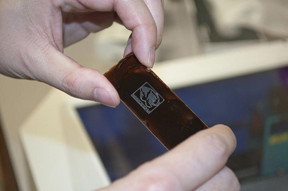 |
| Assistant Professor Jian Lin and his team developed a technique using direct laser writing methods. The team created a way of synthesizing hybrid nanocatalysts into any patterned geometric shape, including the Mizzou Tigers logo. CREDIT: Ryan Owens, College of Engineering |
Abstract:
In the race to design smaller handheld devices and smartphones, a key factor is decreasing the sizes of components. As the demand for thinner and lighter microelectronic devices increases, manufacturers often are limited by how oddly shaped the energy sources must become to make them conform to the smaller space. Now, researchers at the University of Missouri, have developed a method of transferring an energy source to virtually any shape. Using an efficient laser-writing technique, MU scientists can help smartphone manufacturers potentially fabricate energy storage units like microbatteries and micro fuel cells that are more environmentally friendly, highly designable and thin.
Engineers adapt laser method to create micro energy units: Laser-writing technique can help manufacturers create micro energy storage and conversion units; possibilities are 'endless,' researchers say
Columbia, MO | Posted on March 22nd, 2016"The direct laser writing (DLW) method and technique has seen a rapid advancement in the past decade," said Jian Lin, an assistant professor in the Department of Mechanical and Aerospace Engineering in the MU College of Engineering. "The main goal of our research was to find an efficient and cost-effective way to integrate nanostructures with micro energy storage units for applications in micro-electronics. Our lab decided to test whether catalysts could be synthesized and patterned on any surface by a one-step laser processing method to produce microbatteries and micro fuel cells in the shapes dictated by computer programs."
With this in mind, Lin and his team, including Heng (Henry) Deng, a doctoral candidate at MU, set out to prove their theory. They adapted the DLW method to synthesize and pattern hybrid nanocatalysts, or fuel sources, into complex geometric shapes. Using computer-controlled laser writing that uses higher heat and pressure, the scientists were able to produce a surface that became electrically conducive and also has catalytic functionalities.
"This is the first step in manufacturing micro fuel cells that convert chemical energy into electrical energy and batteries that can integrate into microcircuits" said Lin. "Also this technique has been proven to produce microsupercapacitors. By honing the process, handheld device and smartphone manufacturers will be able to produce components in whatever shape or size they choose, greatly impacting the size of these devices. Also, manufacturers will be able to choose more environmentally friendly catalysts for generating energy such as hydrogen or oxygen, which are considered cleaner fuels. The possibilities will be endless."
The paper, "Laser induced MoS2/carbon hybrids for hydrogen evolution reaction catalysts," recently was published in a special issue of "Emerging Investigators 2016: Novel Design Strategies for New Functional Materials" in the Journal of Materials Chemistry-A.
####
For more information, please click here
Contacts:
Jeff Sossamon
573-882-3346
Copyright © University of Missouri-Columbia
If you have a comment, please Contact us.Issuers of news releases, not 7th Wave, Inc. or Nanotechnology Now, are solely responsible for the accuracy of the content.
Bookmark:


| Related News Press |
News and information
 Quantum computer improves AI predictions April 17th, 2026
Flexible sensor gains sensitivity under pressure April 17th, 2026
A reusable chip for particulate matter sensing April 17th, 2026
Detecting vibrational quantum beating in the predissociation dynamics of SF6 using time-resolved photoelectron spectroscopy April 17th, 2026
Chemistry
Projecting light to dispense liquids: A new route to ultra-precise microdroplets January 30th, 2026
From sensors to smart systems: the rise of AI-driven photonic noses January 30th, 2026
"Nanoreactor" cage uses visible light for catalytic and ultra-selective cross-cycloadditions October 3rd, 2025
Cambridge chemists discover simple way to build bigger molecules – one carbon at a time June 6th, 2025
Hardware
The present and future of computing get a boost from new research July 21st, 2023
A Carbon Nanotube Microprocessor Mature Enough to Say Hello: Three new breakthroughs make commercial nanotube processors possible March 2nd, 2020
Powering the future: Smallest all-digital circuit opens doors to 5 nm next-gen semiconductor February 11th, 2020
Possible Futures
A fundamentally new therapeutic approach to cystic fibrosis: Nanobody repairs cellular defect April 17th, 2026
UC Irvine physicists discover method to reverse ‘quantum scrambling’ : The work addresses the problem of information loss in quantum computing system April 17th, 2026
Chip Technology
A reusable chip for particulate matter sensing April 17th, 2026
Metasurfaces smooth light to boost magnetic sensing precision January 30th, 2026
Optical computing/Photonic computing
ICFO researchers overcome long-standing bottleneck in single photon detection with twisted 2D materials August 8th, 2025
Programmable electron-induced color router array May 14th, 2025
Discoveries
Quantum computer improves AI predictions April 17th, 2026
Flexible sensor gains sensitivity under pressure April 17th, 2026
A reusable chip for particulate matter sensing April 17th, 2026
Detecting vibrational quantum beating in the predissociation dynamics of SF6 using time-resolved photoelectron spectroscopy April 17th, 2026
Announcements
A fundamentally new therapeutic approach to cystic fibrosis: Nanobody repairs cellular defect April 17th, 2026
UC Irvine physicists discover method to reverse ‘quantum scrambling’ : The work addresses the problem of information loss in quantum computing system April 17th, 2026
Interviews/Book Reviews/Essays/Reports/Podcasts/Journals/White papers/Posters
A fundamentally new therapeutic approach to cystic fibrosis: Nanobody repairs cellular defect April 17th, 2026
UC Irvine physicists discover method to reverse ‘quantum scrambling’ : The work addresses the problem of information loss in quantum computing system April 17th, 2026
Energy
Sensors innovations for smart lithium-based batteries: advancements, opportunities, and potential challenges August 8th, 2025
Simple algorithm paired with standard imaging tool could predict failure in lithium metal batteries August 8th, 2025
Battery Technology/Capacitors/Generators/Piezoelectrics/Thermoelectrics/Energy storage
Decoding hydrogen‑bond network of electrolyte for cryogenic durable aqueous zinc‑ion batteries January 30th, 2026
COF scaffold membrane with gate‑lane nanostructure for efficient Li+/Mg2+ separation January 30th, 2026
MXene nanomaterials enter a new dimension Multilayer nanomaterial: MXene flakes created at Drexel University show new promise as 1D scrolls January 30th, 2026
Photonics/Optics/Lasers
Metasurfaces smooth light to boost magnetic sensing precision January 30th, 2026
From sensors to smart systems: the rise of AI-driven photonic noses January 30th, 2026
 |
||
 |
||
| The latest news from around the world, FREE | ||
 |
||
|
|
||
| Premium Products | ||
 |
||
|
Only the news you want to read!
Learn More |
||
 |
||
|
Full-service, expert consulting
Learn More |
||
|
|
||