Home > Press > Graphene decharging and molecular shielding
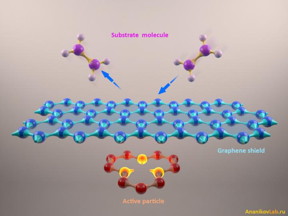 |
| This image shows a graphene layer as an effective chemical shield, which regulates the level of molecular interactions. CREDIT: AnanikovLab |
Abstract:
Joint theoretical and experimental study suggested that graphene sheets efficiently shield chemical interactions. One of the promising applications of this phenomenon is associated with im-proving quality of 2D materials by "de-charging" of charged defect centers on the surface of carbon materials. Another important feature is the ability to control selectivity and activity of the supported metallic catalysts M/C on the carbon substrate.
Graphene decharging and molecular shielding
Moscow, Russia | Posted on February 8th, 2016Researchers studied carbon materials with defects on the surface (such defects represent an active species, which should be shielded). Indeed, the experiments demonstrated that the defects areas are quite reactive and, as one may expect, defect sites retain high activity towards various molecules. However, as soon as the defects were covered with few layers of graphene flakes, the distribution of reactive centers became uniform (without localized reactivity centers typical for de-fect areas). In other words, covering of the surface defects with graphene layers has decreased the influence of charged defects and made them "invisible" in terms of chemical interactions at the mo-lecular level.
####
For more information, please click here
Contacts:
Valentine Ananikov
Copyright © Institute of Organic Chemistry, Russian Academy of Sciences
If you have a comment, please Contact us.Issuers of news releases, not 7th Wave, Inc. or Nanotechnology Now, are solely responsible for the accuracy of the content.
Bookmark:


| Related Links |
| Related News Press |
News and information
 Quantum computer improves AI predictions April 17th, 2026
Flexible sensor gains sensitivity under pressure April 17th, 2026
A reusable chip for particulate matter sensing April 17th, 2026
Detecting vibrational quantum beating in the predissociation dynamics of SF6 using time-resolved photoelectron spectroscopy April 17th, 2026
Chemistry
Projecting light to dispense liquids: A new route to ultra-precise microdroplets January 30th, 2026
From sensors to smart systems: the rise of AI-driven photonic noses January 30th, 2026
"Nanoreactor" cage uses visible light for catalytic and ultra-selective cross-cycloadditions October 3rd, 2025
Cambridge chemists discover simple way to build bigger molecules – one carbon at a time June 6th, 2025
Single-atom catalysts change spin state when boosted by a magnetic field June 4th, 2025
Graphene/ Graphite
Electrifying results shed light on graphene foam as a potential material for lab grown cartilage June 6th, 2025
Breakthrough in proton barrier films using pore-free graphene oxide: Kumamoto University researchers achieve new milestone in advanced coating technologies September 13th, 2024
Discoveries
Quantum computer improves AI predictions April 17th, 2026
Flexible sensor gains sensitivity under pressure April 17th, 2026
A reusable chip for particulate matter sensing April 17th, 2026
Detecting vibrational quantum beating in the predissociation dynamics of SF6 using time-resolved photoelectron spectroscopy April 17th, 2026
Materials/Metamaterials/Magnetoresistance
First real-time observation of two-dimensional melting process: Researchers at Mainz University unveil new insights into magnetic vortex structures August 8th, 2025
Researchers unveil a groundbreaking clay-based solution to capture carbon dioxide and combat climate change June 6th, 2025
A 1960s idea inspires NBI researchers to study hitherto inaccessible quantum states June 6th, 2025
Institute for Nanoscience hosts annual proposal planning meeting May 16th, 2025
Announcements
A fundamentally new therapeutic approach to cystic fibrosis: Nanobody repairs cellular defect April 17th, 2026
UC Irvine physicists discover method to reverse ‘quantum scrambling’ : The work addresses the problem of information loss in quantum computing system April 17th, 2026
Interviews/Book Reviews/Essays/Reports/Podcasts/Journals/White papers/Posters
A fundamentally new therapeutic approach to cystic fibrosis: Nanobody repairs cellular defect April 17th, 2026
UC Irvine physicists discover method to reverse ‘quantum scrambling’ : The work addresses the problem of information loss in quantum computing system April 17th, 2026
 |
||
 |
||
| The latest news from around the world, FREE | ||
 |
||
|
|
||
| Premium Products | ||
 |
||
|
Only the news you want to read!
Learn More |
||
 |
||
|
Full-service, expert consulting
Learn More |
||
|
|
||