Home > Press > An alternative to platinum: Iron-nitrogen compounds as catalysts in graphene
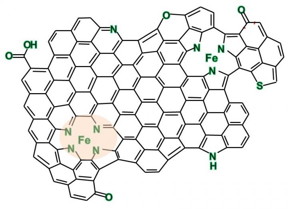 |
| Nano-island of graphene in which iron-nitrogen complexes are embedded. The FeN4 complexes (shown in orange) are catalytically active.
Image: S. Fiechter/HZB |
Abstract:
Fuel cells convert the chemical energy stored in hydrogen (H2) into electrical energy by electrochemically "combusting" hydrogen gas with oxygen (O2) from the air into water (H2O), thereby generating electricity. As a result, future electric automobiles might be operated quite well with fuel cells instead of with heavy batteries. But for "cold" combustion of hydrogen and oxygen to function well, the anode and cathode of the fuel cell must be coated with extremely active catalysts. The problem is that the platinum-based catalysts employed for this contribute about 25 per cent of the total fuel-cell costs.
An alternative to platinum: Iron-nitrogen compounds as catalysts in graphene
Berlin, Germany | Posted on January 28th, 2016However, iron-nitrogen complexes in graphene (known as Fe-N-C catalysts) have been achieving levels of activity comparable to Pt/C catalysts for several years already. "Systematic investigation of Fe-N-C catalysts was difficult though, since most approaches for preparing the materials lead to heterogeneous compounds. These contain various species of iron compounds such as iron carbides or nitrides besides the intended FeN4 centres", explains Sebastian Fiechter of HZB.
High density of catalytically active centres
"We had already developed a new preparation method at HZB a few years ago to produce an inexpensive catalyst material from organometallic compounds such as iron or cobalt porphyrin", reports Peter Bogdanoff, HZB. Ulrike Kramm and Iris Herrmann-Geppert improved the process for producing it as part of their doctoral studies at HZB. As a result, the metal-N-C catalysts developed at HZB held the world record for the highest density of catalytically active centres of various nitro-metallic compounds up to about 2011. However, it remained unclear as to which inorganic compounds influenced the catalytic efficiency. The team was now able to determine this.
Purification process removes interfering compounds
The highlight in the current work is a purification process (a combination of thermal treatment with a subsequent etching step) by which the proportion of metallic compounds that interfere with catalytic activity can be substantially reduced, even for catalysts that are highly heterogeneous. The interesting thing here is that the activity increases enormously! Ulrike Kramm, who has since become a junior professor at TU Darmstadt, was successful in purifying several catalysts to such an extent that all the iron present in the graphene layers was exclusively in form of complexes made of iron and four nitrogen atoms (FeN4). The scientists thereby disproved the hypothesis debated among experts by which improvement in the activity of the FeN4 centres only resulted from promoters, as they are known, such as iron nanoparticles.
Now verified: FeN4 centres provide the high catalytic efficiency even without promoters
"To check this hypothesis, we employed numerous complex measurement techniques like Mößbauer spectroscopy, electron paramagnetic resonance spectroscopy and X-ray absorption spectroscopy at BESSY II. These enabled us to precisely survey the atomic structure of the catalytic centres", Ulrike Kramm reports.
"The purification process enables us now to create catalysts having exclusively FeN4 centres. This allows us to subsequently select compounds to be added afterwards as promoters that further improve the activity level or stability of these catalysts", as Ulrike Kramm summarises her research approach at TU Darmstadt.
Sebastian Fiechter and Peter Bogdanoff are continuing their research at HZB on novel catalysts, especially in regard to hydrogen generation using sunlight. "We can also use the insights into how these metal-N-C catalysts work in our on-going development of catalysing materials for solar-based hydrogen production at HZB," says Fiechter.
Together, the research activities at HZB and TU Darmstadt could enable the development of a complete regenerative energy cycle, using solar hydrogen in low cost fuel cells, thus producing electricity without climate gas emission.
The results have now been published in the Journal of the American Chemical Society.
On an easy way to prepare Metal-Nitrogen doped carbon with exclusive presence of MeN4-type sites active for the ORR, by Ulrike I. Kramm, Iris Herrmann-Geppert, Jan Behrends, Klaus Lips, Sebastian Fiechter and Peter Bogdanoff
####
For more information, please click here
Contacts:
Prof. Dr. Sebastian Fiechter
49-308-062-42927
Copyright © Helmholtz-Zentrum Berlin für Materialien und Energie
If you have a comment, please Contact us.Issuers of news releases, not 7th Wave, Inc. or Nanotechnology Now, are solely responsible for the accuracy of the content.
Bookmark:


| Related Links |
| Related News Press |
News and information
 Quantum computer improves AI predictions April 17th, 2026
Flexible sensor gains sensitivity under pressure April 17th, 2026
A reusable chip for particulate matter sensing April 17th, 2026
Detecting vibrational quantum beating in the predissociation dynamics of SF6 using time-resolved photoelectron spectroscopy April 17th, 2026
Chemistry
Projecting light to dispense liquids: A new route to ultra-precise microdroplets January 30th, 2026
From sensors to smart systems: the rise of AI-driven photonic noses January 30th, 2026
"Nanoreactor" cage uses visible light for catalytic and ultra-selective cross-cycloadditions October 3rd, 2025
Cambridge chemists discover simple way to build bigger molecules – one carbon at a time June 6th, 2025
Single-atom catalysts change spin state when boosted by a magnetic field June 4th, 2025
Graphene/ Graphite
Electrifying results shed light on graphene foam as a potential material for lab grown cartilage June 6th, 2025
Breakthrough in proton barrier films using pore-free graphene oxide: Kumamoto University researchers achieve new milestone in advanced coating technologies September 13th, 2024
Possible Futures
A fundamentally new therapeutic approach to cystic fibrosis: Nanobody repairs cellular defect April 17th, 2026
UC Irvine physicists discover method to reverse ‘quantum scrambling’ : The work addresses the problem of information loss in quantum computing system April 17th, 2026
Discoveries
Quantum computer improves AI predictions April 17th, 2026
Flexible sensor gains sensitivity under pressure April 17th, 2026
A reusable chip for particulate matter sensing April 17th, 2026
Detecting vibrational quantum beating in the predissociation dynamics of SF6 using time-resolved photoelectron spectroscopy April 17th, 2026
Materials/Metamaterials/Magnetoresistance
First real-time observation of two-dimensional melting process: Researchers at Mainz University unveil new insights into magnetic vortex structures August 8th, 2025
Researchers unveil a groundbreaking clay-based solution to capture carbon dioxide and combat climate change June 6th, 2025
A 1960s idea inspires NBI researchers to study hitherto inaccessible quantum states June 6th, 2025
Institute for Nanoscience hosts annual proposal planning meeting May 16th, 2025
Announcements
A fundamentally new therapeutic approach to cystic fibrosis: Nanobody repairs cellular defect April 17th, 2026
UC Irvine physicists discover method to reverse ‘quantum scrambling’ : The work addresses the problem of information loss in quantum computing system April 17th, 2026
Interviews/Book Reviews/Essays/Reports/Podcasts/Journals/White papers/Posters
A fundamentally new therapeutic approach to cystic fibrosis: Nanobody repairs cellular defect April 17th, 2026
UC Irvine physicists discover method to reverse ‘quantum scrambling’ : The work addresses the problem of information loss in quantum computing system April 17th, 2026
Energy
Sensors innovations for smart lithium-based batteries: advancements, opportunities, and potential challenges August 8th, 2025
Simple algorithm paired with standard imaging tool could predict failure in lithium metal batteries August 8th, 2025
Automotive/Transportation
Decoding hydrogen‑bond network of electrolyte for cryogenic durable aqueous zinc‑ion batteries January 30th, 2026
Sensors innovations for smart lithium-based batteries: advancements, opportunities, and potential challenges August 8th, 2025
Simple algorithm paired with standard imaging tool could predict failure in lithium metal batteries August 8th, 2025
Fuel Cells
Deciphering local microstrain-induced optimization of asymmetric Fe single atomic sites for efficient oxygen reduction August 8th, 2025
Current and Future Developments in Nanomaterials and Carbon Nanotubes: Applications of Nanomaterials in Energy Storage and Electronics October 28th, 2022
Solar/Photovoltaic
Spinel-type sulfide semiconductors to operate the next-generation LEDs and solar cells For solar-cell absorbers and green-LED source October 3rd, 2025
KAIST researchers introduce new and improved, next-generation perovskite solar cell November 8th, 2024
Groundbreaking precision in single-molecule optoelectronics August 16th, 2024
Development of zinc oxide nanopagoda array photoelectrode: photoelectrochemical water-splitting hydrogen production January 12th, 2024
 |
||
 |
||
| The latest news from around the world, FREE | ||
 |
||
|
|
||
| Premium Products | ||
 |
||
|
Only the news you want to read!
Learn More |
||
 |
||
|
Full-service, expert consulting
Learn More |
||
|
|
||