Home > Press > Physicists discover material for a more efficient energy storage: Experiment confirms predictions of the University of Luxembourg
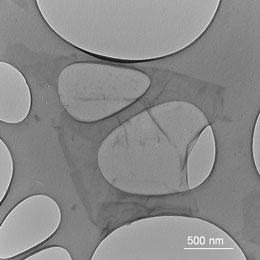 |
| These are graphene flakes in the plastics graphene compound magnified 40.000 times
CREDIT: University of Luxembourg |
Abstract:
Predictions of physicists of the University of Luxembourg recently lead to the discovery of a material with special electric properties which engages the interest of plastics producing industry. Three years ago, physicists from Luxembourg had theoretically predicted the unusual characteristics of a particular composite material. These calculations could now be confirmed by experiment in cooperation with the "Centre de Recherche Paul Pascal" in Bordeaux, France, and resulted in the discovery of a so-called high-k-material, which might enable the production of better energy storage devices - the basis for smaller, faster and more efficient electronics.
Physicists discover material for a more efficient energy storage: Experiment confirms predictions of the University of Luxembourg
Luxembourg | Posted on December 18th, 2015The earlier calculations made by the team around Tanja Schilling, professor of physics at the University of Luxembourg, were at first rather bad news for the field of materials research: they indicated that certain compound materials made of polymers and flaky graphene, unlike those made of polymers and carbon nanotubes, did not increase the conductivity of the material to the degree that was generally expected until then. It was a surprising conclusion at the time which questioned the use of graphene in order to increase conductivity.
This prediction, however, now lead to a highly promising discovery: the effect that put the conductivity of the plastics-graphene-compound into question, causes it to have remarkable dielectric properties. This means that one can generate a strong electric field inside of it - the fundamental property for the production of efficient capacitors. These are tiny components that can store energy statically and occur in almost all electronic devices, where they act as voltage regulators or information storage, among other things. Computers, for example, contain billions of those.
"Materials with a high dielectric constant, so-called high-k-materials, are highly sought after," says Tanja Schilling, head of the research project at the Faculty of Science, Technology and Communication of the University of Luxembourg. "The discovery based on our predictions was now published in the renowned journal Nature Communications - which we are very happy about."
The special dielectric properties of the compound material occur as a result of its liquid crystal properties impeding the arrangement of the graphene flakes into a conducting structure. So when there is an electric current, it does not flow directly through the compound, but instead generates a strong electric field. While in other compound materials the current permeable effect is the dominant one, the Luxembourg physicists could demonstrate mathematically that, in this case, the liquid crystal properties play the major role and are responsible for the unexpected electric properties.
The chemicals company Solvay, partner of the research project, now wants to continue the research around this new high-k-material, aiming to produce synthetics for particularly efficient capacitors and further applications in the future.
####
For more information, please click here
Contacts:
Britta Schlüter
352-466-644-6563
Copyright © University of Luxembourg
If you have a comment, please Contact us.Issuers of news releases, not 7th Wave, Inc. or Nanotechnology Now, are solely responsible for the accuracy of the content.
Bookmark:


| Related News Press |
News and information
 Quantum computer improves AI predictions April 17th, 2026
Flexible sensor gains sensitivity under pressure April 17th, 2026
A reusable chip for particulate matter sensing April 17th, 2026
Detecting vibrational quantum beating in the predissociation dynamics of SF6 using time-resolved photoelectron spectroscopy April 17th, 2026
Graphene/ Graphite
Electrifying results shed light on graphene foam as a potential material for lab grown cartilage June 6th, 2025
Breakthrough in proton barrier films using pore-free graphene oxide: Kumamoto University researchers achieve new milestone in advanced coating technologies September 13th, 2024
Hardware
The present and future of computing get a boost from new research July 21st, 2023
A Carbon Nanotube Microprocessor Mature Enough to Say Hello: Three new breakthroughs make commercial nanotube processors possible March 2nd, 2020
Powering the future: Smallest all-digital circuit opens doors to 5 nm next-gen semiconductor February 11th, 2020
Possible Futures
A fundamentally new therapeutic approach to cystic fibrosis: Nanobody repairs cellular defect April 17th, 2026
UC Irvine physicists discover method to reverse ‘quantum scrambling’ : The work addresses the problem of information loss in quantum computing system April 17th, 2026
Chip Technology
A reusable chip for particulate matter sensing April 17th, 2026
Metasurfaces smooth light to boost magnetic sensing precision January 30th, 2026
Discoveries
Quantum computer improves AI predictions April 17th, 2026
Flexible sensor gains sensitivity under pressure April 17th, 2026
A reusable chip for particulate matter sensing April 17th, 2026
Detecting vibrational quantum beating in the predissociation dynamics of SF6 using time-resolved photoelectron spectroscopy April 17th, 2026
Materials/Metamaterials/Magnetoresistance
First real-time observation of two-dimensional melting process: Researchers at Mainz University unveil new insights into magnetic vortex structures August 8th, 2025
Researchers unveil a groundbreaking clay-based solution to capture carbon dioxide and combat climate change June 6th, 2025
A 1960s idea inspires NBI researchers to study hitherto inaccessible quantum states June 6th, 2025
Institute for Nanoscience hosts annual proposal planning meeting May 16th, 2025
Announcements
A fundamentally new therapeutic approach to cystic fibrosis: Nanobody repairs cellular defect April 17th, 2026
UC Irvine physicists discover method to reverse ‘quantum scrambling’ : The work addresses the problem of information loss in quantum computing system April 17th, 2026
Interviews/Book Reviews/Essays/Reports/Podcasts/Journals/White papers/Posters
A fundamentally new therapeutic approach to cystic fibrosis: Nanobody repairs cellular defect April 17th, 2026
UC Irvine physicists discover method to reverse ‘quantum scrambling’ : The work addresses the problem of information loss in quantum computing system April 17th, 2026
Research partnerships
Lab to industry: InSe wafer-scale breakthrough for future electronics August 8th, 2025
HKU physicists uncover hidden order in the quantum world through deconfined quantum critical points April 25th, 2025
 |
||
 |
||
| The latest news from around the world, FREE | ||
 |
||
|
|
||
| Premium Products | ||
 |
||
|
Only the news you want to read!
Learn More |
||
 |
||
|
Full-service, expert consulting
Learn More |
||
|
|
||