Home > Press > 'Holey' graphene for energy storage: Charged holes in graphene increase energy storage capacity
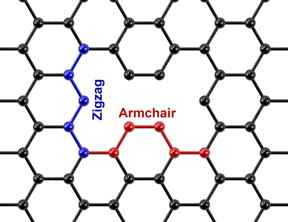 |
| This image shows zigzag and armchair defects in graphene. CREDIT: Rajaram Narayanan/Jacobs School of Engineering/UC San Diego |
Abstract:
Engineers at the University of California, San Diego have discovered a method to increase the amount of electric charge that can be stored in graphene, a two-dimensional form of carbon. The research, published recently online in the journal Nano Letters, may provide a better understanding of how to improve the energy storage ability of capacitors for potential applications in cars, wind turbines, and solar power.
'Holey' graphene for energy storage: Charged holes in graphene increase energy storage capacity
San Diego, CA | Posted on April 22nd, 2015Capacitors charge and discharge very fast, and are more useful for quick large bursts of energy, such as in camera flashes and power plants. Their ability to rapidly charge and discharge is an advantage over the long charge time of batteries. However, the problem with capacitors is that they store less energy than batteries.
How can the energy storage of a capacitor be improved? One approach by researchers in the lab of mechanical engineering professor Prabhakar Bandaru at the Jacobs School of Engineering at UC San Diego was to introduce more charge into a capacitor electrode using graphene as a model material for their tests. The principle is that increased charge leads to increased capacitance, which translates to increased energy storage.
How it's made
Making a perfect carbon nanotube structure -- one without defects, which are holes corresponding to missing carbon atoms -- is next to impossible. Rather than avoiding defects, the researchers in Bandaru's lab figured out a practical way to use them instead.
"I was motivated from the point of view that charged defects may be useful for energy storage," said Bandaru.
The team used a method called argon-ion based plasma processing, in which graphene samples are bombarded with positively-charged argon ions. During this process, carbon atoms are knocked out of the graphene layers and leave behind holes containing positive charges -- these are the charged defects. Exposing the graphene samples to argon plasma increased the capacitance of the materials three-fold.
"It was exciting to show that we can introduce extra capacitance by introducing charged defects, and that we could control what kind of charged defect we could introduce into a material," said Rajaram Narayanan, a graduate student in professor Bandaru's research group and first author of the study.
Using Raman spectroscopy and electrochemical measurements, the team was able to characterize the types of defects that argon plasma processing introduced into the graphene lattices. The results revealed the formation of extended defects known as "armchair" and "zigzag" defects, which are named based on the configurations of the missing carbon atoms.
Additionally, electrochemical studies helped the team discover a new length scale that measures the distance between charges. "This new length scale will be important for electrical applications, since it can provide a basis for how small we can make electrical devices," said Bandaru.
####
For more information, please click here
Contacts:
Liezel Labios
858-246-1124
Copyright © University of California - San Diego
If you have a comment, please Contact us.Issuers of news releases, not 7th Wave, Inc. or Nanotechnology Now, are solely responsible for the accuracy of the content.
Bookmark:


| Related Links |
| Related News Press |
News and information
 Quantum computer improves AI predictions April 17th, 2026
Flexible sensor gains sensitivity under pressure April 17th, 2026
A reusable chip for particulate matter sensing April 17th, 2026
Detecting vibrational quantum beating in the predissociation dynamics of SF6 using time-resolved photoelectron spectroscopy April 17th, 2026
Imaging
Simple algorithm paired with standard imaging tool could predict failure in lithium metal batteries August 8th, 2025
Graphene/ Graphite
Electrifying results shed light on graphene foam as a potential material for lab grown cartilage June 6th, 2025
Breakthrough in proton barrier films using pore-free graphene oxide: Kumamoto University researchers achieve new milestone in advanced coating technologies September 13th, 2024
Discoveries
Quantum computer improves AI predictions April 17th, 2026
Flexible sensor gains sensitivity under pressure April 17th, 2026
A reusable chip for particulate matter sensing April 17th, 2026
Detecting vibrational quantum beating in the predissociation dynamics of SF6 using time-resolved photoelectron spectroscopy April 17th, 2026
Announcements
A fundamentally new therapeutic approach to cystic fibrosis: Nanobody repairs cellular defect April 17th, 2026
UC Irvine physicists discover method to reverse ‘quantum scrambling’ : The work addresses the problem of information loss in quantum computing system April 17th, 2026
Interviews/Book Reviews/Essays/Reports/Podcasts/Journals/White papers/Posters
A fundamentally new therapeutic approach to cystic fibrosis: Nanobody repairs cellular defect April 17th, 2026
UC Irvine physicists discover method to reverse ‘quantum scrambling’ : The work addresses the problem of information loss in quantum computing system April 17th, 2026
Tools
Metasurfaces smooth light to boost magnetic sensing precision January 30th, 2026
From sensors to smart systems: the rise of AI-driven photonic noses January 30th, 2026
Japan launches fully domestically produced quantum computer: Expo visitors to experience quantum computing firsthand August 8th, 2025
Energy
Sensors innovations for smart lithium-based batteries: advancements, opportunities, and potential challenges August 8th, 2025
Simple algorithm paired with standard imaging tool could predict failure in lithium metal batteries August 8th, 2025
Automotive/Transportation
Decoding hydrogen‑bond network of electrolyte for cryogenic durable aqueous zinc‑ion batteries January 30th, 2026
Sensors innovations for smart lithium-based batteries: advancements, opportunities, and potential challenges August 8th, 2025
Simple algorithm paired with standard imaging tool could predict failure in lithium metal batteries August 8th, 2025
Battery Technology/Capacitors/Generators/Piezoelectrics/Thermoelectrics/Energy storage
Decoding hydrogen‑bond network of electrolyte for cryogenic durable aqueous zinc‑ion batteries January 30th, 2026
COF scaffold membrane with gate‑lane nanostructure for efficient Li+/Mg2+ separation January 30th, 2026
MXene nanomaterials enter a new dimension Multilayer nanomaterial: MXene flakes created at Drexel University show new promise as 1D scrolls January 30th, 2026
 |
||
 |
||
| The latest news from around the world, FREE | ||
 |
||
|
|
||
| Premium Products | ||
 |
||
|
Only the news you want to read!
Learn More |
||
 |
||
|
Full-service, expert consulting
Learn More |
||
|
|
||