Home > Press > Carnegie Mellon chemists create tiny gold nanoparticles that reflect nature's patterns
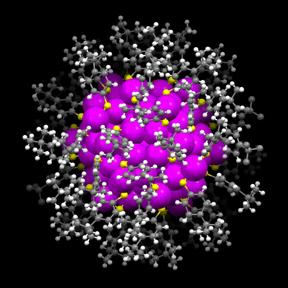 |
| The x-ray crystallographic structure of the gold nanoparticle is shown. Gold atoms = magenta; sulfur atoms = yellow; carbon atoms = gray; hydrogen atoms = white. CREDIT: Carnegie Mellon |
Abstract:
Our world is full of patterns, from the twist of a DNA molecule to the spiral of the Milky Way. New research from Carnegie Mellon chemists has revealed that tiny, synthetic gold nanoparticles exhibit some of nature's most intricate patterns.
Carnegie Mellon chemists create tiny gold nanoparticles that reflect nature's patterns
Pittsburgh, PA | Posted on April 9th, 2015Unveiling the kaleidoscope of these patterns was a Herculean task, and it marks the first time that a nanoparticle of this size has been crystallized and its structure mapped out atom by atom. The researchers report their work in the March 20 issue of Science Advances.
"As you broadly think about different research areas or even our everyday lives, these kinds of patterns, these hierarchical patterns, are universal," said Rongchao Jin, associate professor of chemistry. "Our universe is really beautiful and when you see this kind of information in something as small as a 133-atom nanoparticle and as big as the Milky Way, it's really amazing."
Gold nanoparticles, which can vary in size from 1 to 100 nanometers, are a promising technology that has applications in a wide range of fields including catalysis, electronics, materials science and health care. But, in order to use gold nanoparticles in practical applications, scientists must first understand the tiny particles' structure.
"Structure essentially determines the particle's properties, so without knowing the structure, you wouldn't be able to understand the properties and you wouldn't be able to functionalize them for specific applications," said Jin, an expert in creating atomically precise gold nanoparticles.
With this latest research, Jin and his colleagues, including graduate student Chenjie Zeng, have solved the structure of a nanoparticle, Au133, made up of 133 gold atoms and 52 surface-protecting molecules--the biggest nanoparticle structure ever resolved with X-ray crystallography. While microscopy can reveal the size, shape and the atomic lattice of nanoparticles, it can't discern the surface structure. X-ray crystallography can, by mapping out the position of every atom on the nanoparticles' surface and showing how they bond with the gold core. Knowing the surface structure is key to using the nanoparticles for practical applications, such as catalysis, and for uncovering fundamental science, such as the basis of the particle's stability.
The crystal structure of the Au133 nanoparticle divulged many secrets.
"With X-ray crystallography, we were able to see very beautiful patterns, which was a very exciting discovery. These patterns only show up when the nanoparticle size becomes big enough," Jin said.
During production, the Au133 particles self-assemble into three layers within each particle: the gold core, the surface molecules that protect it and the interface between the two. In the crystal structure, Zeng discovered that the gold core is in the shape of an icosahedron. At the interface between the core and the surface-protecting molecules is a layer of sulfur atoms that bind with the gold atoms. The sulfur-gold-sulfur combinations stack into ladder-like helical structures. Finally, attached to the sulfur molecules is an outer layer of surface-protecting molecules whose carbon tails self-assemble into fourfold swirls.
"The helical features remind us of a DNA double helix and the rotating arrangement of the carbon tails is reminiscent of the way our galaxy is arranged. It's really amazing," Jin said.
These particular patterns are responsible for the high stability of Au133 compared to other sizes of gold nanoparticles. The researchers also tested the optical and electronic properties of Au133 and found that these gold nanoparticles are not metallic. Normally, gold is one of the best conductors of electrical current, but the size of Au133 is so small that the particle hasn't yet become metallic. Jin's group is currently testing the nanoparticles for use as catalysts, substances that can increase the rate of a chemical reaction.
###
Jin's collaborators include Zeng and Yuxiang Chen, graduate students in CMU's Chemistry Department; Kristin Kirschbaum, research associate professor at the University of Toledo, who performed the X-ray crystallography; and postdoctoral fellow Kannatassen Appavoo and staff scientist Matthew Y. Sfeir, who carried out the femtosecond optical studies, at the Center for Functional Nanomaterials at Brookhaven National Laboratory. The research was supported by the Air Force Office of Scientific Research and the Camille Dreyfus Teacher-Scholar Awards Program.
####
For more information, please click here
Contacts:
Jocelyn Duffy
412-268-9982
Copyright © Carnegie Mellon University
If you have a comment, please Contact us.Issuers of news releases, not 7th Wave, Inc. or Nanotechnology Now, are solely responsible for the accuracy of the content.
Bookmark:


| Related News Press |
News and information
 Quantum computer improves AI predictions April 17th, 2026
Flexible sensor gains sensitivity under pressure April 17th, 2026
A reusable chip for particulate matter sensing April 17th, 2026
Detecting vibrational quantum beating in the predissociation dynamics of SF6 using time-resolved photoelectron spectroscopy April 17th, 2026
Imaging
Chemistry
Projecting light to dispense liquids: A new route to ultra-precise microdroplets January 30th, 2026
From sensors to smart systems: the rise of AI-driven photonic noses January 30th, 2026
"Nanoreactor" cage uses visible light for catalytic and ultra-selective cross-cycloadditions October 3rd, 2025
Govt.-Legislation/Regulation/Funding/Policy
Quantum computer improves AI predictions April 17th, 2026
Metasurfaces smooth light to boost magnetic sensing precision January 30th, 2026
New imaging approach transforms study of bacterial biofilms August 8th, 2025
Self Assembly
Diamond glitter: A play of colors with artificial DNA crystals May 17th, 2024
Liquid crystal templated chiral nanomaterials October 14th, 2022
Nanoclusters self-organize into centimeter-scale hierarchical assemblies April 22nd, 2022
Atom by atom: building precise smaller nanoparticles with templates March 4th, 2022
Discoveries
Quantum computer improves AI predictions April 17th, 2026
Flexible sensor gains sensitivity under pressure April 17th, 2026
A reusable chip for particulate matter sensing April 17th, 2026
Detecting vibrational quantum beating in the predissociation dynamics of SF6 using time-resolved photoelectron spectroscopy April 17th, 2026
Materials/Metamaterials/Magnetoresistance
First real-time observation of two-dimensional melting process: Researchers at Mainz University unveil new insights into magnetic vortex structures August 8th, 2025
Researchers unveil a groundbreaking clay-based solution to capture carbon dioxide and combat climate change June 6th, 2025
A 1960s idea inspires NBI researchers to study hitherto inaccessible quantum states June 6th, 2025
Institute for Nanoscience hosts annual proposal planning meeting May 16th, 2025
Announcements
A fundamentally new therapeutic approach to cystic fibrosis: Nanobody repairs cellular defect April 17th, 2026
UC Irvine physicists discover method to reverse ‘quantum scrambling’ : The work addresses the problem of information loss in quantum computing system April 17th, 2026
Interviews/Book Reviews/Essays/Reports/Podcasts/Journals/White papers/Posters
A fundamentally new therapeutic approach to cystic fibrosis: Nanobody repairs cellular defect April 17th, 2026
UC Irvine physicists discover method to reverse ‘quantum scrambling’ : The work addresses the problem of information loss in quantum computing system April 17th, 2026
Tools
Metasurfaces smooth light to boost magnetic sensing precision January 30th, 2026
From sensors to smart systems: the rise of AI-driven photonic noses January 30th, 2026
Japan launches fully domestically produced quantum computer: Expo visitors to experience quantum computing firsthand August 8th, 2025
Military
Quantum engineers ‘squeeze’ laser frequency combs to make more sensitive gas sensors January 17th, 2025
Chainmail-like material could be the future of armor: First 2D mechanically interlocked polymer exhibits exceptional flexibility and strength January 17th, 2025
Single atoms show their true color July 5th, 2024
NRL charters Navy’s quantum inertial navigation path to reduce drift April 5th, 2024
Research partnerships
Lab to industry: InSe wafer-scale breakthrough for future electronics August 8th, 2025
HKU physicists uncover hidden order in the quantum world through deconfined quantum critical points April 25th, 2025
 |
||
 |
||
| The latest news from around the world, FREE | ||
 |
||
|
|
||
| Premium Products | ||
 |
||
|
Only the news you want to read!
Learn More |
||
 |
||
|
Full-service, expert consulting
Learn More |
||
|
|
||