Home > Press > Energy-generating cloth could replace batteries in wearable devices
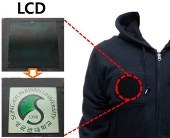 |
| A new kind of material can harness energy from human movement and use it to light up a small LCD display. Credit: American Chemical Society |
Abstract:
From light-up shoes to smart watches, wearable electronics are gaining traction among consumers, but these gadgets' versatility is still held back by the stiff, short-lived batteries that are required. These limitations, however, could soon be overcome. In the journal ACS Nano, scientists report the first durable, flexible cloth that harnesses human motion to generate energy. It can also self-charge batteries or supercapacitors without an external power source and make new commercial and medical applications possible.
Energy-generating cloth could replace batteries in wearable devices
Washington, DC | Posted on March 4th, 2015Sang-Woo Kim and colleagues point out that the potential of wearable electronics extends far beyond the flashy and convenient. Small, lightweight devices could play life-changing roles as robotic skin or in other biomedical applications. But to maximize their utility, such electronics need an ultra-flexible, long-lasting energy source that is seamlessly incorporated into the device's design. For a possible solution, Kim's team turned to the emerging technology of "triboelectric nanogenerators," or TNGs, which harvest energy from everyday motion.
The researchers created a novel TNG fabric out of a silvery textile coated with nanorods and a silicon-based organic material. When they stacked four pieces of the cloth together and pushed down on the material, it captured the energy generated from the pressure. The material immediately pumped out that energy, which was used to power light-emitting diodes, a liquid crystal display and a vehicle's keyless entry remote. The cloth worked for more than 12,000 cycles.
###
The authors acknowledge funding from the National Research Foundation of Korea.
####
About American Chemical Society
The American Chemical Society is a nonprofit organization chartered by the U.S. Congress. With more than 158,000 members, ACS is the world's largest scientific society and a global leader in providing access to chemistry-related research through its multiple databases, peer-reviewed journals and scientific conferences. Its main offices are in Washington, D.C., and Columbus, Ohio.
For more information, please click here
Contacts:
Michael Bernstein
202-872-6042
Sang-Woo Kim, Ph.D.
School of Advanced Materials Science and Engineering
and SKKU Advanced Institute of Nanotechnology
Center for Human Interface Nanotechnology
Sungkyunkwan University (SKKU)
Suwon 440-746
Republic of Korea
Copyright © American Chemical Society
If you have a comment, please Contact us.Issuers of news releases, not 7th Wave, Inc. or Nanotechnology Now, are solely responsible for the accuracy of the content.
Bookmark:


| Related Links |
 DOWNLOAD FULL-TEXT ARTICLE - "Nanopatterned Textile-Based Wearable Triboelectric Nanogenerator"
| Related News Press |
News and information
Quantum computer improves AI predictions April 17th, 2026
Flexible sensor gains sensitivity under pressure April 17th, 2026
A reusable chip for particulate matter sensing April 17th, 2026
Detecting vibrational quantum beating in the predissociation dynamics of SF6 using time-resolved photoelectron spectroscopy April 17th, 2026
Govt.-Legislation/Regulation/Funding/Policy
Quantum computer improves AI predictions April 17th, 2026
Metasurfaces smooth light to boost magnetic sensing precision January 30th, 2026
New imaging approach transforms study of bacterial biofilms August 8th, 2025
Discoveries
Quantum computer improves AI predictions April 17th, 2026
Flexible sensor gains sensitivity under pressure April 17th, 2026
A reusable chip for particulate matter sensing April 17th, 2026
Detecting vibrational quantum beating in the predissociation dynamics of SF6 using time-resolved photoelectron spectroscopy April 17th, 2026
Announcements
A fundamentally new therapeutic approach to cystic fibrosis: Nanobody repairs cellular defect April 17th, 2026
UC Irvine physicists discover method to reverse ‘quantum scrambling’ : The work addresses the problem of information loss in quantum computing system April 17th, 2026
Interviews/Book Reviews/Essays/Reports/Podcasts/Journals/White papers/Posters
A fundamentally new therapeutic approach to cystic fibrosis: Nanobody repairs cellular defect April 17th, 2026
UC Irvine physicists discover method to reverse ‘quantum scrambling’ : The work addresses the problem of information loss in quantum computing system April 17th, 2026
Textiles/Clothing
Protective equipment with graphene nanotubes meets the strictest ESD safety standards March 25th, 2022
Polymer fibers with graphene nanotubes make it possible to heat hard-to-reach, complex-shaped items February 11th, 2022
Flexible material shows potential for use in fabrics to heat, cool July 3rd, 2020
Battery Technology/Capacitors/Generators/Piezoelectrics/Thermoelectrics/Energy storage
Decoding hydrogen‑bond network of electrolyte for cryogenic durable aqueous zinc‑ion batteries January 30th, 2026
COF scaffold membrane with gate‑lane nanostructure for efficient Li+/Mg2+ separation January 30th, 2026
MXene nanomaterials enter a new dimension Multilayer nanomaterial: MXene flakes created at Drexel University show new promise as 1D scrolls January 30th, 2026
 |
||
 |
||
| The latest news from around the world, FREE | ||
 |
||
|
|
||
| Premium Products | ||
 |
||
|
Only the news you want to read!
Learn More |
||
 |
||
|
Full-service, expert consulting
Learn More |
||
|
|
||