Home > Press > Trees go high-tech: process turns cellulose into energy storage devices
 |
Abstract:
Based on a fundamental chemical discovery by scientists at Oregon State University, it appears that trees may soon play a major role in making high-tech energy storage devices.
Trees go high-tech: process turns cellulose into energy storage devices
Corvallis, OR | Posted on April 7th, 2014OSU chemists have found that cellulose - the most abundant organic polymer on Earth and a key component of trees - can be heated in a furnace in the presence of ammonia, and turned into the building blocks for supercapacitors.
These supercapacitors are extraordinary, high-power energy devices with a wide range of industrial applications, in everything from electronics to automobiles and aviation. But widespread use of them has been held back primarily by cost and the difficulty of producing high-quality carbon electrodes.
The new approach just discovered at Oregon State can produce nitrogen-doped, nanoporous carbon membranes - the electrodes of a supercapacitor - at low cost, quickly, in an environmentally benign process. The only byproduct is methane, which could be used immediately as a fuel or for other purposes.
"The ease, speed and potential of this process is really exciting," said Xiulei (David) Ji, an assistant professor of chemistry in the OSU College of Science, and lead author on a study announcing the discovery in Nano Letters, a journal of the American Chemical Society. The research was funded by OSU.
"For the first time we've proven that you can react cellulose with ammonia and create these N-doped nanoporous carbon membranes," Ji said. "It's surprising that such a basic reaction was not reported before. Not only are there industrial applications, but this opens a whole new scientific area, studying reducing gas agents for carbon activation.
"We're going to take cheap wood and turn it into a valuable high-tech product," he said.
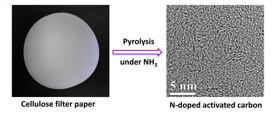
These carbon membranes at the nano-scale are extraordinarily thin - a single gram of them can have a surface area of nearly 2,000 square meters. That's part of what makes them useful in supercapacitors. And the new process used to do this is a single-step reaction that's fast and inexpensive. It starts with something about as simple as a cellulose filter paper - conceptually similar to the disposable paper filter in a coffee maker.
The exposure to high heat and ammonia converts the cellulose to a nanoporous carbon material needed for supercapacitors, and should enable them to be produced, in mass, more cheaply than before.
A supercapacitor is a type of energy storage device, but it can be recharged much faster than a battery and has a great deal more power. They are mostly used in any type of device where rapid power storage and short, but powerful energy release is needed.
Supercapacitors can be used in computers and consumer electronics, such as the flash in a digital camera. They have applications in heavy industry, and are able to power anything from a crane to a forklift. A supercapacitor can capture energy that might otherwise be wasted, such as in braking operations. And their energy storage abilities may help "smooth out" the power flow from alternative energy systems, such as wind energy.
They can power a defibrillator, open the emergency slides on an aircraft and greatly improve the efficiency of hybrid electric automobiles.
Besides supercapacitors, nanoporous carbon materials also have applications in adsorbing gas pollutants, environmental filters, water treatment and other uses.
"There are many applications of supercapacitors around the world, but right now the field is constrained by cost," Ji said. "If we use this very fast, simple process to make these devices much less expensive, there could be huge benefits."
####
About Oregon State University
As one of the largest academic units at OSU, the College of Science has seven departments and 12 pre-professional programs. It provides the basic science courses essential to the education of every OSU student, builds future leaders in science, and its faculty are international leaders in scientific research.
For more information, please click here
Contacts:
David Xiulei Ji
541-737-6798
MEDIA CONTACT:
David Stauth,
541-737-0787
Copyright © Oregon State University
If you have a comment, please Contact us.Issuers of news releases, not 7th Wave, Inc. or Nanotechnology Now, are solely responsible for the accuracy of the content.
Bookmark:


| Related Links |
| Related News Press |
News and information
 Quantum computer improves AI predictions April 17th, 2026
Flexible sensor gains sensitivity under pressure April 17th, 2026
A reusable chip for particulate matter sensing April 17th, 2026
Detecting vibrational quantum beating in the predissociation dynamics of SF6 using time-resolved photoelectron spectroscopy April 17th, 2026
Discoveries
Quantum computer improves AI predictions April 17th, 2026
Flexible sensor gains sensitivity under pressure April 17th, 2026
A reusable chip for particulate matter sensing April 17th, 2026
Detecting vibrational quantum beating in the predissociation dynamics of SF6 using time-resolved photoelectron spectroscopy April 17th, 2026
Announcements
A fundamentally new therapeutic approach to cystic fibrosis: Nanobody repairs cellular defect April 17th, 2026
UC Irvine physicists discover method to reverse ‘quantum scrambling’ : The work addresses the problem of information loss in quantum computing system April 17th, 2026
Interviews/Book Reviews/Essays/Reports/Podcasts/Journals/White papers/Posters
A fundamentally new therapeutic approach to cystic fibrosis: Nanobody repairs cellular defect April 17th, 2026
UC Irvine physicists discover method to reverse ‘quantum scrambling’ : The work addresses the problem of information loss in quantum computing system April 17th, 2026
Environment
A reusable chip for particulate matter sensing April 17th, 2026
Researchers unveil a groundbreaking clay-based solution to capture carbon dioxide and combat climate change June 6th, 2025
Water
Taking salt out of the water equation October 7th, 2022
Battery Technology/Capacitors/Generators/Piezoelectrics/Thermoelectrics/Energy storage
Decoding hydrogen‑bond network of electrolyte for cryogenic durable aqueous zinc‑ion batteries January 30th, 2026
COF scaffold membrane with gate‑lane nanostructure for efficient Li+/Mg2+ separation January 30th, 2026
MXene nanomaterials enter a new dimension Multilayer nanomaterial: MXene flakes created at Drexel University show new promise as 1D scrolls January 30th, 2026
 |
||
 |
||
| The latest news from around the world, FREE | ||
 |
||
|
|
||
| Premium Products | ||
 |
||
|
Only the news you want to read!
Learn More |
||
 |
||
|
Full-service, expert consulting
Learn More |
||
|
|
||