Home > Press > Shining a light on tiny polymer shapes: Visiting graduate student studies high-throughput manufacturing of precisely shaped microparticles
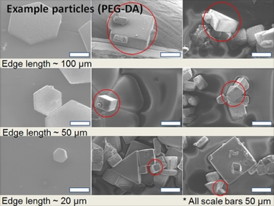 |
| Shown here are examples of micro shapes polymerized by ultraviolet light in polyethylene glycol diacrylate (PEG-DA). Image courtesy of Ryan Oliver/Mechanosynthesis Group |
Abstract:
Ryan Oliver, a visiting graduate student in the lab of associate professor of mechanical engineering A. John Hart, is developing a technique called maskless fluidic lithography that creates unique shapes in a liquid polymer by exposing it to patterned ultraviolet light, a process known as photopolymerization.
Shining a light on tiny polymer shapes: Visiting graduate student studies high-throughput manufacturing of precisely shaped microparticles
Cambridge, MA | Posted on February 11th, 2014For example, Oliver uses a projector to pattern shapes in polyethylene glycol diacrylate (PEG-DA), a common biocompatible polymer. Unlike semiconductor processing, which uses wafer masks produced as single-use items, the integrated projection system allows for rapid change of the pattern.
Key to the system is a Texas Instruments digital micromirror device (DMD) that can turn micromirrors on and off 32,552 times a second. "Because the mirrors are so fast, we can make decisions very quickly, which is hard to do with a masked system," Oliver says. "You would spend several days ordering or fabricating a mask rather than milliseconds if you needed a new pattern." By controlling how long each mirror is switched on during a single second, the system varies the intensity of the projection to form two-dimensional or three-dimensional structures. Oliver likens the process to layer-by-layer assembly in a single step.
Ryan and Hart chose the stop-flow lithography approach, inspired by research from Professor Patrick Doyle's group at MIT, while they were at the University of Michigan as a platform for studying the manufacture of large quantities of custom microparticles. Their vision is to use particles that are designed to work together and act as a sensitive biosensor. To realize the vision, Ryan has a goal to produce microparticles from about 250 nanometers to about 100 microns in a library of shapes such as diamonds, triangles, squares, and octagons. "We're exploring methods of taking them down to the nanoscale, but the current system produces microparticles," Oliver says. "What sets this method apart is, one, high throughput; two, flexibility using the DMD chip; and three, the fact that you can control the shape as well as the size of the particles, and possibly the chemistry."
Oliver is studying how to manipulate a collection of polymer particles on a liquid surface in order to assemble them in specific ways. "We needed a platform in order to synthesize microparticles that we could perform self-assembly experiments on, because that promises to allow us to build sensors that we can't build now, that are too complex — they're made out of too many types of materials to fabricate using traditional manufacturing methods," Oliver says. "A lot of applications may require control over the shape, the surface finish, the chemistry, and the size of microparticles, so we've been exploring this as a method toward that end, as well as understanding how to improve the shape accuracy while increasing throughput."
Such templated polymers can be used for a range of processes, from drug delivery to cell culture assays to casting molds. Researchers in Hart's Mechanosynthesis Lab also adapted the ultraviolet-light-based polymerization to a roll-to-roll system in addition to the microfluidic system.
One drawback with PEG, which is a hydrogel, is that it readily absorbs water, so it can swell or change shape in wet environments.
"Beyond the manufacturing process, we are interested in secondary means to assemble the particles into complex, hierarchical structures, such as those including cells," Oliver says. "These assemblies could be very useful for performing high-throughput bioassays or building novel tissue-like structures."
Oliver followed Hart to MIT from the University of Michigan. He led work on the Robofurnace project, an automated bench-top chemical vapor deposition system for growing carbon nanotubes and other nanomaterials. He hopes to finish his PhD through Michigan in August. His dissertation will focus on a suite of tools for high-throughput polymer micromanufacturing and manipulation, including the direct-write fluidic lithography method. Oliver presented his work on polymers at a Materials Research Society meeting and at the Enabling Nanofabrication for Rapid Innovation workshop in 2013.
Denis Paiste
Materials Processing Center
####
For more information, please click here
Copyright © Massachusetts Institute of Technology
If you have a comment, please Contact us.Issuers of news releases, not 7th Wave, Inc. or Nanotechnology Now, are solely responsible for the accuracy of the content.
Bookmark:


| Related News Press |
News and information
 Quantum computer improves AI predictions April 17th, 2026
Flexible sensor gains sensitivity under pressure April 17th, 2026
A reusable chip for particulate matter sensing April 17th, 2026
Detecting vibrational quantum beating in the predissociation dynamics of SF6 using time-resolved photoelectron spectroscopy April 17th, 2026
Microfluidics/Nanofluidics
Projecting light to dispense liquids: A new route to ultra-precise microdroplets January 30th, 2026
Implantable device shrinks pancreatic tumors: Taming pancreatic cancer with intratumoral immunotherapy April 14th, 2023
Researchers design new inks for 3D-printable wearable bioelectronics: Potential uses include printing electronic tattoos for medical tracking applications August 19th, 2022
Academic/Education
Rice University launches Rice Synthetic Biology Institute to improve lives January 12th, 2024
Multi-institution, $4.6 million NSF grant to fund nanotechnology training September 9th, 2022
Self Assembly
Diamond glitter: A play of colors with artificial DNA crystals May 17th, 2024
Liquid crystal templated chiral nanomaterials October 14th, 2022
Nanoclusters self-organize into centimeter-scale hierarchical assemblies April 22nd, 2022
Atom by atom: building precise smaller nanoparticles with templates March 4th, 2022
Materials/Metamaterials/Magnetoresistance
First real-time observation of two-dimensional melting process: Researchers at Mainz University unveil new insights into magnetic vortex structures August 8th, 2025
Researchers unveil a groundbreaking clay-based solution to capture carbon dioxide and combat climate change June 6th, 2025
A 1960s idea inspires NBI researchers to study hitherto inaccessible quantum states June 6th, 2025
Institute for Nanoscience hosts annual proposal planning meeting May 16th, 2025
Announcements
A fundamentally new therapeutic approach to cystic fibrosis: Nanobody repairs cellular defect April 17th, 2026
UC Irvine physicists discover method to reverse ‘quantum scrambling’ : The work addresses the problem of information loss in quantum computing system April 17th, 2026
Tools
Metasurfaces smooth light to boost magnetic sensing precision January 30th, 2026
From sensors to smart systems: the rise of AI-driven photonic noses January 30th, 2026
Japan launches fully domestically produced quantum computer: Expo visitors to experience quantum computing firsthand August 8th, 2025
 |
||
 |
||
| The latest news from around the world, FREE | ||
 |
||
|
|
||
| Premium Products | ||
 |
||
|
Only the news you want to read!
Learn More |
||
 |
||
|
Full-service, expert consulting
Learn More |
||
|
|
||