Home > Press > Not-weak knots bolster carbon fiber: New material created at Rice University with graphene oxide flakes
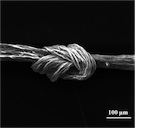 |
| A knotted carbon fiber made at Rice University has the same tensile strength along its entire length. That property may make it suitable for advanced fabrics. (Credit: Tour Group/Rice University) |
Abstract:
Large flakes of graphene oxide are the essential ingredient in a new recipe for robust carbon fiber created at Rice University.
The fiber spun at Rice is unique for the strength of its knots. Most fibers are most likely to snap under tension at the knot, but Rice's fiber demonstrates what the researchers refer to as "100 percent knot efficiency," where the fiber is as likely to break anywhere along its length as at the knot.
Not-weak knots bolster carbon fiber: New material created at Rice University with graphene oxide flakes
Houston, TX | Posted on July 8th, 2013The new work from the Rice lab of chemist James Tour appears online today in the journal Advanced Materials.
The material could be used to increase the strength of many products that use carbon fiber, like composites for strong, light aircraft or fabrics for bulletproof apparel, according to the researchers.
"To see this is very strange," Tour said. "The knot is as strong as any other part of the fiber. That never happens in a carbon fiber or polymer fibers."
Credit goes to the unique properties of graphene oxide flakes created in an environmentally friendly process patented by Rice a few years ago. The flakes that are chemically extracted from graphite seem small. They have an average diameter of 22 microns, a quarter the width of an average human hair. But they're massive compared with the petroleum-based pitch used in current carbon fiber. "The pitch particles are two nanometers in size, which makes our flakes about ten thousand times larger," said Rice graduate student Changsheng Xiang, lead author of the new paper.
Like with pitch, the weak van der Waals force holds the graphene flakes together. Unlike pitch, the atom-thick flakes have an enormous surface area and cling to each other like the scales on a fish when pulled into a fiber. The wet-spinning process is similar to one recently used to create highly conductive fibers made of nanotubes, but in this case Xiang just used water as the solvent rather than a super acid.
Bendability at the knot is due to the fiber's bending modulus, which is a measure of its flexibility, Xiang said. "Because graphene oxide has very low bending modulus, it thinks there's no knot there," he said.
Tour said industrial carbon fibers -- a source of steel-like strength in ultralight materials ranging from baseball bats to bicycles to bombers -- haven't improved much in decades because the chemistry involved is approaching its limits. But the new carbon fibers spun at room temperature at Rice already show impressive tensile strength and modulus and have the potential to be even stronger when annealed at higher temperatures.
Heating the fibers to about 2,100 degrees Celsius, the industry standard for making carbon fiber, will likely eliminate the knotting strength, Xiang said, but should greatly improve the material's tensile strength, which will be good for making novel composite materials.
The Rice researchers also created a second type of fiber using smaller 9-micron flakes of graphene oxide. The small-flake fibers, unlike the large, were pulled from the wet-spinning process under tension, which brought the flakes into even better alignment and resulted in fibers with strength approaching that of commercial products, even at room temperature.
Co-authors of the paper are Rice graduate students Colin Young, Gabriel Cerioti, Chi-Chau Hwang and Zheng Yan; postdoctoral researchers Xuan Wan and Jian Lin; Junichiro Kono, a professor of electrical and computer engineering and of physics and astronomy; and Matteo Pasquali, a professor of chemical and biomolecular engineering and of chemistry. Tour is the T.T. and W.F. Chao Chair in Chemistry as well as a professor of mechanical engineering and materials science and of computer science at Rice.
The Air Force Research Laboratory (through the University Technology Corp.), the Office of Naval Research, the Air Force Office of Scientific Research and the Welch Foundation supported the research.
####
About Rice University
Located on a 300-acre forested campus in Houston, Rice University is consistently ranked among the nation's top 20 universities by U.S. News & World Report. Rice has highly respected schools of Architecture, Business, Continuing Studies, Engineering, Humanities, Music, Natural Sciences and Social Sciences and is home to the Baker Institute for Public Policy. With 3,708 undergraduates and 2,374 graduate students, Rice's undergraduate student-to-faculty ratio is 6-to-1. Its residential college system builds close-knit communities and lifelong friendships, just one reason why Rice has been ranked No. 1 for best quality of life multiple times by the Princeton Review and No. 2 for "best value" among private universities by Kiplinger's Personal Finance. To read "What they're saying about Rice," go to tinyurl.com/AboutRiceU.
Follow Rice News and Media Relations via Twitter @RiceUNews
For more information, please click here
Contacts:
David Ruth
713-348-6327
Jade Boyd
713-348-6778
Copyright © Rice University
If you have a comment, please Contact us.Issuers of news releases, not 7th Wave, Inc. or Nanotechnology Now, are solely responsible for the accuracy of the content.
Bookmark:


| Related Links |
| Related News Press |
News and information
 Quantum computer improves AI predictions April 17th, 2026
Flexible sensor gains sensitivity under pressure April 17th, 2026
A reusable chip for particulate matter sensing April 17th, 2026
Detecting vibrational quantum beating in the predissociation dynamics of SF6 using time-resolved photoelectron spectroscopy April 17th, 2026
Chemistry
Projecting light to dispense liquids: A new route to ultra-precise microdroplets January 30th, 2026
From sensors to smart systems: the rise of AI-driven photonic noses January 30th, 2026
"Nanoreactor" cage uses visible light for catalytic and ultra-selective cross-cycloadditions October 3rd, 2025
Cambridge chemists discover simple way to build bigger molecules – one carbon at a time June 6th, 2025
Single-atom catalysts change spin state when boosted by a magnetic field June 4th, 2025
Graphene/ Graphite
Electrifying results shed light on graphene foam as a potential material for lab grown cartilage June 6th, 2025
Breakthrough in proton barrier films using pore-free graphene oxide: Kumamoto University researchers achieve new milestone in advanced coating technologies September 13th, 2024
Govt.-Legislation/Regulation/Funding/Policy
Quantum computer improves AI predictions April 17th, 2026
Metasurfaces smooth light to boost magnetic sensing precision January 30th, 2026
New imaging approach transforms study of bacterial biofilms August 8th, 2025
Discoveries
Quantum computer improves AI predictions April 17th, 2026
Flexible sensor gains sensitivity under pressure April 17th, 2026
A reusable chip for particulate matter sensing April 17th, 2026
Detecting vibrational quantum beating in the predissociation dynamics of SF6 using time-resolved photoelectron spectroscopy April 17th, 2026
Materials/Metamaterials/Magnetoresistance
First real-time observation of two-dimensional melting process: Researchers at Mainz University unveil new insights into magnetic vortex structures August 8th, 2025
Researchers unveil a groundbreaking clay-based solution to capture carbon dioxide and combat climate change June 6th, 2025
A 1960s idea inspires NBI researchers to study hitherto inaccessible quantum states June 6th, 2025
Institute for Nanoscience hosts annual proposal planning meeting May 16th, 2025
Announcements
A fundamentally new therapeutic approach to cystic fibrosis: Nanobody repairs cellular defect April 17th, 2026
UC Irvine physicists discover method to reverse ‘quantum scrambling’ : The work addresses the problem of information loss in quantum computing system April 17th, 2026
Interviews/Book Reviews/Essays/Reports/Podcasts/Journals/White papers/Posters
A fundamentally new therapeutic approach to cystic fibrosis: Nanobody repairs cellular defect April 17th, 2026
UC Irvine physicists discover method to reverse ‘quantum scrambling’ : The work addresses the problem of information loss in quantum computing system April 17th, 2026
Military
Quantum engineers ‘squeeze’ laser frequency combs to make more sensitive gas sensors January 17th, 2025
Chainmail-like material could be the future of armor: First 2D mechanically interlocked polymer exhibits exceptional flexibility and strength January 17th, 2025
Single atoms show their true color July 5th, 2024
NRL charters Navy’s quantum inertial navigation path to reduce drift April 5th, 2024
Sports
Electrifying results shed light on graphene foam as a potential material for lab grown cartilage June 6th, 2025
Surrey reveals its implantable biosensor that operates without batteries May 22nd, 2020
Collagen nanofibrils in mammalian tissues get stronger with exercise December 14th, 2018
Aerospace/Space
Decoding hydrogen‑bond network of electrolyte for cryogenic durable aqueous zinc‑ion batteries January 30th, 2026
ICFO researchers overcome long-standing bottleneck in single photon detection with twisted 2D materials August 8th, 2025
Onion-like nanoparticles found in aircraft exhaust May 14th, 2025
 |
||
 |
||
| The latest news from around the world, FREE | ||
 |
||
|
|
||
| Premium Products | ||
 |
||
|
Only the news you want to read!
Learn More |
||
 |
||
|
Full-service, expert consulting
Learn More |
||
|
|
||