Home > Press > How to build doughnuts with Lego blocks: Complex polymer rings with breathtaking nanoscale architecture revealed
 |
Abstract:
Scientists have uncovered how nature minimises energy costs in rings of liquids with an internal nanostructure made of two chemically discordant polymers joined with strong bonds, or di-blocks, deposited on a silicon surface, in an article about to be published in EPJE¹.
How to build doughnuts with Lego blocks: Complex polymer rings with breathtaking nanoscale architecture revealed
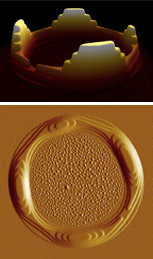
New York / Heidelberg | Posted on December 21st, 2011Josh McGraw and his colleagues from McMaster University, Canada, and the University of Reading, UK, first created rings of di-block polymers that they liken to building doughnuts from Lego blocks due to the nature of the material used. This material has an internal structure discretised like Lego blocks, resulting in rings approximating the seamless shape of a doughnut (see photo at right of previously unseen nanoscale assemblies).
McGraw and his colleagues measured the dynamics of interacting edges in ring structures that display asymmetric steps, i.e., different spacing inside and outside the ring, when initially created. They found that the interaction shaping the ring over time is the repulsion between edges. While the molecular details remain elusive, the source of this repulsion is intuitive: an edge is a defect which perturbs the surface profile with an associated cost to the surface energy.
The edge repulsion prevents two neighbouring edges from getting too near each other. As two isolated edges approach, the perturbation deviates further, thereby deforming the equilibrium edge structure and increasing the free energy. For rings solely subject to the repulsive edge interaction, the authors found that the equilibrium shape of their edges had to be symmetric.
These edges could be considered defects in a material with an otherwise perfect order at the nanoscale. Thus, research based on the elucidation of defect interactions could help scientists trying to eliminate such defects by understanding how these materials self-assemble. Such systems could also provide an ideal basis for creating patterns on the nanoscale, data storage, and nanoelectronics.
Reference
1. McGraw J. D., Rowe I. D.W., Matsen M. W., and Dalnoki-Veress K. (2011). Dynamics of interacting edge defects in copolymer lamellae, European Physical Journal E (EPJ E) DOI 10.1140/epje/i2011-11131-7
####
For more information, please click here
Contacts:
Joan Robinson
Corporate Communications Manager, Springer-Verlag
Tiergartenstrasse 17
69121 Heidelberg
Germany
Phone: +49 6221 487 81 30
Fax: +49 6221 487 68130
Copyright © Springer
If you have a comment, please Contact us.Issuers of news releases, not 7th Wave, Inc. or Nanotechnology Now, are solely responsible for the accuracy of the content.
Bookmark:


| Related Links |
| Related News Press |
News and information
 Quantum computer improves AI predictions April 17th, 2026
Flexible sensor gains sensitivity under pressure April 17th, 2026
A reusable chip for particulate matter sensing April 17th, 2026
Detecting vibrational quantum beating in the predissociation dynamics of SF6 using time-resolved photoelectron spectroscopy April 17th, 2026
Chemistry
Projecting light to dispense liquids: A new route to ultra-precise microdroplets January 30th, 2026
From sensors to smart systems: the rise of AI-driven photonic noses January 30th, 2026
"Nanoreactor" cage uses visible light for catalytic and ultra-selective cross-cycloadditions October 3rd, 2025
Cambridge chemists discover simple way to build bigger molecules – one carbon at a time June 6th, 2025
Memory Technology
Researchers tackle the memory bottleneck stalling quantum computing October 3rd, 2025
First real-time observation of two-dimensional melting process: Researchers at Mainz University unveil new insights into magnetic vortex structures August 8th, 2025
Utilizing palladium for addressing contact issues of buried oxide thin film transistors April 5th, 2024
Self Assembly
Diamond glitter: A play of colors with artificial DNA crystals May 17th, 2024
Liquid crystal templated chiral nanomaterials October 14th, 2022
Nanoclusters self-organize into centimeter-scale hierarchical assemblies April 22nd, 2022
Atom by atom: building precise smaller nanoparticles with templates March 4th, 2022
Nanoelectronics
Lab to industry: InSe wafer-scale breakthrough for future electronics August 8th, 2025
Interdisciplinary: Rice team tackles the future of semiconductors Multiferroics could be the key to ultralow-energy computing October 6th, 2023
Key element for a scalable quantum computer: Physicists from Forschungszentrum Jülich and RWTH Aachen University demonstrate electron transport on a quantum chip September 23rd, 2022
Reduced power consumption in semiconductor devices September 23rd, 2022
Discoveries
Quantum computer improves AI predictions April 17th, 2026
Flexible sensor gains sensitivity under pressure April 17th, 2026
A reusable chip for particulate matter sensing April 17th, 2026
Detecting vibrational quantum beating in the predissociation dynamics of SF6 using time-resolved photoelectron spectroscopy April 17th, 2026
Materials/Metamaterials/Magnetoresistance
First real-time observation of two-dimensional melting process: Researchers at Mainz University unveil new insights into magnetic vortex structures August 8th, 2025
Researchers unveil a groundbreaking clay-based solution to capture carbon dioxide and combat climate change June 6th, 2025
A 1960s idea inspires NBI researchers to study hitherto inaccessible quantum states June 6th, 2025
Institute for Nanoscience hosts annual proposal planning meeting May 16th, 2025
Announcements
A fundamentally new therapeutic approach to cystic fibrosis: Nanobody repairs cellular defect April 17th, 2026
UC Irvine physicists discover method to reverse ‘quantum scrambling’ : The work addresses the problem of information loss in quantum computing system April 17th, 2026
Research partnerships
Lab to industry: InSe wafer-scale breakthrough for future electronics August 8th, 2025
HKU physicists uncover hidden order in the quantum world through deconfined quantum critical points April 25th, 2025
 |
||
 |
||
| The latest news from around the world, FREE | ||
 |
||
|
|
||
| Premium Products | ||
 |
||
|
Only the news you want to read!
Learn More |
||
 |
||
|
Full-service, expert consulting
Learn More |
||
|
|
||