Home > Press > Highly Active Enzymes on Graphene Oxide Surface
 |
Abstract:
Chemically reduced graphene oxide is a good substrate for high enzyme loads, and activities comparable with those found in solution can be achieved on this surface, as shown by Chinese scientists.
Highly Active Enzymes on Graphene Oxide Surface
Germany | Posted on November 10th, 2011Graphene oxide (GO) is an interesting substrate for absorption and immobilization of biological compounds because of its stability, low toxicity, and unique chemical, electrical, and mechanical properties. It has been used in biomolecule detection and as a drug carrier, and more recently as a substrate on which to immobilize enzymes for catalytic use. However until now, such attachment has had to be done either covalently, or via electrostatic interactions between the enzyme and the GO surface. Covalent bonding may alter the properties of the enzyme by changing its shape, but the electrostatic interactions can also affect enzyme activity.
Scientists have started to experiment with a modified kind of GO called chemically reduced graphene oxide (CRGO) to overcome this problem of attachment. CRGO has fewer surface functional groups than GO, so should perturb the enzyme on it less. Now, a team led by Jingyan Zhang at East China University of Science and Technology and Shouwu Guo at Shanghai Jiao Tong University, China, has looked systematically at the loading and activity of enzymes on CRGO with varying degrees of reduction.
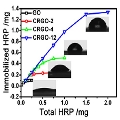
The team found that the more reduced the CRGO, the higher the possible loading of the enzyme, and that loadings of up to 60 times those possible on classically used materials were possible with CRGO. They found that the high loading was caused by hydrophobic interactions between the CRGO surface and the surface of the enzyme molecules, rather than the electrostatic interactions present with regular GO.
But when the team looked at the activity of the enzymes, they got quite a surprise. While one enzyme (horseradish peroxidase; HRP) was much less active than in solution, another (oxalate oxidase; OxOx) was nearly as active and retained up to 90% of its activity even after ten cycles of use, depending on the extent of CRGO reduction. Previous studies on immobilization of OxOx, e.g., on solid beads, have yielded much lower activities. The scientists attribute this finding to the particular structures of the two enzymes and how they bind to the surface. Some enzymes will change conformation on binding to the hydrophobic surface, which involves a dehydration step; this may affect the activity of the enzyme, while it appears that OxOx does not alter so much.
This new way to immobilize OxOx on CRGO while retaining high activity is very promising for clinical determinations of oxalate. The team believe that their method can be extended to use for other enzymes that retain their structure upon hydrophobic binding and dehydration, and that it has applications in detection and as a molecular carrier.
####
For more information, please click here
Copyright © Wiley-VCH Materials Science Journals
If you have a comment, please Contact us.Issuers of news releases, not 7th Wave, Inc. or Nanotechnology Now, are solely responsible for the accuracy of the content.
Bookmark:


| Related Links |
 Y. Zhang et al., Small ; DOI: 10.1002/smll.201101695
| Related News Press |
News and information
Quantum computer improves AI predictions April 17th, 2026
Flexible sensor gains sensitivity under pressure April 17th, 2026
A reusable chip for particulate matter sensing April 17th, 2026
Detecting vibrational quantum beating in the predissociation dynamics of SF6 using time-resolved photoelectron spectroscopy April 17th, 2026
Chemistry
Projecting light to dispense liquids: A new route to ultra-precise microdroplets January 30th, 2026
From sensors to smart systems: the rise of AI-driven photonic noses January 30th, 2026
"Nanoreactor" cage uses visible light for catalytic and ultra-selective cross-cycloadditions October 3rd, 2025
Cambridge chemists discover simple way to build bigger molecules – one carbon at a time June 6th, 2025
Single-atom catalysts change spin state when boosted by a magnetic field June 4th, 2025
Graphene/ Graphite
Electrifying results shed light on graphene foam as a potential material for lab grown cartilage June 6th, 2025
Breakthrough in proton barrier films using pore-free graphene oxide: Kumamoto University researchers achieve new milestone in advanced coating technologies September 13th, 2024
Discoveries
Quantum computer improves AI predictions April 17th, 2026
Flexible sensor gains sensitivity under pressure April 17th, 2026
A reusable chip for particulate matter sensing April 17th, 2026
Detecting vibrational quantum beating in the predissociation dynamics of SF6 using time-resolved photoelectron spectroscopy April 17th, 2026
Announcements
A fundamentally new therapeutic approach to cystic fibrosis: Nanobody repairs cellular defect April 17th, 2026
UC Irvine physicists discover method to reverse ‘quantum scrambling’ : The work addresses the problem of information loss in quantum computing system April 17th, 2026
 |
||
 |
||
| The latest news from around the world, FREE | ||
 |
||
|
|
||
| Premium Products | ||
 |
||
|
Only the news you want to read!
Learn More |
||
 |
||
|
Full-service, expert consulting
Learn More |
||
|
|
||